A Woman’s Worth Part II – sentencing for violent crimes against women in Ireland

Back in 2012, noticing a pattern of lenient sentencing of perpetrators of crimes of violence against women, I started to keep a record on this blog. 

There was a broader rationale for the original post; I wanted to demonstrate the way that small, seemingly innocuous behaviours and attitudes towards women ultimately impacted upon their safety, and I also wanted to focus on how society regards women who have been victims of crime, versus how the perpetrators of violent and/or sexual crimes against women are viewed and treated.

Month by month, year by year I added examples of judgements that could be construed as unduly lenient to the post; however it started to become very long and unwieldly. You can read the original here, but this post, which I have laid out by judge in order to identify patterns, will focus purely on recording the sentencings. I am happy to receive additions and corrections. 

Judge Martin Nolan

  • In 2012, Thomas Finn, who viciously beat a neighbour in her garden in Finglas in an unprovoked assault had a two-year jail sentence suspended on condition that he pay his victim €3,000. Judge Nolan remanded him in custody for two weeks while he considered the sentence, and cited his clean criminal record and expression of remorse when imposing the sentence.
  • Earlier in 2012 Aidan Farrington, who sexually assaulted two of his adult nieces escaped a jail term after Nolan said publication of his name would “be punishment in itself”. His defence included a large number of character references, and his wife had taken the stand, describing him as a “magnificent person”. Nolan said “the abuse was very serious, but the seriousness of the assaults themselves does not mandate a custodial sentence”, as they were lower down the scale than other cases coming before the court and lasted a relatively short amount of time.
  • Nolan in 2012 also presided over the case of Mark Jordan, who, after assaulting his then girlfriend, leaving her with facial injuries, was handed down a two and a half-year suspended sentence on condition he pay her €5,000. Jordan broke his hand while punching his partner, who has since spoken about the lasting trauma the assault has had on her, and her frustration with the messages that such sentencing sends.
  • In October 2012, Nolan suspended the entire four-year jail term handed out to convicted sex attacker Graham Griffiths – on condition that he pay €15,000 to the woman he admitted violently assaulting while apparently under the influence of narcotics. Griffiths’ victim was just 18 years old, and was too traumatised to attend court.
  • In July 2013, a Dublin father of four who sexually assaulted his neighbour, while her eight-year-old son was present in the room and pleaded with him to stop hurting his mother, was given a two-year suspended sentence by Nolan. The child, instructed by his mother, ran to get help. Nolan said he felt that because of the man’s remorse, lack of previous conditions and the fact that he had since moved out the area, that the crime did not justify a custodial sentence.
    • In November 2014, the DPP successfully appealed this case, resulting in the sentence being increased to four years. However the four-year sentence was also suspended in full in November 2014 by the Court of Appeal. Ms Justice Mary Irvine, while stating that it had been wrong to place the case on the “low end of the spectrum” of seriousness and that it was in fact “very serious”, taking a number of mitigating factors into account, she stated that the court found it “only just and proper” that the four-year sentence be backdated and suspended in full. The father of the victim said that neither his daughter nor her son had been able to access counselling supports due to cutbacks.
  • In January 2015, Judge Nolan gave Stephen McCarthy, who sexually assaulted a woman as she slept in her bed following a party a two-and-a-half-year suspended sentence. McCarthy told gardai when questioned that he “tripped and landed on top of” the victim. Nolan took McCarthy’s lack of previous convictions and guilty plea into account, as well as the fact that McCarthy had paid his victim €2,000 in compensation.
  • In February 2016, Jeffrey Mitchell was sentenced to a three years in prison by Nolan for a violent unprovoked assault on a woman late at night as she walked home alone. Mitchell had 70 previous convictions for crimes like assault and robbery. His victim said she suffered flashbacks and felt “crippled with anxiety”, and did not know if she would ever feel safe again. According to Nolan, due to the seriousness of the offence, and the defendant’s long history of convictions, he had no choice but to impose a “substantial” sentence.

Justice Garrett Sheehan

  • In June 2013, Sheehan handed convicted rapist Niall Counihan of Longford a seven-year suspended sentence. His reasoning? Imprisonment would “impose hardship on his family”. Counihan – who his then 14-year-old victim claimed had shown no remorse since the crimes of rape and sexual assault were committed over 20 years ago – has two autistic children. Sheehan asserted that Counihan had “self-rehabilitated” in the meantime. “What he did to me has affected every aspect of my life, said his victim, “and it has left me with a pain, trauma, loss and sadness that I continue to feel every day”.
  • in 2012, Sheehan opted to shorten rapist Gerard Kane’s 12-year sentence by three years, on condition that he sit his Leaving Certificate while in prison. Kane broke into his victim’s house, raped her twice and threatened to kill her and bury her in her own garden. Kane had, on the night of the rape, been out on bail for a burglary.
  • In October 2013, Sheehan sentenced a Cork man to ten years in prison for breaking into his ex-girlfriend’s house armed with a hatchet and a knife, and subjecting her to a five-hour ordeal during which he physically abused her, raped her repeatedly, and hacked off her hair while he forced her to perform oral sex because she “wasn’t doing it right”. He then threatened to kill her. In court, it was claimed that he wanted to apologise to his victim, but was “too shy” to do so. The final three years of the sentence were suspended due to his willingness to participate in a sex offenders’ programme in prison.  The woman involved had all the details of her assault read out in the courtroom, and reported in graphic detail in national newspapers. She has since left her home. This seven-year sentence was, according to Sheehan, at the “upper end of the scale” for such crimes.

Judge Desmond Hogan

  • In July 2012, Dublin Circuit Criminal Court judge Hogan suspended five and a half years of the six-year prison term he’d handed down to wealthy businessman Anthony Lyons for attacking and sexually assaulting a woman in the early hours , ordering the attacker to pay his victim €75,000 in compensation. His victim was reportedly horrified, claiming never to have wanted money, but a prison sentence instead. Hogan referred to Lyons as being “being of previously good character”.
    • The DPP successfully appealed the leniency of this sentence, and in August 2014, the Court of Criminal Appeal decreed that the correct sentence should in fact be six years, with four suspended. The DPP argued that Judge Hogan had attached undue weight to mitigating factors, one of which was the compensation order.
  • In 2013, Gheorghe Alexandroae of Blackrock, Dublin was convicted of two charges of sexual assault on a woman during a party. Hogan suspended Alexandroae’s five-year jail sentence, on condition that he paid his victim €10,000. Many people “spoke highly” of Alexandroae, noted Hogan. “It is the type of offence where a drunken person took advantage of another person who … had also taken a certain amount of drink”, opined the judge. The woman, who has since left the country, told in her victim impact statement how she now suffers with depression and has difficulties with intimacy.

Judge Carroll Moran

  • Martin Quigley, a businessman, dragged a teenager into a spare bedroom of a Killarney B&B in the middle of the night and sexually assaulted her. He was handed a suspended sentence at the Circuit Criminal Court in Tralee by  in April 2014. While there was a degree of violence involved, according to Judge Moran, all of the touching was outside her clothes. Early admission by the man and the guilty plea to the sex assault charge which secured the conviction and spared the victim from going through a trial was taken into account. Quigley had apparently also suffered adverse publicity, which had an adverse effect on him and on his business.

Justice Patrick McCarthy

  • On July 13th, 2015,  McCarthy suspended a seven-year sentence to Magnus Meyer Hustveit, who confessed to raping and sexually assaulting his partner up to 10 times while she slept, saying he had to consider the fact that had Hustveit not confessed his crimes, there would be no case. Incidentally Hustveit initially confessed not to the authorities, but to his former partner, in an email exchange. His words: “I convinced myself it was a victimless crime because you were asleep”. The victim of his crime suffered from PTSD, anxiety  and eating disorders, and attempted suicide. During the trial, an incident of childhood sexual abuse was suggested by the perpetator’s defence as a contributory factor to her psychological problems.
    • The DPP sought a review of this sentence on grounds of undue lenience, and on 15 March 2016 Hustveit was senentced to 15 months imprisonment by Mr Justice George Birmingham. Birmingham said in his judgement that it was not in dispute that this was an unusual case, and “indeed an exceptional one”. A combination of a number of factors, he said, including Hustveit’s cooperation, voluntary return to Ireland from his native Norway to be charged, his previous good character, the positive life he was now leading in Norway “justified and required” a lesser sentence than would normally apply in cases of multiple rapes. 

Judge Patrick McCartan

  • On 6th March 2015,  McCartan handed down a three-year suspended sentence to Liudas Vaisvilas after he sexually assaulted a young woman in Eddie Rocket’s diner on  O’Connell Street. The assault took place shortly after he had been released from garda custody following the assault of another 19-year-old woman in Dublin Airport late at night. In the previous incident, the woman was waiting for a flight when he approached her, verbally harassed her and grabbed her between her legs. When she tried to get away, he followed her and rugby -tackled her, pinning her to the ground and putting his hand between her legs. McCartan had previously directed that Vaisvilas undergo a psychiatric assessment which concluded he had been in “a temporary state of mind” following a spate of bereavements and extreme tiredness.

Justice Paul Carney (1943-2015)

  • In what was one of the most high-profile sentencing stories of 2012, Patrick O’Brien, father of Wicklow woman Fiona Doyle, who had subjected her to a ten-year ordeal of sexual abuse starting when she was just four years old, was released on bail by the late Justice Paul Carney after being found guilty of 16 charges of rape and indecent assault. After a public outcry, during which Fiona waived her right to anonymity and met with Taoiseach Enda Kenny to discuss her 20 year struggle for justice and her personal experience of the treatment of survivors of assault in the court system, the decision was reversed, and bail was revoked. O’Brien was jailed for 12 years – with nine of those suspended. Fiona called the original decision “utterly heartbreaking”, and backed the Law Reform Commission’s recommendation that mandatory minimum sentences be applied for rape. One might argue that even the sentence itself was unduly lenient.
  • In February 2013, a 49 year-old Tipperary man convicted of sexually assaulting a 15 year-old girl after supplying her with alcohol was handed a three-year prison sentence by Carney – with the final year suspended. Carney noted the man’s “previous good character” and his “strong work ethic”.
  • Indeed, Justice Carney had long-standing form in this regard, having back in 2007 handed convicted rapist Adam Keane a three-year suspended sentence for rape, citing the rapist’s previous good record and the fact that he came from a good home. Keane flicked a cigarette at his victim when leaving the court in what was described as a “triumphalist gesture”. She waived her right to anonymity, and after an appeal from the DPP, Keane’s sentence was subsequently increased to ten years by the Court of Criminal Appeal (with the last three suspended).
  • Carney was again involved in the case of John Daly, when in 2000, he was sentenced to three years in prison with one year suspended for attempted rape and aggravated sexual assault charges. The sentence was successfully appealed by the DPP on the grounds of undue leniency and increased to six years. Daly, had previously pleaded guilty to attempted rape and indecent assault  on two young girls in the early 80s, and aggravated sexual assault on a 62 year-old woman in the 90s. In October 2011, Daly boarded a Luas bound for a Rihanna concert, with the intention of molesting young girls for his sexual satisfaction. In April 2014, Judge Mary Ellen Ring sentenced Daly to four years in prison for this crime, but suspended the last two years. One of his victims said that as a result of the assault she felt uncomfortable meeting strangers on public transport, and is generally more afraid.
  • Carney was once again involved when on 1st December 2014, the Court of Appeal maintained that an eight-year sentence imposed by the judge upon a man for repeatedly raping a neighbour’s young daughter for over three years was too lenient. The abuse began when the child was just five years of age and involved violent acts of depravity “amounting to torture”. The child’s parents had also been abusing her and have since been charged. Carney had sentenced the man to eight years’ imprisonment for each of the 15 counts of rape, and five years for each of the five counts of sexual assault – to run concurrently. Justice Seamus Ryan deemed the sentencing unduly lenient, and a new sentence hearing was due to take place early in 2015.

Judge Rory McCabe

  •  Despite referring to a series of incidents where a 48-year old man sexually assaulted a 17 year-old girl as “frightening, deliberate, sustained, unsolicited and uninvited”, Judge McCabe saw fit to adjourn his case for a year so that the conduct of the perpetrator could be assessed in the meantime. John Ring, of Castlebar, Co. Mayo targeted the girl, who was working alone at her workplace and was assaulting her until another customer interrupted them. He later followed her in his van, handing her his number on a piece of paper telling her to give him a call. Later that day, he returned to the store, winked at her and stuck out his tongue. After the incident, the court heard, the girl was nervous around strangers and afraid to walk down her road alone. Jim Ring arrived to court with €2,000 in compensation for his victim.

Suicide first-aid – a useful life skill? HSE ASIST training …

Following my last post over on Facebook, I’ve just registered with the HSE to complete their ASIST (Applied Suicide Intervention Skills Training) course. Though not highly publicised, it’s a free, two-day interactive workshop in suicide first-aid which trains participants to reduce the immediate risk of suicide and increases the support for a person at risk.

ASIST

The issue of  our high suicide rates is always simmering away in the background, but it feels like recently, frustration with our mental health services, and increasingly, the difficulty in accessing treatment is starting to reach boiling point, as more and more people tell their story. There was the horrific death of Caoilte O’Broin, whose family had so desperately tried to get him the help he needed, only to meet frustration and closed doors at every turn, the tragic death of Stephen Byrne, and of course the dreadful loss a while back of Sharon Grace and her little girls, not to mention the loss of Una Butler‘s family. And of course Bressie’s impassioned appeal to the Oireachtas Joint Committee on Health and Children to address the “epidemic of our generation”. I could go on; these are just a handful of examples.

Dealing with service issues can be fraught, frustrating and there are many problems to be navigated, not least the question of the involvement of families in mental health treatment, and the terrifying barriers to treatment that exists when a person, such as Caoilte, has a dual diagnosis.

I therefore feel, that for as long as we live in a country where equity of access to well-resourced, timely, affordable, holistic, compassionate, recovery-led mental health treatments is at present, a distant aspiration, we need to start equipping ourselves to better deal with the reality around us. That reality is that approximately 500 people annually in this country lose their lives to suicide. While our government has an obligation to step up to the plate, I can’t – won’t – accept that there is nothing we ourselves can do as a society to try and change this.

Prevention strategies have their place when it comes to addressing suicide; however, we can all sit at any point on the mental health spectrum at any time, and sometimes, it’s emergency intervention that’s needed. While we have become very, very good at telling people in distress that they should “seek help” or “talk to someone”, if someone did exactly that and told you they were considering killing themselves, would you know what to do? Would you feel confident you could help?

I know I wouldn’t.

According to the HSE, the ASIST workshop encourages honest, open and direct talk about suicide as part of preparing people to provide suicide first aid, and helps participants understand what help and support people in crisis might need. But it aims to instil a confidence in dealing with crisis situations that may just save a life. ASIST workshop places are limited, they say, therefore preference must be given to participants who are likely to come into contact with someone who is at risk of suicide in their daily lives. Given our current suicide rates, that could be any of us.

See how I got on.

Further Information

  • Training dates: Regular trainings are scheduled around the country – you can find more information on these by contacting your Regional Resource Officer for Suicide Prevention at the following link. http://www.hse.ie/…/resour…/officers_suicide_prevention.html
  • Cost: ASIST training is free. You just need to register in advance.
  • Who can take part? Anyone can partake in ASIST training, but it is particularly suitable for all kinds of caregivers – health workers, teachers, community workers, Gardai, youth workers, volunteers, people responding to family, friends and co-workers. he course can be intense, and it’s not recommended for people who may have lost someone to suicide or have been recently bereaved.

Download the ASIST leaflet 

Other mental health training resourses from the HSE National Office for Suicide Prevention

Our broken health system

This article was first published in The Mayo News on 19th January 2016.

Raising your voice to an overworked nurse in the middle of the A&E department, teeming with patients, crammed with beds and trolleys; that sounds like a pretty obnoxious thing to do. Yelling at her as she tries to do her job sounds like the height of ignorance. But when you’re sitting in the waiting room and a relative calls you from inside the emergency department to tell you they urgently need your help, it means something’s not quite right.

Everyone knows A&E is a busy spot. But in our visit over Christmas, a result of a respiratory illness, my relation was seen surprisingly quickly. In the midst of their assessment, they suffered a severe asthma attack. They were helped to a small room at the back of the department and sat in a chair, with the promise of relief to come via a nebuliser, a device that uses oxygen to break up a liquid medical solution to deliver relieving medicine directly to the lungs. They were left alone. As the minutes passed, they started to feel faint, as they struggled to get air into their lungs. And no-one returned.

So when my phone rang, I knew something was amiss. Confused, by the time I made my way into the department – where I wasn’t technically meant to be – and located them, their distress was evident. Although I tried to appear calm, it was obvious that help was urgently needed.

I ran to seek assistance from someone – anyone. I hijacked a nurse, already occupied, and begged her to help. And when she started asking perfectly reasonable questions like the patient’s name, the location of their file, the identity of the original nurse, panic got the better of me. And I raised my voice to that nurse. That tired, overworked nurse near the end of a long shift, trying to do her job in what can only be described as horrendous conditions – to yell at her to forget the files and to please, just help, right now.

And she did, without batting an eyelid. And within seconds the oxygen was flowing, and with it, a tiny bit of relief amidst the chaos. The blood returned to all our cheeks. We thanked her profusely.

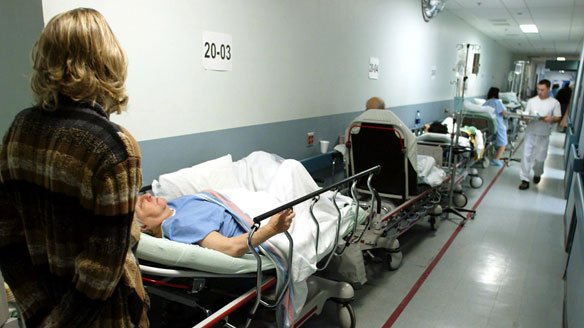
As we waited in the room for a doctor to arrive, both trying to calm ourselves, I got my bearings. I went to find water, and the corridors strewn with people on trolleys. One man was starving, he said. No food for hours. In the waiting room, the coffee machine was broken, the snack machine was broken and the toilets were out of order. There was nowhere to get a bite to eat.

 Across the way lay an elderly gentleman in a gown. “When will the doctor see him, do you think?” asked his wife. “I’m afraid there are eight other people ahead of him,” said the nurse apologetically, “that need attention more urgently.”

patients on trolleys

When the doctor arrived, he was young and gentle and tired. Sensing our distress, he spoke in soft and reassuring tones, explaining what he was going to do and why. And we started to feel safe again.

And the mystery of why the original nurse didn’t return, or administer oxygen when all the equipment was right there in the room, was never solved, because it didn’t matter, and because I didn’t trust myself not to raise my voice again. Maybe someone else needed attention more urgently. Perhaps, with a hundred other things on her plate in the midst of that madness, she just forgot. Nurses are human too.

I chatted with the porter as he wheeled the trolley down to the deserted X-ray department. “I love coming down here for a bit of a peace and quiet,” he said. “That place”, he gestured, “is like a zoo.” A doctor had been assaulted in a row earlier in the day, he said.

We were lucky. After treatment, we escaped in a matter of hours. I drove back down the road feeling fortunate to have a passenger. I wondered what would have happened had I not been there. Perhaps it would have been fine. But perhaps not, and that’s the thing.

They say this is a country in recovery. But its health system is very ill.

Patients deserve – at the very least – to feel safe in A&E. To know they are getting the best possible care, not to feel at the mercy of an overcrowded system. Medical professionals – among them many unsung heroes – deserve to feel safe and have sufficient resources to work to the best of their ability.

And none of them deserve to be yelled at while doing their jobs.

Ballycastle’s Giro de Baile – a novice’s account of a first sportive

It was some trepidation that I loaded the bike into the boot of the car for the Giro de Baile on a rainy Sunday morning in August. Having never taken part in a cycling event before, and having done no serious training, I don’t mind admitting I was panicking a little at the prospect of what lay ahead. 60km along the exposed north west Atlantic coast in the wind and the rain? Sure, you’d have to be mad.

Giro de Baile sign

Giro time

Having recently moved back to North Mayo, I was on the lookout for a new hobby. Cycling is something I’ve always enjoyed but never pursued regularly, apart from the odd commute or jaunt around Dublin or Mayo. Having been aware of the success of the inaugural Giro de Baile in 2014, and smitten by the stunning route, I’d been keeping an eye on their Facebook page, and had it pencilled it into the diary. As the day drew closer, the nerves multiplied, but there’s nothing like a challenge to make or break an intention, right? Having been chatting with the organisers on Twitter, they very gently cajoled me into giving it a shot. And when a group gets together and puts in a shedload of work to organise and promote an event to benefit and promote their community and locality, I do feel it’s important to support that effort where possible.

Arriving in Ballycastle, the festivities were in full swing, with a DJ pumping out motivational beats, an impressive inflatable start line and of course a healthy lashing of green and red flags. Football is at the heart of everything down here. Inside the Community Hall, there was a palpable air of anticipation as 320 cyclists, experienced and novice alike availed of the spread of food and refreshments provided, and prepared for launch.

Giro de Baile volunteers

Volunteers, you rock.

With a cheer, we were off. Pikemen, reminiscent of the 1798 rebellion which forms a huge part of the county’s historical narrative cheered the procession of cyclists at the first corner. Motivational messages on the challenging (this is a euphemism) Flagbrooke Hill gave an extra push (“It’s only a hill, get over it”), though I will admit that it eventually got the better of me and I had to get off and walk. Which I have absolutely no regrets about doing, as it meant I could stop for a second and look back at what is probably the most magnificent view in North Mayo. (If you’re doing this event next year, remember to look around you as you go – on a challenging route, it’s easy to keep the head down, but it means you’re missing out.) A samba band greeted participants at the crest of the hill. Throughout, stewards and marshals were helpful and encouraging. The roads were quiet and felt safe. Even the oncoming traffic was friendly with plenty one-fingered salutes (not that kind, the country kind!) and beeps from motorists.

Flagbrooke Hill

The never-ending Flagbrooke Hill. Yes, there was a “Mayo for Sam” message

I’d tackled the event with a friend who is (thankfully!) of similar ability, and while at times, we found ourselves a little isolated on the route, we were never too far from a race marshal. After the third stop in Moygownagh, we realised we had only 14km to go, and we spent the last 10km telling each other how great we were. Then we turned the last corner into Ballycastle to be met with that last hill! It was probably the most challenging moment of the day and needless to say getting over the finish line was a memorable moment. Our time might not have broken any records (or if it did, it was of the Wooden Spoon variety), but we made it. For two first timers, we couldn’t ask for more than that.

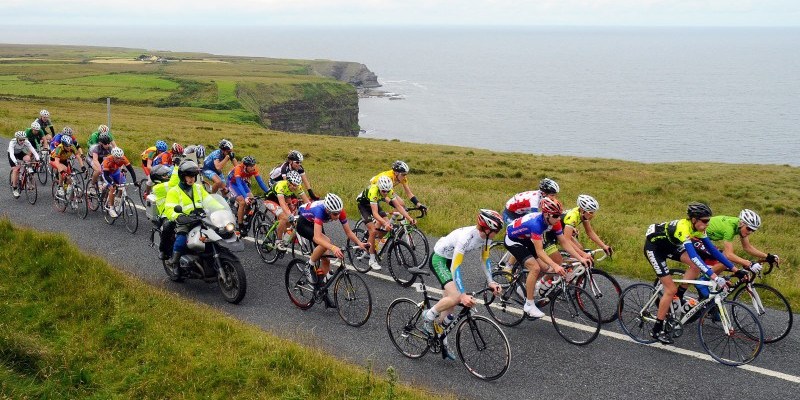
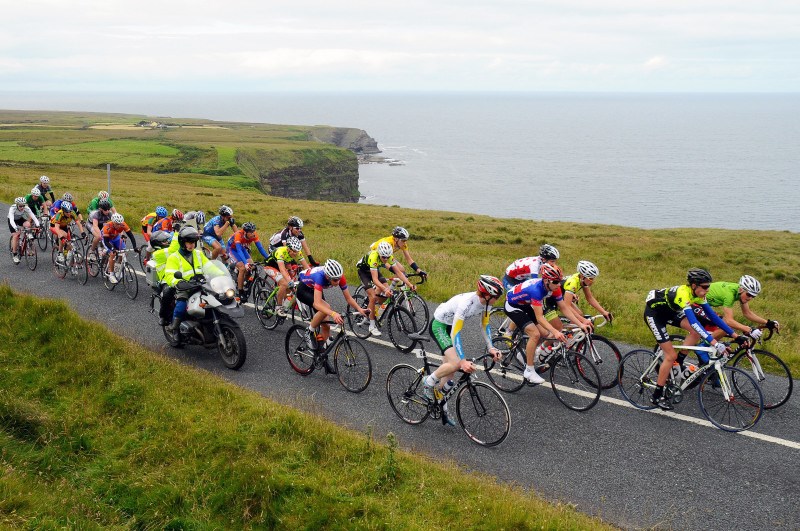
A shot from the 130km route. A good incentive to go further next year

A shot from the 130km route. A good incentive to go further next year

Two things really struck me from the outset about this event.

Firstly, when starting out in anything new, encouragement is important. For novices, taking part in an event like this can be daunting. In the week leading up to the event, the Giro team posted updates on their social media account aimed at participants taking part in their first sportive, such as including practical advice about cycling. In addition, they were hugely reassuring to anyone who might have doubted their abilities to keep up with the pack (i.e. people like me!) If you can do 20k, they said, you can do 60k. There is no pressure to compete. The atmosphere carries you. Plus for every uphill climb there’s a downhill freewheel! Such information might seem trivial to the experienced cyclist but means a great deal to the novice.

Secondly, what stood out was the obvious determination of the wider community of Ballycastle to make this a success. There was a strong and cheerful volunteer presence along the route, plenty of opportunities to refuel and refresh, lots of cheering spectators, and veritable feast of food at the end. The Ballycastle community is a small but proud one, and cycling along the breathtaking route, even in the rain, it’s very clear to see why.

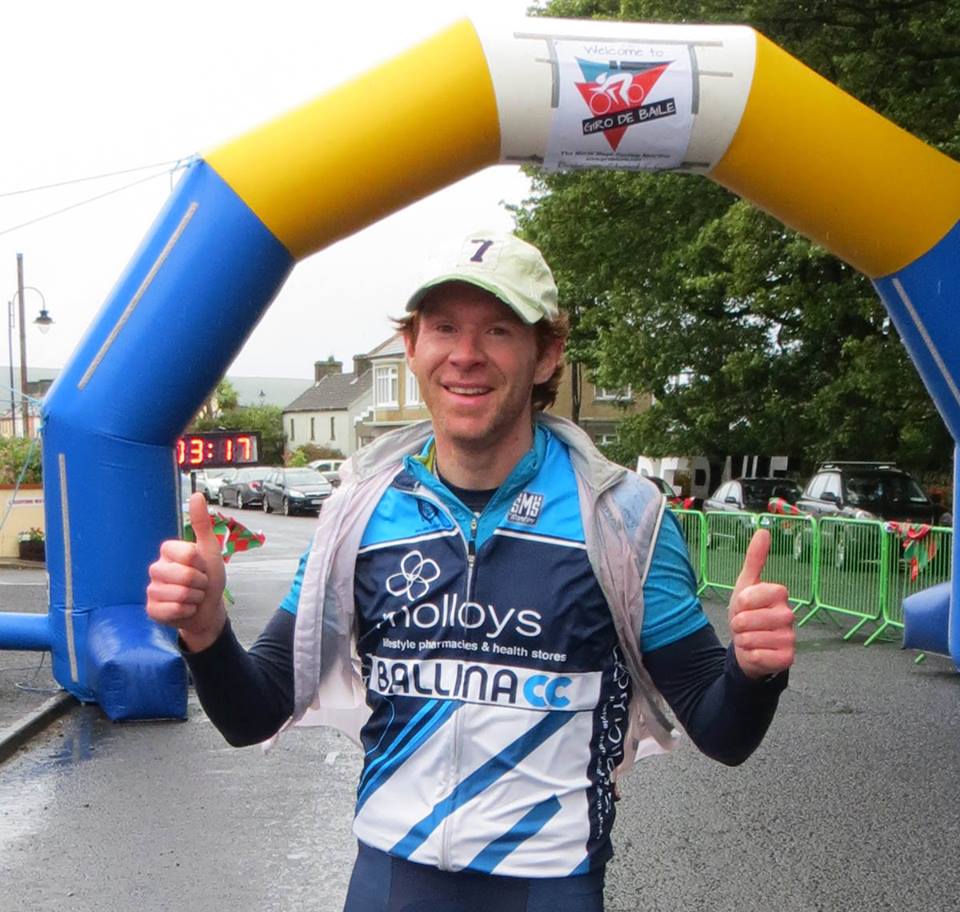
Giro de Baile

Probably one of the happiest moments of my life – seeing the barbecue at the finish line after 60k. Thanks to my buddy Martina for keeping me going!

If any of you are considering doing the Giro next year, and are looking for a new route, I’d recommend checking this out. And if you’re a local wondering whether you’re up to the challenge, my unequivocal advice would be to go for it.  The Giro website says: “The ride is not a race, it’s a chance to enjoy a challenge with like-minded people with spectacular views throughout the routes”. What they don’t say is just how well the event is organised and just what a great sense of achievement you get from taking part and crossing that finish line. It’s kickstarted my cycling hobby and I know I’m looking forward to next year’s event already where hopefully I can tackle the longer 130km route. And let’s hope the sun shines!

Only another two hours to wait for us to finish, Bernard!!

The next Giro de Baile cycle takes place on 31st July 2016, and all information on this North Mayo Sportive can be found at girodebaile.com. Proceeds from this year’s events were split between three local organisations: Cancer Care West, Kiddies Korner Playschool, Ballycastle and Moy River Rescue.

Pic credit; Giro de Baile on Facebook.

The great name-changing debate

Recently there’s been some talk in the national media about the practice of women taking their husbands’ surnames when they marry. A few days ago, two similar and thought-provoking articles in the Irish Independent by writers Barbara Scully and Dearbhail McDonald – both self-declared feminists – examined the merits of the custom, with each expressing some surprise that in this enlightened age of feminism, women should be taking their husbands’ names at all.

For women in Ireland, historically the practice of changing name after marriage has almost been a foregone conclusion. However, the sands as ever are shifting, and there has been a quiet, but growing resistance to the custom. The aforementioned articles generated much debate on social media – including Twitter, where people just love a good argument – and the exchanges threw up some interesting perspectives on the tradition.

Many women who had kept their names said they did so to retain their own identity. For some, it amounted to a political statement; a public rejection of traditional patriarchal structures and notions of submission and subordination. Professional women argued – many from experience – that name-changing can negate years of work put into building a strong reputation or personal brand. Some, rather less optimistically, maintained that they wouldn’t want to be still called by their ex-husband’s names when – when! – they got divorced.

On the other hand, there were women who for various personal reasons embraced the chance to rid themselves of their old name and make a fresh start with a new one. More enjoyed the unity symbolised by their family all having the same surname, while others had happily adopted the double-barrelled system. Some declared that they just liked the novelty, or simply the old-fashioned romance of it all.

Bride And Groom Enjoying Meal At Wedding Reception

Men also contributed to the debate, many of whom declared it wouldn’t bother them either way. However, as McDonald herself mentioned, once the subject of children was broached that perspective tended to change. A small minority had taken their wives’ surnames after marriage, while others visibly balked at the notion. (The very idea!) Men and women alike wondered how the process would work within same-sex marriages. All in all, the exchanges demonstrated once again that nothing is ever black or white; the beauty of it being the freedom that exists for people to make the choice for themselves. Indeed most women were adamant that the decision should be theirs; not dictated by husbands, families or interfering in-laws, and that their preference should not be assumed by others, either – something to bear in mind when addressing your Christmas cards!

On that note, such was the interest in the topic that following McDonald’s article, the Irish Independent even ran a poll on the topic, asking “Should a woman take her husband’s surname?” And therein lies the rub. Women are constantly dictated to – how they should behave, how they should dress, the body shape they should  behave. As feminists, surely we should be asking why on earth should a woman have to do anything? Why would anyone assume they have the right to dictate to women what they should – or should not – be doing with their own names? Why are we not asking why more men don’t offer to make the change? But ultimately, whose business is it, anyway?

Scully’s article suggested that we follow the leads of jurisdictions such as Quebec and Greece (you won’t hear that too often these days) in actually outlawing the practice of wives taking their husbands’ names. This restriction also applies in countries like Netherlands, Belgium and France.  Japan, on the other hand, legally requires couples to adopt either one of the spouses’ surnames when married – but unsurprisingly and somewhat disappointingly, this means that 96% of women make the change.

What seems ludicrous in all of this is the idea of the State having any say either way in what is a private matter.

Implying that women who change their name are somehow damaging the feminist cause is a contradiction in terms. While the feminist argument appears in the main to be that women who take their husband’s names are complicit in preserving a patriarchal structure, surely true feminism means promoting  the freedom of women to make their own choices – including taking their husbands’ names if they wish – and supporting and respecting that freedom, even if the outcome contradicts your own philosophy? Judging women for making this choice is unnecessarily divisive, and  . once again assigns women with sole responsibility for changing societal norms.

There are plenty of battles yet to be fought by women in the quest for equality. This should not be one of them.

This column first appeared in the print version of The Mayo News on Tuesday 4th August 2015

Seven things I’ve learned since returning West

At the end of May, after sixteen years living away from my Mayo hometown, in search of a different pace of life and a greater sense of community, I decided to make the move back West. I wrote about it here in The Mayo News at the time.

I’m now seven weeks back on home soil, and can safely say that I haven’t (yet) questioned the decision. I feel consistently more happier, more relaxed and at ease and I treasure being close to my family again, and reconnecting with friends; spending real, unhurried time with them. Because I am in equal measures a firm believer that life is short and there to be lived, and a deluded optimist, I decided not to seek full-time employment for now and have remained  freelance in order to make the most of the west of Ireland summer. So far, that decision has ensured that I have spent lots of time outdoors on my own in the lashing rain.

But all in all, it’s been a surprisingly easy transition, though the adjustment process is ongoing.  Here are just seven things I’ve learned since returning west.

You can get around quickly

Getting around in the West of Ireland takes no time at all. This has been one of the unanticipated delights of the return west. One of the reasons I moved was because commuting cross-city every day was (literally) driving me out of my mind. Living in a small town means that I no longer view traffic lights as a target, and even taking into account the curiously high proportion of very slow drivers, I don’t behave like a deranged fishwife behind the wheel any more. (Much.) I am constantly marvelling about just how little time it takes to get anywhere. In my new blissed out state of mind, I have even found myself coasting along at 50km an hour on occasion, much to the chagrin of visiting D-reg Audi drivers. I also still sometimes manage to be late.

Weather envy does you no good at all

Moving west always came with the caveat of ‘more rain’, and the best way of dealing with it is just to bring a brolly and get on with it. However, in bygone days we didn’t have to cope with being reminded of this all the time on social media by our smug easterly counterparts. There is little so maddening as reading about the rest of the country’s woes as they collectively sweat in a heatwave, having to watch them Instagramming their 99s/pasty legs in surfing shorts while meanwhile, you are donning full waterproofs just to sprint to the car. However jealousy gets you nowhere, and I have consoled myself with the fact that I am saving a small fortune on Factor 40 while maintaining a pale and youthful visage. In your faces, you sunburned suckers.

View of Clew Bay from Ben Gorm in the rain

Clew Bay, taken from Ben Gorm in the Nephin Beg range. In the rain, of course

 Freelancing is fun … but challenging

While there are the obvious advantages of being your own boss such as calling the shots and managing your own time, there is also the uncertainty of not knowing whether you’ll be able to pay the rent in two or three months’ time. But freelancing involves (a) deciding what exactly you’re freelancing in (am I writing, researching, copywriting, social media managing, PR-ing or doing a combination of some or all of these?), and (b) packaging and promoting it; this is something I haven’t managed to do very well just yet, mainly both because I haven’t needed to and I’m still figuring it out. Just today two projects I had in the diary for August fell through for various reasons, so while it does mean I can now go on my holidays without a looming deadline, it also makes the prospect of further holidays look a bit bleaker. But them’s the breaks – and there’s nothing like the prospect of an overdraft to inspire some enterprising creativity.

There is no excuse for boredom

Even if you’re on a budget, I’ve found that here, there are shedloads of things to see and do. Before moving, I was advised by well-meaning friends to think carefully about returning due to the lack of “things” going on. While there’s no Camden Street nightlife and pulled pork eateries are fewer, I’m still a bit baffled; I’ve barely spent an evening sitting in since I got back. It’s festival season down here (and summer of course), so there are lots of local jollies, but apart from pursuing actual hobbies like running, hillwalking and cycling (there are over 40 sporting clubs of various types in this area alone) there are plenty of volunteer-led projects into which to throw yourself. Unless you’re actually sitting in your house watching paint dry, I can’t understand how anyone can ever be bored. And there is always something new and fascinating to learn about your home town if you’re interested in looking. Failing that, you can always take up knitting.

There is a “local” mindset … and it can be a sensitive one

While there’s lots of evidence of a strong community spirit – something I missed for a long time, away from home – local involvement also comes with its own politics, sensitivities and dare I say it, egos. It’s been interesting to remember just how easily offended people can be if you don’t explicitly acknowledge their individual contributions, or if you question their established ways of doing things, and sometimes bearing this in mind from the outset can help to keep the waters smooth. Likewise, easing your way gently into a new group is the way to go – tenure can result in territorial tensions. Diplomacy  – treading carefully but confidently – is a skill in itself.  What can I say? I’m always learning.

 Football is a religion

Yeah, we all knew that already. Now I just get to worship inside the church all the time. Watch out Sam, we’re comin’ to get you. Yes, this is our year.

It’s bloody gorgeous here.

Of course, I am completely, unashamedly biased, and this is not a learning, rather a reminder. I wake most mornings feeling lucky to live in such a gorgeous part of the world.  I’m torn between wanting to tell the world about it and share its stunning secrets, and keep it all to ourselves. But sharing is caring, right? Even in the rain I think it’s beautiful (though I may be in a minority there) and a walk on a deserted beach in the wind and the rain oddly never fails to make me feel alive. And at this rate, we might even get another sunny day before September.

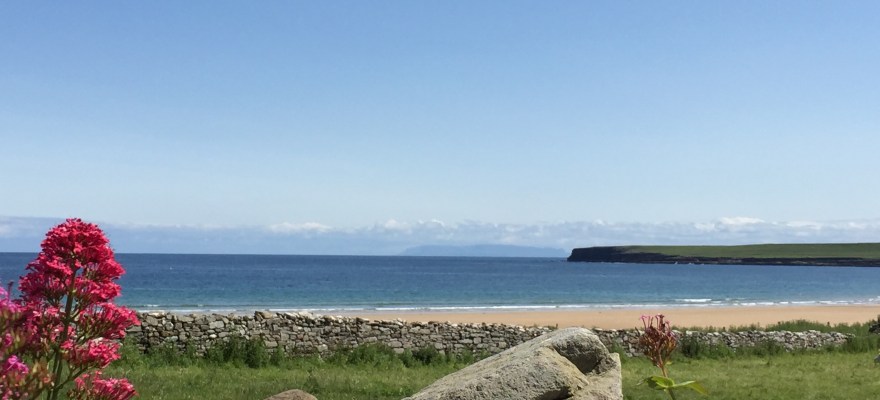
Lacken in summer, on 14th July 2015. Yes, that one day.

IMG_3344

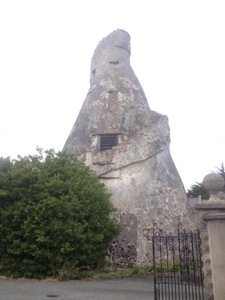
Legend has it that a pagan chieftain, Crom Dubh attempted to burn St. Patrick to death, but our Paddy was having none of it. Crom Dubh, seeing that he had met his match hid in his fort, but Patrick hit the ground with his crozier breaking it and leaving the fort – known as Dun Briste – isolated from the mainland. Crom Dubh was eaten to death by midges, something that will come as no surprise to anyone who has spent a day working in the bog in Mayo.

Service with a smile … it works both ways

With a month of country living under my belt after the move back west (God, it’s great to be home), the boxes are finally unpacked and I’m readjusting to the easier pace of life in the homeland. There’s plenty to love, but a constant source of joy is just how little time it takes to get from A to B. Because Dublin has approximately 94 sets of traffic lights per kilometre, sometimes the drive to pick up a litre of milk and a few spuds entails more braking than driving. Here, you just turn the key in the ignition and you’re there. Dorothy and her red slippers ain’t got nothing on life in Mayo.

It also strikes me daily how much friendlier people are. That’s part of our charm, but importantly, in a region depending so heavily on tourism, it’s also an essential business attribute. Hand in hand with that comes good customer service, which, it’s fair to say, is probably the norm. That’s why, when confronted with a bad experience, it jars all the more. But while the majority of encounters are positive, if truth be told, we could still sometimes do better.

As a customer, when you go to the shop to buy a litre of milk, or to buy a stamp in the post office, what are your expectations of that experience? Do you like to be greeted with a hello, some eye contact, a chat? Do you prefer to be handed your change, rather than it being slapped on the counter? Entering a clothes shop, do you expect a friendly greeting and an offer of help? On your weekly shop, do you prefer it when the cashier talks to you, not their colleagues? Most of all, is a smile important? Most of us would probably agree that these are the most basic tenets of customer service. Having someone go the extra mile thereafter is just the icing on the cake.

When the basics aren’t met, there is a knock-on effect. Chances are, if your experience in a shop is an unfriendly, unhelpful one, you’ll bring your money elsewhere next time. As a local, if you experience poor service in a restaurant or café, you’ll probably tell ten people about it. As a tourist, add TripAdvisor into the mix and tack on a few zeros. Poor service and lack of warmth in a business make for a poor tourist experience, and colour their entire impression of an area. Meanwhile, among locals it discourages loyalty. And whoever deals with customers is the face of that business, regardless of the name over the door. If that face is a scowling one, you’re onto a loser from the start. Little things, big implications.

There are, of course, two sides to every argument. Working in the service industry and dealing with the public can be no picnic, and years of retail management in a past life taught me that contrary to popular belief, the customer is most definitely not always right. On the contrary, they can be rude, confrontational and frequently downright mad. Working in fashion exposed me to all sorts, from the “I know my rights” brigade (they generally don’t) to those who think it appropriate to use your fitting rooms for their bodily functions (yes, even that one). Once, I went home with a black eye, the result of a shoe thrown at me by a gentleman I can only describe as being overexcited. So there is little doubt that facing the public on a daily basis can bring its challenges. If you’ve just been eaten alive by an irate customer, it can be hard to plaster on a smile to greet the next one.

High angle view of cashier with a line of people at the check-out counter

But good service is essential for business to thrive and survive. Taking pride in your business will garner respect from your customers, and not just in the hospitality industry. Visiting tourists become part of our landscape for a while, using our supermarkets, our filling stations, our corner shops. Their experiences help to build their impressions of our county, as well as building our economy. And for those of us at home, service with a smile can brighten the day. But remember, it works both ways!

This was originally printed in The Mayo News on 15th July 2015.

‘Yes, I said, yes I will yes’ – why ‘Yes’ x 2 is the way to go this Friday

With a mere few days to polling day, you’d be forgiven for being under the impression that we were voting on just one issue on May 22nd. Coverage of the marriage referendum has been so comprehensive, relentless and so repetitive, that it’s all the more surprising that media haven’t been focusing on the other choice being presented to voters – the proposal to lower the age of presidential candidates to 21 – if for no other reason than to just give us all a bit of light relief. But it’s highly likely a significant proportion of the population aren’t even aware they’ll be handed two ballot papers on Friday week. A fine example of democracy in action.

As fatigue begins to set in though, it’s likely we’ll see some half-hearted efforts in the next few days to publicly debate why we should allow 21 year-olds – people who may not even yet have started their first job – to run for President of Ireland.

The reactions to the proposal to date have tended to be predictably dismissive and a bit disparaging, which is disappointing. Granted, this isn’t the most pressing change that needs making in Ireland, but at a time when politics is crying out for an injection of youthful enthusiasm, the scorn that’s been instantly heaped on the suggestion without any detailed consideration subtly demonstrates how we really regard our young people. Surprisingly, even youth organisations have been relatively quiet on the matter, instead preferring to focus on the marriage referendum – which ironically, is a campaign with which young people have thus far engaged on levels rarely seen before. But perhaps they’re just being smart by not channelling their energy and resources into flogging a dead horse when there’s a far more pressing issue on the table.

Why is this amendment even being put to the people? Well, the issue arose during the Constitutional Convention, a forum of 100 citizens established in 2012 to discuss amendments to the Constitution. The Constitutional Convention had also sought amendments on housing rights, social security and healthcare services, but this was somehow deemed more appropriate. It’s a funny one; but it’s likely that the government felt backing a contentious, divisive and ground-breaking Constitutional amendment such as allowing two people in love to officially declare their commitment to each other a risky enough manoeuvre without creating further havoc. Best to play it safe on this one, because let’s face it, this government is already all too familiar with the sensation of egg drying into their whiskers.

So, what discussion have we heard to date in #PresRef, as it’s known in the online sphere? Well, the main assertion is that no-one aged under the age of 35 could possibly have the life experience, capability or maturity expected to carry themselves with dignity in this position of great importance. The majority seems to concur. Apart from perhaps the fact that allowing someone to become President in their twenties means you might get landed with paying the Presidential Pension for a few extra years, that, incredibly appears to be the sum total of the debate. Pretty incredible for something as important as a Constitutional Amendment.

The debate has failed on any level to counteract this argument by pointing out the inherent ageism, laziness and unfairness of it.  We are not voting on whether or not we will have a 21 year-old President, though given the level of opposition to it, you’d be forgiven for thinking that a Yes vote would automatically propel one of Jedward into Michael D’s still-warm seat in the Áras come 2019. I can tell you, however, I’d far sooner see either one  – or both of them in there – than the likes of Dana.

The key argument for voting YES to the Presidential amendment is that the current system is anti-democratic, because young people don’t even get the opportunity to present themselves to the electorate. They are currently automatically excluded based on an arbitrary number, rather than getting the chance to be elected or rejected on their merit, or lack of. There is no good reason for this, but plenty of good reasons for our young people – many of them perfectly talented, hardworking, intelligent and capable – to be given the opportunity to put themselves out there. They deserve, at the very least, not to be excluded from this process. And in fact, the key objection to this referendum should be that it proposes to continue excluding adults aged 18-21 from running for Presidential office – the only justification apparently being that it will then mirror the age at which you can become a TD.

So it’ll be two emphatic Yeses for me, because I want to see Ireland becoming a place that’s fairer and kinder, and it strikes me as more than  a little hypocritical to be voting for inclusiveness in one referendum while simultaneously opposing it in the other. But the joy of democracy is that we all have our say, so on Friday week, wherever you stand, be sure to have yours too.

jedward

An abridged version of this post appeared in The Mayo News on Tuesday 12th May 2015.

Gender Quotas – a necessary evil?

This article was originally published in The Mayo News on Tuesday 9th April 2015.

Spring is in the air, bringing with it longer days and glorious sunshine. But mixed with the scent of fresh cut grass and cherry blossom, there’s the distinct whiff of a general election, and while in theory, we’re nearly a year away from returning to the polls, politicians are already in full-on electioneering mode. One intriguing element of the next election will be the influence of gender quotas. All political parties will face losing half their funding unless at least 30% of candidates put forward are women.

A drastic measure? Consider this. 566 candidates ran in the 2011 General Election. 86 were women.  25 won seats, meaning that under 14% of our TDs are women – abysmal by international standards. Women’s skills and experience are therefore not proportionally represented in decision-making that affects everyone. This, despite acknowledgement that balanced political participation by both sexes means fairer, more effective democracies – something, surely to which we should all aspire?

So why aren’t women running for election? Commonly cited as barriers to proportional female representation in Ireland are the Five Cs: Cash, Culture, Childcare, Confidence and Candidate Selection. These five factors are interlinked, each impacting the other to create barriers to female participation.

Take cash, to start. Running for election is expensive. Women are economically less well-off then men (this is a fact!). Employments rates drop significantly when children arrive, and many women – who generally still bear primary responsibility for family life – balance this by working part-time, restricting public involvement. Last year, Mayor of Tralee, Pat Hussey resigned from Fine Gael, citing gender quotas. Women, he claimed were being “pushed in” by his party, excluding more experienced members. Mr Hussey, incidentally, claimed to have no problem with women joining councils, but felt factors like babysitting would make it prohibitively expensive for them – an attitude which sharply undermines the role of men in childcare. Which in turn, leads me to culture – the core of it all.

Women battle culture all the time. They’re expected to do more. We have higher expectations of them. Female politicians aren’t just judged on performance, they’re also critiqued on image, appearance, even their voices. When are male politicians subjected to such scrutiny? You can see why confidence, the fourth C is a factor. A key objection to quotas is that women will be selected purely to “make up numbers”; not because they are the best possible candidate. Essentially, a fear that quotas will elect incompetent women at the expense of good men. The economic crash doesn’t say much about the competency of those running the country at the time. Where was accountability and meritocracy then? Why are we now suggesting that women need to prove competency, where men never had to?

Finally, while all of the above contribute to candidate selection difficulties, there is a supply and demand problem. Parties select election candidates, so selector attitudes can contribute – if male candidates have been the norm, breaking the mould can be hard. However, a lack of supply of female candidates putting themselves forward (for the reasons above) restricts those who do want to run women. The vicious circle continues!

So is imposing gender quotas the means of breaking this cycle?

I’m not fully convinced. Quotas are a crude measure, which ignore the issues underpinning the problem. Rather, we need to address barriers that dissuade women in the first place. Childcare, for example, should be viewed not as a female issue, but as a family one. Family-friendly policies may help, but however – and here lies the critical argument! – unless women are adequately represented in the first place, who will drive the change necessary to attract more women into politics?

Evidence also suggests that increased visibility of females in politics can mobilise women, resulting in greater involvement. So while gender quotas aren’t in themselves the answer, I can’t help feeling that – as a temporary measure – they’ll help fast-track some reform necessary to encourage involvement, and so are worth a shot. I therefore reluctantly find myself in favour. Recognising and addressing the issue is a vital first step, so here’s hoping that the outcome of quotas can prove that this is more than just tokenism, and will result in solid, positives outcomes for society as a whole.

Media still too quick and willing to stigmatise depression

This column was published in The Mayo News on Tuesday 31st March 2015.

It was difficult last week to miss coverage of the Germanwings plane crash that claimed 150 lives in the French Alps. A catastrophe of unimaginable proportions, it embodied every private fear we’ve all tried to bury when getting on a plane. The horror experienced by the 150 passengers on board as it dawned on them what was about to happen is the stuff of our worst nightmares, and the proximity of the tragedy undoubtedly cast a chill over us all.

Co-pilot Andreas Lubitz is now, sadly, a household name. Remarkable by his ordinariness, his Facebook page depicted him as a smiling, leather jacket-clad sportsman interested in travel, music, and clubs. Apparently popular, he appeared well-known and respected in his community. By all accounts, a perfectly normal young man who happened to fly planes for a living.

So what made Lubitz decide to commit, apparently out of the blue, such an abhorrent act of violence in such a calm and calculated manner?

The simple answer is that we don’t know. No-one could, at this point, claim to know with certainty. But at the time of writing, on Friday morning, the majority of the tabloid newspapers claimed to have the answer.

It was depression, they screamed. It emerged that Andreas Lubitz is said to have sought psychiatric help for “a bout of heavy depression” six years ago, which necessitated a break from his flight training. After he was cleared to resume he passed all subsequent tests – including psychological tests – with flying colours, and was subject to regular medical checks.

These last details appear to have been overlooked by many of the tabloids, who, high on outrage, published screaming headlines such as: “German who deliberately crashed Airbus had a long history of depression – so why was he let anywhere near a plane?”, “Why on earth was he allowed to fly?”, ”Depressed pilot crashed jet” and charmingly, “Cockpit maniac”.

While the families of the deceased should be prioritised and respected in the analysis of this disaster, responsible media reporting should not be overlooked, and the messages emanating from those headlines demonstrate that while we might think we have progressed when it comes to normalising mental health, ultimately, the willingness to stigmatise those with problems is never far away.

If depression is being touted as the primary reason for Lubitz’s actions, it any wonder there is still a reluctance to talk about mental health? In particular, is it any wonder that there is a particular reluctance to disclose mental health problems in the workplace? Nearly 6 in 10 people believe that being open about a mental health problem at work would negatively affect their career prospects. Reading headlines like this, is it any wonder?

Discourse like this perpetuates the damaging myth that those with mental illness are more likely to be violent. Should no-one who has suffered depression in their lifetime be permitted to hold positions with responsibility for the safety of other people? If that were the case, we’d have a lot of people sitting at home. As someone who has, should I be forbidden to get behind the wheel of a car, lest I get a murderous urge to plough it into someone? While everyone’s experience is different, many will understand that when depression strikes, it’s often about as much as you can do to get out of bed in the morning, let alone murder 150 people.

We can speculate endlessly on what drove Lubitz to do what he did. Mental health issues may have been a contributory factor, but it is impossible to attribute them as a cause.  Too frequently, when a violent act is committed, the tendency is to point to mental ill-health as the primary reason. And when the media presents it in such a way, it’s not just hurtful to those of us who have experienced problems, it’s damaging and it’s irresponsible. It’s also downright lazy.

At the time of writing, investigators claimed they had found a ‘clue’ in Lubitz’s home that might shed some light on why he did what he did. For the families and friends of the deceased, we can only hope that such answers are forthcoming. But they will be cold comfort.


Germanwings plane crash Alps memorial

Are you really entitled to your opinion?

This column was published in The Mayo News on Tuesday 3rd February 2014.

“It’s my opinion and I’m entitled to it.”

How often have you heard that conversation-killer trotted out during an argument? If you’re like me, hearing it will have the same effect as nails on a blackboard. It makes me wince, but then, I do love a good argument.

However, I have some news for you, opinionators. You’re more than entitled to your opinion – if you can defend it.

No longer confined to boring long-suffering friends or family in the pub or at the dinner table, modern communication channels ensure that the argumentative among us have soapboxes from which to orate all we like. (Whether anyone’s listening is another matter.) We’re accustomed to a variety of rants, whether about the government, sport, or the horror that is inadvertently biting into one of the coffee-flavoured Roses. No matter what our expertise, everyone has an opinion, and sure, we’re all entitled to them. But having them one thing. Considering the effects that stating them might have is another. That’s where we also have a responsibility.

Words are powerful. We should never underestimate them. We should also be aware of our audiences when using them. Sounding off about a local politician, for example on Facebook, sounds innocuous. After all, it’s your page, right? You’re entitled to your opinion, yes? But consider the effect your words might have on that politician’s family.

You don’t believe gay couples should be allowed to get married? That’s your opinion, of course. But can you explain why not? Because you think it will harm society? Have you evidence to support that? No? Well, my friend, perhaps you should examine your opinion in more detail. You might learn something about yourself.

An openness to having our opinions challenged is one of the cornerstones of a healthy democratic society. Unless you can provide an argument, saying “I’m entitled to my opinion” really implies “There’s no depth to my argument, and I can’t be bothered justifying it.” It’s self-entitlement to assume we can just say whatever we want, consequences be damned, regardless of whether or not we know what we’re talking about. It also suggests that we’re either too lazy or too closed-minded to contemplate the possibility that we might actually be wrong.

window

“I’m entitled to my opinion” is frequently used to justify attitudes that should have been abandoned long ago like racism, sexism and homophobia. Without censoring – which may just drive these dangerous beliefs underground – we should instead calmly challenge them with facts and evidence.

In the context of public debate, scrutiny of ‘opinion’ helps to prevent the blurring of the line between it and ‘evidence’. For example, if someone argues for banning fluoridation in our water, despite a lack of scientific evidence that it’s harmful, it is in the public interest to challenge this opinion and debunk myths. The same applies to social and health issues. The media has responsibilities in this regard to ensure that evidence presented in debates is robustly interrogated, and in turn to ensure that when opinion is challenged, when necessary, it’s challenged by people qualified to do so. And we need to be sure that equivalence is not being granted as a rule between experts and non-experts in public policy debates.

Having our opinions challenged can be uncomfortable. Often, our views are so tied up with our self-identify that having them challenged can feel like personal criticism. But wouldn’t the world be a very dull and indeed dangerous place if we agreed on everything? And surely our opinions should evolve as we grow as human beings in age and maturity? If flaws in our thinking are pointed out, in an ideal world we really should try not to get immediately offended or angry (or in my case, sulk), and instead embrace the opportunity to learn. To that end, including subjects like philosophy on the curriculum is worthwhile, in order to foster thoughtfulness and an eagerness to construct, interrogate and defend arguments from a young age. And of course, to help us be comfortable with being wrong once in a while.

Changing your mind is not weakness. Refusing to open it is.

But there’s one thing on which I’ll never entertain a challenge. Those blasted coffee-flavoured Roses have got to go.

New Year, New Me? Let’s be realistic …

My New Year intentions, as published in The Mayo News last Tuesday 6th January. (I won’t comment on how I’m progressing …)

2015 goals in metal type

Every New Year’s Eve I get out the notepad and pen and sit with furrowed brow to try and come up with some realistic New Year’s resolutions. Every New Year’s Eve, I also look back 12 months to see how I’ve fared previously. The latter exercise usually serves as an annual reminder of what a failure I am and demonstrates that the former is nothing more a waste of a good hour of my life.

So for 2015, in order to avoid this painful and disappointing process I have thrown off the shackles of convention, liberated myself from the inevitable cycle of self-flagellation and decided not to make any resolutions for the next 12 months. The year, therefore already looks like one lacking in any ambition whatsover. But on the bright side, the December 31st review already looks promising by default.

New Years’ resolutions are an interesting exercise, though. It’s good to start with a heart and mind full of virtuous intentions, but it can be demoralising when you flounder mere days into the process, and the more you struggle, the more tempting it can be to throw in the towel early on. That said, it’s still good to have things to aim for, right? With this in mind, I’ve decided to cheat and set myself some aspirations for the year ahead. Aspirations are softer and more forgiving than resolutions, being as they are, little more than good intentions. They are also, of course, an absolute cop-out. But if there’s one thing I’m determined to do this year, it’s to not set myself up for further failures. So without further ado, I have below outlined some of my 2015 aspirations, so they may inspire you too.

For 2015, I aspire to …

… Take time out. At least 30 minutes daily, to walk/run outdoors, without music, screens or conversation. Going outdoors is of course fraught with such terrors as rain, low-flying pigeons and potential alien abductions but I’m told taking such time out works wonders for your physical and mental health, so on balance this is probably worth a try.

… Reach out more to others. We all have good intentions, but having personally felt a bit low heading into the Christmas festivities, it made a big difference when someone reached out to me. In the daily grind it’s easy to forget that those around us might have their own struggles, and a kind word might make all the difference. (The exception being if you’re a Meath or a Chelsea supporter on the bad side of a result, in which case I shall unashamedly take joy in your misery.)

… Be a better-behaved driver. This will essentially mean refraining from behaving like a deranged fishwife when someone else is a being bad driver in my vicinity. This is mostly for my own selfish benefit, to ultimately avoid expensive coronary interventional procedures, but also, charitably, for the benefit of innocent passengers who may unwittingly find themselves privy to such outbursts. (This aspiration would of course be unnecessary if you people would just USE YOUR INDICATORS.)

… Try more new things. In 2014 I tried Spanish, kickboxing and writing a newspaper column, with varying degrees of success, but each taught me something new, and some resulted in unintentional hilarity for others, so everyone’s a winner. (On that note, do keep an eye out for my new Morris Dancing column, coming soon.)

… Be a Better Loser. This means not sinking into bitterness and despair (again) for the winter when Mayo don’t win the All-Ireland. I’m obviously writing this in a shameless effort to reverse-psychology the hell out of the 2015 season. Having had lots of practice, I can cope with being wrong, so feel free to throw this in my face on 20th September. I’ll be too busy doing the congo around Croker to care.

I’ll keep you posted on my modest endeavours, but jesting aside, dear readers, all that remains is to wish you and yours a happy and healthy 2015. Be safe and be kind to each other, and – just as importantly – to yourselves. Here’s hoping it’s a good one for us all.

“Today is tough … but I also know that I have much to give”

“I believe, whether rightly or wrongly, that there’s a stereotypical definition of someone who suffers from depression … That stereotype is completely inaccurate.”

Somebody I know got in touch and asked me to share the below piece they wrote, with the hope that it might resonate with someone; that it might just help someone. It’s candid, and it’s courageous, and it can’t have been easy to write. I’d ask that if it strikes a chord with you, you might share it. And try to remember that no matter how low you feel, how despairing, that chances are, you too have more to give.

Thanks to the writer for entrusting me with his words, which I have reproduced in full below.

“I’ll miss Doggy when I die”….The first words I heard this morning when I walked into my daughter’s bedroom. She was in floods of tears. I comforted her as best I could telling her that she has many many years ahead of her and that Mammy and Daddy love her lots. I don’t know what upset her, possibly a bad dream, but it’s fair to say that 5 minutes later she was her usual chatty, good humoured self and eating her Weetabix. Doggy isn’t actually a dog, but a cuddly toy that could even be a lamb, and she’s had it since she was born, which, incidentally is 5 years ago next week.

The incident got me thinking as to how resilient children are, but also, how incidents in childhood, while quickly forgotten on the surface, can dwell in the subconscious and lead to issues in later years. I’m far from being a psychologist, but suffering in later life as a result of a childhood incident is certainly true of me. I have suffered from depression for 24 years, since I was 17 years old, and I can pinpoint exactly what lead to it, and like my daughter is now, I was 4 years old at the time, nearly 5, and for a short period of time was not in my parents direct care. The whats and whys will remain with me to the grave – neither of my parents are, or ever were aware of what happened. My Dad has passed away since, and were my mother to become aware of the details, I think it would kill her too.

I’ve kept my depression to myself for every single day of the last 24 years. My wife knows what happened when I was a child, she’s the only one I’ve ever opened up to about it, but I’ve never told her of the darkness that consumes me almost daily. Maybe that’s selfish, or maybe it’s selfless, I really don’t know, but it’s the way I deal with it. My close friends would say I’m moody, or “thick’ as they put it, but again, none of them would have any idea as to how difficult every day is. I don’t know how best to explain that – probably because I’m quite extroverted, and put myself in situations through music and drama, where I’m in the public eye. Because people see me as having the confidence to sing or act in front of hundreds, I couldn’t therefore possibly suffer from depression? I’ve recently completed a musical, in which, my role was that of a depressed, angry, loner, a role that I feel I did justice to. Why do I feel I did it justice? Because it was easy for me to portray the real me. It’s ironic, how many people, many strangers included, who have approached me on the street since to congratulate me, and asking how I was able to deliver such a difficult role……if only they knew just how easy it was for me on this occasion.

To watch a football match, musical, or a play, or even to watch a band play a gig on stage, is to see a snapshot in time of that player, actor or musician. The audience sees what the eye allows them. I believe, whether rightly or wrongly, that there’s a stereotypical definition of someone who suffers from depression, one of someone introverted, unable to engage, sitting in a dark room popping anti depressants, suicidal, and certainly not someone who would be able to take to a football pitch or a musical stage. That stereotype is completely inaccurate. My depression, and I can only speak for myself, manifests itself in a completely different manner.

Depression for me has meant that the primary issue I have difficulty controlling, is my anger. I’m highly prone to becoming angry at the drop of a hat – not in violent terms, but in terms of opposing someone or something, or becoming irritable over the most mundane of issues. This is where I feel sorry for my family, because as the closest people to me, they endure it most. I can only imagine that I’m difficult to be around at times, and damn close to impossible when I’m finding things most difficult. I’m also highly critical of myself, and have found myself being too hard on, and too critical of my daughter as a result. She’s only a child for God’s sake!! This is the one thing that I find upsets me most. I’ve also found myself to be prone to particular “triggers” that turn things dark for me very, very quickly. The reason for me taking to the keyboard today, (the first time I’ve done such a thing), is as a result of such an occasion yesterday which has left me feeling so worthless that I could crawl into a corner and die. My wife, who is normally my rock, was quite irritable herself yesterday. During a conversation between me, her, and her immediate family, I badgered her on a non issue, which led to her telling me to “Fuck Off”. This in itself I wouldn’t tend to take to heart, but it was the manner in which it was delivered, and the venom in her voice that knocked me completely, leading me to start questioning whether or not she has any respect for me any more, or whether indeed there may even be someone else, someone better in her life.

I’m probably in as lonely a place today as I’ve been in years. It’s just been my daughter and I at home today, which is normally a bit of a lift for me because we have such fun together, but today, I’ve found myself becoming the stereotype – wanting to sleep, I’ve barely eaten, and yes, if it wasn’t for my daughter, I don’t honestly know what scene my wife would return from work tonight to find.

I’ve lost 2 close friends to suicide in the last 3 years. There have been times when I’ve been at my lowest, that I’ve considered the same. Today is one of those days. However, I’ve seen first hand, the devastation of mothers, fathers, sons, daughters, brothers, sisters, a wife and a girlfriend as a result of those 2 deaths, not to mention the questions of close friends that have been left unanswered. The main reason that even though it may cross my mind, I don’t think I’m capable of taking my own life, is the sound that I can hear coming from the next room, the sound of my daughter singing “Let It Go”, from “Frozen” for the 100th time today!!! It’s one of the few things today that has brought a smile to my face. She’s dancing round the room with glitter falling from her “Anna dress”, all over the floor. I’m glad she’s in there and I’m in here, so that she can’t see the only thing falling in this room – my tears on the keyboard.

Frozen Elsa costume

That aside, while I’m finding today to be difficult, I know that even though some days are tough, I also know that I have much to give. I have another musical in a few weeks to prepare for, I have a gig tonight, but most of all, I have a daughter that needs me and while there are times that she might wonder, she has a father who loves her more than she’ll ever know. I have a wife who, despite what happened yesterday, I would walk across hot coals for. The shortest day of the year is 5 days past, so things can only get brighter, plus the football starts in less than 2 weeks.

I’m not 100% sure what made me write this, but it’s been therapeutic of sorts. Having written it, I’m going to ask someone I trust to make it public so that maybe someone reading it in a similar situation will also feel that they have more to give.

Bishops’ arguments against same-sex marriage don’t stack up

This article appeared in The Mayo News on Tuesday 9th December. 

Last weekend, the Catholic Bishops of Ireland distributed a 16-page document to all 1,300 parishes in the country, outlining their opposition to same sex-marriage, in light of the imminent referendum on same-sex marriage due to take place in Spring 2015. In this lengthy tome, the bishops suggested that same-sex marriage is contradiction in terms, because marriage, by its nature is a “committed relationship between and man and a woman which is open to the transmission of life.”

image

Photo: Alan Betson/The Irish Times

The debate on same-sex marriage has been rumbling away in the background on social media and the airwaves over the past year and is set to ramp up after Christmas, when campaigning from both “sides” will begin in earnest. Let’s call a spade a spade; it hasn’t been pleasant to date, nor will it continue without causing considerate, disproportionate hurt to many. I can’t cover the entire discussion here, but some of the arguments are questionable, so within the constraints of this column let’s lay some facts on the table.

First things first – the same-sex marriage referendum is concerned with granting civil marriage to same-sex couples, not Catholic marriage. That’s an important distinction. While many wedding ceremonies take place in churches, those that don’t hold exactly the same legal footing – it’s all about that little piece of paper you sign at the end. (And of course, the small fee.) So while Catholic bishops are perfectly entitled to express their opinion on same sex-marriage, the passing of the referendum will – reasonably – not oblige the church to facilitate it.

Secondly, who defines marriage? It doesn’t fall within the Catholic Church’s remit to do so – in fact, claiming it is a little cheeky given its existence outside Catholicism, and given that the first recorded marriage contracts pre-date Jesus himself by about 600 years. Marriage can mean different things to different people – for some it’s about love, other about taxes (both equally troublesome, if you ask me). For more, it’s about children, for others it’s not. To suggest that procreation is central to marriage doesn’t reflect the reality of many marriages today, and is unfair, even hurtful to those married couples who don’t want children and those would love to have children, but can’t.

Children – the big one. One of the central tenets of the Catholic argument against same-sex marriage claims it could effectively “deprive children of the right to a mother and a father”. Now, let’s get this straight (no pun intended). This Referendum is not about parental rights. Many children currently don’t have a mother or father, or either. Others live in unsafe homes with both. Gay people routinely have children, gay couples in Ireland can foster children, and gay individuals can adopt children. The imminent Children and Family Relationships Bill provides for allowing same-sex couples in civil partnerships to jointly adopt, thus protecting those children should something happen to one parent, and is likely to be passed before the referendum takes place. And the obviously, unmarried people – gay, straight, whatever – have children all the time. So this argument simply doesn’t stand up to scrutiny on any level, I’m afraid.

Finally, for those who would suggest that civil partnership in its current form is sufficient protection for gay couples, there are over 160 statutory differences between it and civil marriage, many centering around finance, taxation, even the home.

The fact is, allowing lesbian and gay couples – our own families, friends and colleagues – to pledge their love and commitment, secure their futures and those of their children won’t change or affect any existing or future marriage of a man and a woman. Other people’s finances, family lives and bedroom activities are their own business – nothing to do with a Church that with all its own problems, can surely find something more constructive and Christian to do with its time. Ultimately, if you don’t like gay marriage, no-one is forcing you to have one. But if you believe in equality, it surely stands to reason that everyone should have the same opportunity to be miserable.

I’ll be voting ‘yes’. Will you?

Bastards, gays and respectable people…

It’s an old post but nevertheless holds true – a really worthwhile and powerful read by Claire McGettrick on why homophobia has no place in the discussion of children’s rights.

fecksake's avatarFeck sake...

I am not – by any stretch of the imagination – a regular blogger, but there are times when you simply have to speak up, and this is one of them. The following is written in a personal capacity.

The bastard, like the prostitute, thief, and beggar, belongs to that motley crowd of disreputable social types which society has generally resented, always endured. He is a living symbol of social irregularity, an undeniable evidence of contramoral forces; in short, a problem – a problem as old and unsolved as human existence itself.

Davis, K. (1939) ‘Illegitimacy and the Social Structure’.

American Journal of Sociology, 45(2): 215-233.

I have always thought of bastards (and I will explain my use of the term below) and lesbians/gay men as compatible brethren. Both have been despised and considered a ‘problem’ (often by the same groups of people), both are misunderstood, both experience discrimination and…

View original post 1,212 more words

Connected – but are we connecting?

As published in the European Newspaper of the Year, The Mayo News on Tuesday 11th November 2014 🙂

In recent weeks, Fr. Brendan Hoban, a prominent member of the Association of Catholic Priests, appealed to Irish Bishops to ignore a Vatican directive instructing priests to remain at the altar during the Sign of Peace ritual during Mass. Because of its position in the ceremony, right before Communion, it is suggested that the hustle and bustle of the handshake disrupts the spiritual preparation of those preparing to receive the Sacrament, and one assumes, those administering it. However, the directive, according to Fr. Hoban, could do “untold damage” to the church, by destroying a custom that is part and parcel of pastoral care. If implemented, it would mean that priests should desist from offering the sign of peace to newlywed couples and their loved ones and to grieving families during funeral ceremonies. We are told that the Church and the church community are one and the same, but this unfortunate directive would essentially serve to create another barrier between the clergy and the community. And that’s a shame – for both.

Plenty could be written about the coldness, the heavy-handedness of the Vatican, and the chasm that exists between its reality and the lived reality of the lives of ordinary church members (and many of the clergy, human beings themselves), but – you can breathe a sigh of relief – I’ll save that for another day. Rather, what struck me about the directive was the way it aims to create distance and establish barriers where really, the need to demolish them appears far more prudent and necessary.

Once upon another lifetime, an old friend elbowed me and whispered during the Sign of Peace at a wedding. “Look around you”, he said. “Everyone in the place is smiling.” Now, it should be said that the same fella had a tendency to prank you during the Sign of Peace by holding onto your hand like a vice grips and not releasing it until either it turned blue or you made an undignified show of yourself trying to shake him off, whichever happened first, but unnerving habits aside, he had a point. Just reaching out, looking someone else in the eye and shaking their hand had lifted the room and filled it with a new light. The simple act of connecting, wishing someone else well. Surely that’s something that should be encouraged, not dissuaded?

It’s a thought that’s stayed with me down the years, and particularly so as we evolve into more technology-dependent beings. We’re privileged enough to have multiple means of connecting and communicating, yet sometimes it feels like we’re retreating further and further from each other. Where once we might have written a note, picked up the phone or knocked on the neighbour’s door, we now communicate using SMS, email, Facebook. Instead of looking someone in the eye, we stare at a screen. Sure, technology makes the world so much smaller, it’s a godsend for those with loved ones far away, and it facilitates business interactions in a manner light years away from fax machines and hand-delivered memos.  The likes of Twitter also enables us to connect with people that would have been previously out of reach – people that might previously have only featured on CD covers, posters on our walls and our dreams –  but how meaningful are those connections?

It’s hard not to wonder if we’re becoming more reclusive – and dare I say, lazy – when it comes to those in closer proximity. When I was growing up, in true country childhood style, no-one called ahead to ask if they could visit. The very idea was scoffed at; they just turned up on the doorstep, often in substantial numbers. It was the norm, and it was actually quite nice, unless the host had no biscuits in the house. Now, we make appointments for face-to-face contact and book ourselves in like we would to the dentist’s chair. Running through my neighbourhood in Dublin recently, I couldn’t help but notice the proliferation of iron security gates outside houses. A safeguard, or a barrier? To me, I must admit, they say one thing loud and clear – “Keep your distance”.  The traditional Irish welcome now comes with a raft of terms and conditions, if you ever get to cross the threshold of your neighbour’s home. Indeed, how many of us living in suburbia can claim to even know their neighbours?  It’s not just in the home, though, it’s at work too – those of us working in open-plan offices will be no stranger to communicating via email with the person sitting next to us – to my embarrassment I’m frequently guilty of this crime against civility and common sense.

I can’t help wondering how this trend will continue into the future and to what extent communication technologies will develop, but one thing’s for certain. No matter how technologically advanced we become, no matter how independent, no matter how futuristic our communication tools, none of them will ever trump the power of a smile, a hug, a handshake at Mass or elsewhere, or a simple chat over a cup of tea. And biscuits only make it better.

Driving Me Round The Bend

Some useful tips to help you become a good driver, as published in the Mayo News on Tuesday 14th October.

I often wonder whose idea it was to start designating certain days and weeks as National Awareness ones. Whoever it was, I am truly grateful to them, because otherwise, I’d have nothing to write about. Last week was National Road Safety Awareness Week, so it feels timely to talk a little bit about driving.

Driving to me is a necessary evil; to be endured, not enjoyed. I do a lot of it, and because I am some kind of sadist who likes to make life as difficult as possible for myself, my commute takes me across Dublin city every morning, from Rathfarnham to Clontarf. This daily penance has made me wonder at times whether I am in fact actually Super Mario, trying to navigate a course with threats and obstacles appearing unexpectedly from all directions.

We all know bad driving, and sometimes we even drive badly ourselves, but I can confidently say that eight years of driving around Dublin has made me the best driver in the country, unlike everyone else around me. With that in mind, I thought I’d share with you some useful lessons I have learned over the course of my driving career. Only when you have successfully mastered all of the below are you considered a competent driver on the country’s roads.

ONE: Headlights are installed on your car as a means of decoration, and occasionally, they can help you to see when driving at night. They are not, of course, in any way meant to help you be seen by other motorists. This is why, under no circumstances, should you use them on a wet day while travelling on a three-lane motorway at 100kmph. This might mean that other motorists attempting to change lanes actually  have a chance of seeing you. The key thing to remember about using your headlights is that as long as YOU can see where you are going, nothing else matters.

TWO: Indicators have a similarly decorative purpose, and are to be used at your own discretion. Times to consider using them could include: changing lanes on a motorway, exiting a roundabout (in this case, it doesn’t really matter which indicator you choose) when overtaking, and pulling out of a car parking space into moving traffic, but these are all optional. Most Irish drivers are telepathic and already know your intentions, so don’t feel under any obligation to help them out. (I often marvel at the fact that there is as yet, no universal hand signal for “USE YOUR BLASTED INDICATORS! I think I might invent one.)

THREE: It is a prudent and efficient use of your time to continue your grooming routine behind the wheel of your car on your morning commute. This can include, but is not limited to, applying a full face of makeup, plucking your eyebrows, squeezing your spots, shaving, or brushing your teeth. Paying attention to surrounding traffic is optional while you embark on this crucial process to ensure that the sight of your 8am face does not scare the living bejaysus out of your colleagues.

FOUR: Good news, cyclists! You are completely exempt from adhering to any of the Rules of the Road. In fact, just do the opposite of everything the rules say and you’ll be grand. In particular, be sure to treat red lights as drivers treat green ones, and in what is a growing trend, cycle to the right of traffic so that you have double the chance to be indignant when they fail to spot you where they would normally expect to see you.  Apply the logic behind tips 1 and 2 above to the use of bicycle lights and hand signals. And treat drivers as The Enemy. (I cycle myself, so this of course gives me the authority to be judgemental of and self-righteous about other cyclists.)

FIVE: When you occasionally break free of the city and head west, ensure to bring the exemplary driving habits you have learned with you to the streets of Ballina and Westport. What Mayo needs more than anything is an influx of angry, impatient drivers, rolling their eyes and giving out about hesitant tourists and elderly pedestrians. In particular (and this is tried and tested), when driving around the dual lane system that blights the bridges of Ballina, be sure to use your horn liberally at anyone who does not understand the term “lane discipline”. This will surely result in a positive outcome and endear you to your fellow drivers.

So now that you have absorbed all of the above, you should now in theory be one of the best and safest drivers in the country. Off you go, do the opposite of everything I have written above and remember, once you are behind the wheel, you are never, ever wrong.

Happy motoring!

driving and shaving

F*m*n*sm – a dirty word?

Some light-hearted thoughts on feminsim I wrote for the Mayo News a few weeks back.

Readers of my online rantings will know that on my twitter biography, I describe myself as follows: “Trying to figure it all out, secretly hoping I never succeed. Researcher, feminist, dreamer, Mayo GAA nut, Mayo Club admin team, Mayo News columnist.” That pretty much sums up most of my existence in less than 140 characters, which is actually a bit alarming when you think about it.

But regardless of my Mayo and GAA allegiances, it’s the “feminist” part of my bio that seems to provoke the most reactions. Recently, before a game in Croke Park, the real world collided with the virtual and I was approached in by a beaming jersey-clad gentleman with an outstretched hand. “Howya Anne-Marie”, he said. “You probably don’t know me, but I follow you on twitter. I’m @MayoMan5000.” I’m always a bit embarrassed when I meet people from the internet in real life, because I give out so much on there, but sure enough, I recognised MayoMan5000 from his photo and we exchanged some niceties. (Incidentally, MayoMan5000 is not his real virtual name, and fortunately not his real name either.) We had the usual GAA pre-match chat. He predicted a 15 point win, I went with a more conservative two points; we were both sadly mistaken. Then the conversation veered wildly into the unexpected. “I hope you don’t mind me saying” says he, (proceeding regardless), “but I see on twitter you call yourself a feminist. Now, I must say, you don’t strike me as much of a feminist at all!” Surprised, and, I’ll admit, a little put out, I asked why on earth not. “Well look at you here”, he says. “Above in Croke Park, cheering on the men. Sure I thought all feminists hated men!” And with a loud guffaw, he was on his way back to the middle of the Cusack Stand to rejoin his companions, leaving me more than a little bewildered.

Feminism is one of those words that’s grown itself a bit of a bad reputation over the years, and has somehow managed associate itself with all sorts of ludicrous activities such as bra-burning and man-hating. Now let’s face it, anyone who has ever shopped for women’s underwear will know full well that bras are far too expensive to be setting alight at will, and frankly, man-hating is too impractical, given the amount of men hanging around the place. Feminism also tends to be labelled as “whiny”, “stereotyping”, “unglamorous”, “unfeminine” and “aggressive” to name but some. Really, being a feminist sounds deeply unpleasant. Why would anyone want to be one?

In reality, feminism can be as simple or complicated as you want to make it. Call me old-fashioned, but in my eyes, ultimately it boils down to this: the belief that men and women should have equal rights and opportunities”. Now, that’s not so outlandish, is it? It’s hardly radical, and doesn’t merit the fear and contempt associated with the word, among men and women alike. It’s true that feminist debate can be contradictory and complex, sometimes even aggressive, and is intrinsically linked with all sorts of other issues such as gender, race, age, class, religion. Ultimately though, it’s about simple equality.

The fact remains that women are still not equally represented in either industry or politics. We are systematically paid less than men, and our childbearing potential is a barrier to career progression. Objectification of women is more common than ever, yet we are routinely prevented from making decisions about our own bodies. I don’t know a single woman who doesn’t object to these facts, yet there is a real reluctance among us to identify as feminists. But the discussion must also acknowledge the tendency among women ourselves to judge each other – our bodies, our clothes, our life choices – we don’t make it easy for ourselves, either

There’s a very simple test you can take that determines whether or not you’re a feminist. You might preface it with, “I’m not a feminist, but …”, but if you’re asked the question “Do you believe that all human beings are equal?” and you answer “yes”, well then, my friend, I hate to break it to you, but I’m afraid you too are a feminist.

Welcome aboard, there’s nothing to be scared of – but do leave the matches at home.

A little note on #littlethings

Today sees the launch of the HSE’s new mental health promotion campaign, Little Things. The campaign is a new, positive wellbeing campaign, designed not quite as a suicide prevention measure, but rather, in order to help us to help ourselves and others through the normal, everyday dips in mood that most of us experience at some point in our lives. It’s about educating, empowering and equipping us to deal with tough times, and just as importantly, reminding us to reach out to others, who may be going through their own difficulties. Ultimately, the aim is early intervention, protection and prevention – stopping normal ‘dips’ from becoming more serious or long-term problems.

littlethings2

Disclaimer from the outset – I was involved in certain elements of the development of this campaign on a professional level. I found it a compelling and educational process, and speaking to members of the public about the new messaging and about mental health in general demonstrated beyond a shadow of a doubt that people really want to make their own difference when it comes to mental health issues in Ireland, but that they’re not always comfortable with doing so. Males in particular freely admit that this is an area they sometimes struggle with, and would like to see conversation around it becoming more normal and acceptable – and less of a big deal.

What was really striking was just how difficult the terms “mental wellbeing” or “emotional wellbeing” were to grasp. Any discussion of mental health invariably reverts to the traditional mental ILL-health narrative, and the concept of looking after your mind, as you would your body, and taking a preventative approach as you would with your physical health, is still alien to many. As a matter of urgency therefore, we need to change that, start educating ourselves and being more proactive in this regard.

Secondly, and this is evident from looking at the #littlethings stream on twitter last night, particularly after Enda Kenny broke a twitter hiatus of almost four years to lend his support to the campaign, there is real anger out there. Fury that the government can be seen to get behind this campaign, yet fail the country so utterly when it comes to the provision of services to those in difficulty who urgently need them. The government, in this year’s “giveaway” budget had a golden opportunity to reinstate the €15million in funding that they whipped away from the “ringfenced” budget last year, yet chose not to do so. €15million is a relatively small sum in the grand scheme of things, especially when you bear in mind that €68m was allocated to the Horse and Greyhound fund (wait for it) “in recognition of the significant shortfall in funding going into the horse and greyhound sectors in recent years as a result of the downturn in the economy”. Public anger is therefore completely and utterly justified, and not for a second should this campaign be deemed a solution to the problems of severe mental ill-health and high suicide rates.

However, that is not to say there isn’t a place for a campaign like this – in fact, quite the opposite. Fixing our problems with mental ill-health in Ireland shouldn’t just consist of implementing suicide prevention measures. Rather, we should be speaking to people who sit on all points of the mental health spectrum – i.e., every one of us, at any given time. As Alan says in one of the TV ads (below) “Thoughts can become feelings if you let them” – a line that succinctly sums up how mental health issues can develop over time, and a decline in mental health can be gradual. You don’t normally just wake up one morning in severe difficulty – it typically happens over time. This campaign is therefore designed to interrupt, to educate, to empower, and to make us aware that there are things we can do for ourselves and others – things that are scientifically proven to have a positive effect – at an earlier stage that can turn the tide before we reach crisis point.

And critically, it should serve as a reminder that every single one of us has a role to play by reaching out to others who may be experiencing their own tough times. And even if they’re not, a little kindness can make an immeasurable difference to someone else’s wellbeing without you ever knowing. Take it from someone who knows.

little things

The campaign is launching today, so you’ll probably see it on your screens at some point this week.  On social media, follow @littlethingshub,  like yourmentalhealth.ie on Facebook, and feel free to share the little things that help you to mind your mind – they may well help others. Check out the newly designed website yourmentalhealth.ie – a “one stop shop” for information on mental health, wellbeing, and also, importantly a directory of support services of all types available throughout the country.

We all need to help each other to prevent suicide

Wednesday 10th September was World Suicide Prevention Day. There are now lots of days and weeks designated for mental health awareness, so much so that it’s starting to become a bit confusing, but I reckon there’s probably never a bad time to be reminded to mind your mind. Next Friday October 10th is World Mental Health Day. With these two dates in mind,  I wrote this column for the Mayo News on Tuesday 16th September.

Last Wednesday was World Suicide Prevention Day, a global day designated for raising awareness of suicide and suicide prevention. Traditionally shrouded in silence and shame, the stigma with which suicide was traditionally regarded in Ireland is being slowly cast aside. But as welcome as that is, it makes the consequences no less devastating, and indeed it is an occurrence with which many of us are all too painfully familiar. Recent statistics from the World Health Organisation suggest that at a global level, someone dies by suicide every 40 seconds. Ireland has the fourth highest suicide rate in Europe, and 475 people died this way last year. Over one a day. That’s a lot of grieving families, partners and friends.

Suicide is complex, as are the reasons behind it. There is, however an established link between suicide and mental ill-health, and we are finally starting to talk about it. The conversation has developed significantly in recent years, and we are slowly but surely moving towards a point where it is just as normal and acceptable to talk about your mental health (or ill-health – there is an important distinction) as it is your physical wellbeing. However, it truly is a case of a lot done, a lot more to do.

Crucially, the question people are starting to ask is “What can we do?” This is a welcome development, given the countless campaigns to raise awareness of suicide and depression. At this point, I think it’s fair to say we’re all well aware of the problem. Now what we need are solutions, and the truth is, every single one of us can make a difference. To put it bluntly, it’s high time we all looked in the mirror, and stepped up and took some responsibility for suicide prevention.

It’s all very well advising people struggling with their mental wellbeing to “reach out”, “get help” and “talk to someone”. That’s the overriding message, and yes, it’s good advice – more often than not, it will help. But as someone who has suffered in the past with mental ill-health, the fundamental problem with telling people who are struggling to “get help” is that it places all the onus on someone who is unwell to take that first step. What if, for a change, those who are well started doing some of the reaching out? When you’re in that dark place, when you’re so unwell that you’re starting to believe that not being alive at all would be preferable to living with unrelenting darkness, it’s common to withdraw and isolate yourself. “Just talking” to someone can seem like a mammoth task. When I experienced my first bout of depression over fourteen years ago, I didn’t leave my house for nearly two weeks. I needed someone to reach out to me, and I was one of the lucky ones – somebody did. I will forever be grateful to that person, because I owe them my life.

If we are serious about tackling suicide, we all need step up to the plate, and start being kinder to each other. We need to be cognisant of the fact that 1 in 4 of the people around us will be suffering from a mental health issue (mild or major) at any one time. Every single one of us at some point will experience emotional difficulties. We don’t know what others are dealing with in their day-to-day lives, and there may not be any signs. But there are lots of little things we can all do. A phone call, an email to someone you haven’t spoken to in a while; even a kind word to a stranger can make the world of difference. When you ask someone how they are, listen to their reply. Remind your loved ones that you love them.

If someone comes to you for help, it can be daunting, but don’t panic – you don’t need to be a professional to help; neither do you need to solve the problem. Just listen. For as little or as long as it takes. Hang in there; don’t give up on them. Believe me when I say that simply being there can be enough. [Update: If you do wish to equip yourself, the HSE ASIST course is an excellent free resource – read my account of it here.]

Let’s look in the mirror and take some responsibility here. Let’s as a community educate ourselves and be more thoughtful, supportive and kinder to each other. And let’s end this scourge on our society for once and for all.

270209_reachingout

Sorry Seems To Be The Hardest Word

My latest Mayo News column, published on Tuesday 2nd September.

Many years ago, as a newbie, I made a bit of a boo-boo at work. Now, it wasn’t a major catastrophe, but it was enough to cause me a sleepless night, and render a few days’ hard grind worthless. Crucially, it also meant that someone else had to intervene and help me clear up my mess. Only months into the probationary period of my new role, I decided that the obvious, clever thing to do was to absolve myself of as much responsibility as possible and just deny everything. Unfortunately, doing so meant that the problem took longer to fix, inconvenienced my colleagues and ultimately, earned me a bigger slap on the wrist.
It took me about 10 years to be able to laugh about it, but the biggest lesson I learned that day was that honesty is, in the long run, probably the best policy, and that admitting you’ve made a mistake can sometimes solve the problem faster.

liam O'neill
That incident sprang to mind last week amidst the furious reaction to the GAA’s decision to stage the All-Ireland Semi-Final replay in Limerick’s Gaelic Grounds. Because a lucrative American Football game had been scheduled for Croke Park, Mayo and Kerry footballers found themselves booted out of their national stadium and dispatched off west to replay the drawn game, like the inconveniences they apparently are. As the storm raged, the reaction of GAA HQ, and in particular President Liam O’Neill struck me. “It would be in Mayo’s best interests”, O’Neill proclaimed, “to get on with it and play the game and qualify for the final and hopefully, for them, end their barren spell.” This dismissive, incendiary statement added more fuel to the fire, and suddenly, all eyes were on O’Neill’s stewardship. On the back of the SKY deal and the Garth Brooks fiasco, the GAA – an organisation that prides itself on the fairness of which it distributes its funds – was suddenly looking like it was embracing its unofficial moniker, the Grab All Association, with O’Neill the Mr. Burns of the narrative. And the controversy raged on.

Imagine the alternative. Just think for a second, an imagine if O’Neill had come out, held his hands up and said “You know what? We messed up here. We’re sorry.” Two little words, too difficult to utter. Two little words, that might have quickly poured oil on troubled waters, placated two angry sets of supporters, absolved O’Neill and reassured players that contrary to what they might reasonably think, they are not at the bottom of the food chain. But “sorry” was a bridge too far.

As we know, however, the GAA are not alone in being sorry-shy. Government after Irish government has had to be shamed into apologising for past wrongs. (We’re still waiting for a heartfelt apology from the last one for derailing the country.) Indeed, in 2008, when they tried to whip medical cards off senior citizens in an effort to clean up their mess, the only person whose apology felt genuine was the Green Party’s Ciaran Cuffe (for all the good that did). More recently, it took James Reilly a year and a local election to apologise for the hardship inflicted on thousands of families in the wake of this medical card debacle. Ex-Justice Minister Alan Shatter was particularly resistant to the word. Both men are no longer in their roles – coincidence? Luis Suarez apologised for ‘BiteGate’ No. 3 only when he had exhausted all his other ridiculous excuses. RTE Radio 1 were recently forced into a half-baked apology when a tweet painted them in a homophobic light. (Incidentally, “We apologise if you were offended” is not an apology. “We are sorry, we made a mistake, and this will not happen again” – now that’s an apology.)

It often feels that as a society, while we teach our children that “owning up” and saying sorry is better in the long run, as adults, we ourselves are conditioned to avoid apologising.

It seems that sorry really is the hardest word.

Women – still the poor relation when it comes to sport?

My second column for the Mayo News, published on 19th August 2014

Two weeks ago, prior to the Mayo vs. Cork All-Ireland quarter final, I took part in a pre-recorded interview on a local radio sports show. The conversation covered a lot – the game, our prospects of victory and the role supporters might play on the day. After the interview was aired, a panellist on the show expressed his delight at a woman offering a strong, constructive opinion on sport. It was good to hear, he said, because for too long we’ve been in the background, making the tea and sandwiches. It was time we were heard. I’m paraphrasing here, and it made me smile as I’ve no doubt it was said with the best of intentions, but it got me thinking. In a supposedly equal society, have we really only come this far?

Discussion of women in sport has come to the fore recently, due in no small part to the Republic of Ireland reaching the semi-finals of the UEFA U19 Championships, and the heroic passage of the Irish Women’s Rugby team to the World Cup semi-final, beating New Zealand en route. Ticking a box the Irish men yet haven’t, you’d have anticipated that the achievement would merit serious coverage. Indeed, there were features, interviews; they even made some front pages. But what garnered the most publicity for female rugby during this period was a breathtakingly puerile article published in the Sunday Independent, laced with the same stereotypes and tired sexual innuendo that women in sport have endured for decades. Dispatched to a club training session to report, the writer started with some infantile titillation, and enlightened us by insisting that her teammates for the evening were “not butch, masculine, beer-swilling, men-hating women” (a cliché most of us thought had died sometime in the 1980s) who would never dream of gracing the field without make-up. No reference to training schedules, dietary requirements, competitions – anything that might have given the public an insight into the world of women playing competitive sport. Another opportunity missed.

The status of women in the sports world is depressingly predictable. Like in so many other spheres, the primary focus is typically appearance. Women are expected to look well while excelling on the field; and this focus on women’s bodies as opposed to athletic prowess is representative of a damaging societal norm outside sport, where women are constantly objectified. Even as supporters, you’d think women existed purely to enhance the scenery, as the relentless pick-a-pretty-face-in-the-crowd shots during Wimbledon and the World Cup demonstrated. (PervCam, I called it.) It’s actually a miracle there were women at the World Cup at all, given the plethora of advertising aimed at “World Cup Widows” in June. You’d be forgiven for thinking that football was an oestrogen-free zone, despite the fact that global viewership of the last World Cup was over 40% female.

Speaking of which, media coverage of “women’s sport” is tiny, relative to “men’s sport”. (Incidentally, isn’t all just … sport?) It’s a chicken and egg argument. Some will maintain that without media coverage, it’s hard to attract people to the games and build an audience.  The counter-argument insists you can cover as many women’s games as you like, but you can’t force people to care. Part of the attraction of sport is the shared experience – being part of a crowd or community. Therefore until crowds and interest grow, women in sport will be battling for coverage. How do we find out what actually works, unless we try? Though, when so much coverage centres on aesthetics over sport, is there even any point? Indeed, perhaps it’s not even up to the media to promote.  Should sporting bodies themselves not be marketing their own games? Then we’re back to a funding and resourcing argument, and we all know how that goes.

It’s not always easy to put your money where your mouth is, either – take the GAA for example. As a an eternal optimist, I’ve had the men’s semi-final weekend in my diary for six months, so barring a disaster, I’ll be in the Cusack Stand on Sunday supporting Mayo. Last Saturday, when the Mayo Ladies played Cork in the All-Ireland quarter final in Tullamore, the time and venue were announced on Monday, just five days prior to the game. Not ideal.

But times are changing. More female voices are talking sport on our airwaves. Respect and regard is among the public is growing.  It was heartening to see the furious backlash against that Sunday Independent article, when a mere five years ago, it would barely have raised an eyebrow. Even more heartening was that many of the objections came from men.

Sisters may have being doing it for themselves for a long, long time, but it’s good to see we’re finally getting somewhere.

Thought for the day

Words and ideas can change the world


Sleep well, Robin.

#100HappyDays Day 5 – a new venture

The piece below with a Mayo theme was first published in the newly redesigned Mayo News on 5th August 2014 as an introduction for my new column, titled An Cailín Rua, which will be appearing every two weeks from now on in that fine publication. I’m really delighted to be working alongside such a great team for a paper of which I’ve been a big fan for a long time. 

My name is Anne-Marie, and I am an exile!

It’s been a while since I lived in Mayo. That’s purely by design; sixteen years ago, as soon as I finished school, I packed my bags and hit the road out of Mayo as fast as my legs could carry me. Brighter lights beckoned, the world was waiting and I didn’t look back. Back then, being from a small village in North Mayo felt stifling and restrictive, with nothing to do and nothing to see. Being elsewhere meant freedom and discovery.

It’s been an interesting few years. They’ve brought me around the world, through a couple of colleges, across a spectrum of employment, with a wonderful variety of people. They brought me up the walls and around the bend more than once too. I wouldn’t change much.

For many of those years, Mayo felt distant. Other places started to feel like home. And while I never minded going back, I didn’t mind leaving either. It’s funny, though, as time passes how your perspective changes. (I think it’s called getting old.) After a few years living in the capital, more and more, I find myself craving the slower pace of life of the West. Now, feeling stifled and restricted means traffic jams and long hours at a desk. Freedom and discovery, on the other hand means the mountains and rivers and wide open spaces of home.

Living in the capital isn’t all bad, of course. I’m one of the lucky ones. I have friends here and a decent standard of living and I’m not exactly far from home. The three-hour drive from Dublin to Mayo pales in comparison to the trips home friends working abroad must endure. Friends who, out of necessity, have left their families and are working on the other side of the world to earn a living and build a future for their children. I have a decent job I enjoy with patient, understanding colleagues who tolerate my need to talk relentlessly about GAA for the first hour of every Monday. And I’m a hop, skip and a jump away from Croke Park, which comes in very handy in this glorious era of Mayo football. B&B is in demand, so book early!

Technology, too, makes it so easy now to stay in touch. The internet ensures we can read the local papers, listen to the local radio, and hear the local news. It struck me the other day that I probably now know more about Mayo now than I ever did when I actually lived there. Social media makes it so much easier to be a GAA fan away from home, too – the news, chatter and gossip you’d only have heard on the street or in the pub at home fifteen years ago are now at your fingertips online, and all Mayo exiles scattered around the world, from Sligo to Saudi Arabia can join the conversation. So while you might not be at home to savour the build-up to a big game like last week’s, it’s the next best thing.

Speaking of which, we really are everywhere, we Mayo people. We get around. My work in research takes me all around the country, and last week I found myself driving through Co. Kilkenny. As I rounded the corner into a tiny village called Crettyard, there high outside a house, flying proudly beside the obligatory Kilkenny flag was our very own green and red. I nearly drove into a wall in excitement. I love the comfort of seeing traces of home in unexpected places around the country and further afield, and during the summer I don’t think there’s another county that shows off its colours quite so proudly. And GAA plays such a strong role in Mayo – It’s a part of our identity, our DNA, and it goes far beyond sport, connecting us no matter where we are. (Incidentally, that day I met a Kilkenny person that day that didn’t like hurling. Who knew such a person existed?)

So while one day I know I’ll be back for good, for now I like knowing that no matter where you go, you’re never too far away. Maybe it’s my advancing years; maybe I’m just getting sentimental. Or maybe there’s some truth in the notion that absence makes the heart grow fonder. Either way, I’ve learned over the years that there’s just no place like home.

Cliffs at Ballycastle, Co. Mayo

The short, desperate life of Mariora Rostas

This would break your heart. And it’s a stark reminder of the fact that while we might dismiss certain sectors of our society that they are fighting their own battles, far more than we can ever know.

Philip Boucher-Hayes's avatarPhilip Boucher-Hayes

Alan Wilson will never again stand trial for the murder of Mariora Rostas. Given the difficulties in getting the case this far it’s doubtful anybody will ever again stand in the dock accused of ending this girls life.

Why this injustice should rankle quite as much as it does is hard to say. Justice denied to the family of any victim, or the memory of that victim diminishes the entire justice system. Perhaps though it is that Mariora was so completely failed by everything in the course of her short life that this last attempt to do right by her is a disappointment that is particularly hard to stomach.

I have reported from Palestinian refugee camps, the squats of migrant Africans in abandoned railroad warehouses, sink estates in Eastern Europe and drug dens in Central America. I have never been as shocked by somebody’s living conditions, though until I went to…

View original post 340 more words

#100HappyDays Day 5 – Ulster Final Pretender

Regular readers of this blog will know that I’m a Mayowoman through and through, and that everywhere I go, I dream of green and red. But I have a fondness for Donegal, and have spent many a happy day and night in that little piece of heaven with the best people you will ever meet.

(I also like Donegal people because they were sound when they won the All-Ireland in 2012 and were happy to party the night away with us losers without actually making us feel like losers. I think it’s called being gracious in victory. Or being drunk.)

Anyway, when the opportunity presented itself to hit Clones for last weekend’s Ulster Final, the bandwagon jumper in me was only raring to go. Day 5 of 100 Happy Days was one of those sunny summer Sundays we GAA fans live for.It was a bit of a last-minute decision, but the day started out like they always do.

Up early, get in the good solid breakfast (Superquinn sausages come into their own on match days), pack the bag with gear for all eventualities (sunscreen, poncho, snow shoes), get on the phone to sort out the tickets, get the colours ready, proceed to the meeting point. Sean and Gerry pick us up at 12.30 and away we go. we arrive in Clones through a sea of blue and white flags, after a very thorough analysis of the impending football fare all the way from the M50. Some of us are feeling a bit ropey after last night’s late night. It’s good to get out of the car.

We pay a fiver and park in a field.

“Pull in there in front of that car. Yeah, yeah, there.”

“But there’s a line of cars behind us, we’ll be blocking them in.”

“No, no yer grand there”.

Fine.

We walk a mile, chatting away. and another bit. When we arrive in the town, Clones is heaving. I’ve never seen anything like it.  The streets are thick with people – thousands spilling onto the streets in a sea of green and gold and white and blue, pints in hand, sunglasses on head. Everyone in Ulster must surely be here.

“It’s like the Fleadh Ceoil”, Gerry says.

We don’t hang around, and we fly on through the town towards the ground, because the minors are playing. I run into a Donegal friend, briefly pause for a hug and a quick hello, but I can’t stop, I have to keep moving. I tell him I’ll see him later.

Arrive in St. Tiernagh’s Park. Of course, all four of us are sitting different sides of the ground. That’s what you get when you only sort out your tickets on the morning of the game. I don’t mind, though. I quite like paddling my own canoe at GAA games; invariably, it works out well. And you’re always going to be in good hands with Monaghan and Donegal people.

The minors have just finished when I take my seat – a wooden bench on the half-way line. Nice spot. A handsome win for Donegal. Mayo are playing the losers, Armagh in two weeks, so I’m sorry I didn’t catch some of it. But I hear enough from those around me to make me feel quietly confident.

There’s a teenager with flowing blonde hair and the shortest of denim cut-offs selling Maxi-Twists out of a cardboard box.

“Anyone for ice-cream?” she calls, half-heartedly. “Free spoon!”

It’d be rude not to.

The teams emerge to a crescendo of noise. The hairs on the back of my neck stand up. Compared to MacHale Park last week, this is a pressure cooker of noise. These supporters know how to make themselves seen and heard and they’re far from shy and retiring. The way it should be. It’s loud. Me, I’m sitting back. I just enjoy being in this special place, watching as an outsider. It’s the most relaxed I’ve been at a football game in months. Today, I can’t lose. I’ve my green and gold headband on for the day, but despite my affinity for the North Westerners, I feel a bit more neutral than I look.

It’s s a scrappy, frustrating, low-scoring first half. Ugly football, but it’s intense and hard fought. There is colour and there is noise and there are hard knocks and tempers fray on the grass and in the stands. The referee, one Maurice Deegan, is not a popular man. The air turns blue more than once.

“Put on the jersey, Deegan why don’t ya? Sure you might just kick a point yerself for them while you’re at it!”

Half time, we stand to stretch the legs, and watch the Tyrone team of ’89 take to the field receive presentations (we beat them in the semi-final that year, I recall). The lady beside me asks where I’m from. I tell her, and she smiles. That smile of pity we’ve come to see and recognise a mile off.

“Ye’ll do it this year, surely. We’re all praying ye’ll do it this year.”

This, from a woman, supporting a Donegal team, who, midway through the second half, are asserting themselves as serious contenders for a second All-Ireland in three years, depending on which pundit you listen to. And she’s praying for us to win. Sometimes I wish we’d win it to hell, just to put every other county out of their misery too.

We’re back. Donegal are pulling away, stamping their authority. Ryan McHugh is sublime. He’s not missing his brother, on the field at least. Big Neil Gallagher is running himself into the ground. Frank McGlynn looks like he’s spent the past month on Copacobana Beach, he’s that brown and energised. But they don’t have it all their own way. Vinnie Corey is keeping manners on Michael Murphy, who unusually hasn’t scored once from play. And Dick Clerkin is not giving up without a fight. Literally.

49 minutes in, and Monaghan get a goal. The stand around me erupts in blue and white and cheers.

But the Donegal fans respond. They shout,  they admonish, they bellow, and St. Tiernach’s reverberates to the sound of “Don-e-gal .. (clap clap clap) Don-e-gal!” They’re the 16th man, without a doubt. The men in green and gold quickly regain composure, and start to turn the screw. Monaghan can’t get close enough to score, and they shoot wide after futile wide. The stewards are called into place, and patrons are implored through the speakers not to enter the field of play once the whistle has gone. You’ll see the presentation from where you’re sitting, we’re told. Grim-faced blue and white clad men stride up the steps, head down, heading for the exits. They’ve seen enough.

It’s all over, and around me, and the roof lifts. (There’s no roof, but I couldn’t think of a better way of putting it.) There are scenes of sheer, unadulterated ecstasy. They’re jumping in the aisles, they’re hugging each other. It’s like they’ve never won a game in their lives and I’ve never seen anything quite like it. It’s super. They swarm down the steps, towards the field. They’re not taking no for an answer It’s not long before the tannoy man is instructing the stewards to open the gate. There’s a roar of approval.

On they flood, onto the field, where they belong. This army of football fanatics. They hang off Michael Murphy’s every word, as he thanks the supporters for playing their part.  And the Anglo-Celt trophy is held aloft to the familiar strains of the “Hills of Donegal”, and Donegal is partying in Monaghan’s back yard. Tír Chonaill abú!  I feel envious that I can only look on from the outside.

We swarm back up towards town. Hordes and hordes of happy and not so happy people stream down the hill towards Creightons. The sun is still shining, and the beer is still flowing. It’ll be a good afternoon regardless. Donegal have won their third Ulster in four years, and Monaghan are not out yet. So it’s not over.

Though my phone is dead, we manage to regroup with ease at the meeting pint. Sarah, Gerry and Sean are smiling. The form is good. We hang around for a pint and to savour the moment, and as we make our way up town and bump into a bigger crew. Everyone’s smiling. We’re in no rush. We’ll let the traffic go.

We make our way back to the field. It’s almost empty. There’s just two cars left. Ours, and the car behind us. Oops.

It’s an easy trip back when you’ve won, and the passengers sit back contentedly. Eyes are closing and heads are dropping in the back as we hit the motorway. (Mine.) We arrive back as the sun is starting to fade, grab some food and it’s home to take it easy, and relive it all on the small screen.

It’s been a great day. And a happy one.

Ulster Final 2014

Until next time …


#100HappyDays Day Four – Tea’s still better

The thunder and rain woke me this morning at 5.50am, but I didn’t mind too much, because there are few things I enjoy as much as a good cleansing thunderstorm and a tropical shower. And today was Friday, a fact which in itself usually suffices to make it a happy day. Despite being bright-eyed and bushy-tailed at stupid o’clock, though, I still managed to be late for work. Go figure.

Because it was lashing so hard, at lunchtime I wrote off the prospect of any outdoor activity, booked cinema tickets and was secretly happy. Naturally, that ensured that the rain stopped instantly, the sun re-emerged and it became one of the nicest, sunniest evenings of the year. (You’re welcome. Anyway, I stuck to my plans. We went to see Boyhood, which is a really lovely piece of work and well worth seeing.

On my way to the IFI, this made me smile.

coffee

Tea’s still better, though. 🙂

Until next time …

#100HappyDays Day 3 – Pavement Pounding

Today was a normal, run of the mill day, if there is such a thing. Nothing remarkable happened in my world, and I didn’t leave my desk until 8pm.

But the day wasn’t over.  These days I find myself craving the countryside more and more, but you can’t go out for a four-mile walk by the river at 10pm in the country, even on a gorgeous summer’s night like this, and feel safe. So I guess you win this one, Dublin.

walk by dusk


#100HappyDays – Day Two

Day 2 of 100. A bit daunting looking 98 days ahead, but I have just proved that I have two days’ staying power which for me, is not bad.

So, full of enthusiasm for this new undertaking I spent today looking for things that might make me feel happy. By 2pm I was starting to get a bit worried that I might be dead inside.

I’m not sure that this is how it’s meant to work but by 4pm, I figured if happiness wasn’t going to me, I would have to go to it. So I picked up the phone and booked a yoga class.

When I first moved to Dublin and was finding my feet in a new city, with a new job, new housemates (three lovely, handsome but hopelessly and worryingly undomesticated guys), a new social life, a rather unstable relationship, an equally unstable car complete with two L-plates, yoga was what kept me between the hedges. (Metaphorically speaking, that is. Behind the wheel was another story.) Two hours, two nights a week to shut out everything and simply concentrate on not dislocating something, not falling on my face, not falling asleep during Shavasana and not farting during child’s pose  (it has happened to someone, in nearly every class I have ever attended, but never me) was enough to distract me from all the pressures of the outside world. Total bliss.

In a world that’s getting increasingly frantic, where it’s hard to “disconnect” or get time away from computer and phone screens, there is something very healing about shutting out the noise, concentrating only on your own breathing, using your body, and appreciating how remarkable it is. And for ten minutes at the end, you lie flat on your back with your eyes closed, slow your breathing and relax all of your muscles and take some time out to spend inside your own mind. It’s precious downtime for your brain and for your body, something we don’t always make time to give ourselves. When done, you thank yourself for that time. Which is nice.

I’d fallen out of the yoga habit over the past couple of years. Last week I tried to touch my toes, only to discover that my hamstrings have apparently shrunk by about a foot and I could barely reach my knees.

So tonight I took myself off , right back to the start to a beginner’s class. To my delight I managed conduct myself with relative dignity throughout and emerged relatively unscathed, having only injured myself mildly by dropping a cork block on my toe.

I think that’s a success, and therefore qualifies as today’s moment of happiness.

To illustrated this momentous milestone, here’s a photo of my feet on my yoga mat.

Yoga feet

I told you I was a rubbish photographer.

And I apologise for making you look at my feet.

Tomorrow’s photo will be nicer, I promise. Until then …

#100HappyDays

Happiness is a funny thing, isn’t it? Sometimes it feels like you have to work so much harder for it than other feelings. Like being worried, upset, sad or hungover. They all seem to happen pretty effortlessly. But happiness requires a whole lot of hard work sometimes.

When I think about happiness, I often think about Oscar Wilde and the story of the Nightingale and the Rose:

“Ah, on what little things does happiness depend! I have read all that the wise men have written, and all the secrets of philosophy are mine, yet for want of a red rose is my life made wretched.”

Poor old Oscar – and the poor old nightingale. It’s a great story. And there’s a certain truth in it about never being quite satisfied with what you have (or where you are), and always seeking something else in the name of happiness.

I’ve been feeling a bit on the blue side lately. Nothing serious, but a sustained run of feeling a bit less happy and infinitely less enthusiastic than I’d like. And I’m bored of it. When I go through a grey patch I find that I get to a stage where frankly, I get a bit sick of myself , and it’s at that stage I decide I have to make changes, in order to avoid actually breaking up with myself.  (That’s a whole other post that I won’t bore you with, but suffice to say, there are lists being written and plans being hatched in the background. Which is good.)

Anyway, in an effort to remind myself that Things Are Not All That Bad, and that I have  lots of things to be happy about, I figured that keeping a note of the good things would be a good start.  I’ve seen people all over social media taking part in 100 Happy Days and while my first reaction, if I’m honest was to roll my eyes a bit, I did find that reading them made me smile. So maybe there’s something to it.

It’s been said that taking a few minutes every day to just appreciate what you have is a good habit to get into, and I know that there is evidence that doing so, in turn, makes you happier. The problem is, I’m extremely good at lamenting what I don’t have. However,  looking at the 100 Happy Days website I am extremely excited to see that partaking in this challenge can pretty much produce miracles. From the site:

“People successfully completing the challenge claimed to:

 – Start noticing what makes them happy every day;
 – Be in a better mood every day;
 – Start receiving more compliments from other people;
 – Realize how lucky they are to have the life they have;
 – Become more optimistic;
 – Fall in love during the challenge.”
Well, I never. Why isn’t everyone doing this?!
But, wait. The website also warns against using the challenge to piss other people off:

“It is not a happiness competition or a showing off contest. If you try to please / make others jealous via your pictures – you lose without even starting. Same goes for cheating.”

Well, that’s a bit of a pain, isn’t it? I’d already planned on making you all sick with jealousy with photos of myself standing in the lashing rain at GAA games or covered in muck half way up a mountain in Mayo, but I guess I’ll just have to rein that in, won’t I? And incidentally, if it’s not a competition, how can you cheat in it?  Hmm.

Anyway, skepticism and semantics aside, I’m going to give it a shot. If nothing else, it will be a good exercise in discipline. I’m a crap photographer though, so if you’re expecting anything visually spectacular, you’re in for a disappointment.


Here’s my first shot. (Not one of my own, but it doesn’t say you have to take a picture, just that you have to submit it. So thanks to Mick for this one!)
From last Sunday, inMacHale Park,Castlebar, after the Mayo senior football team had just won their fourth Connacht title in a row.There’s a lovely sense of togetherness that comes with being a GAA supporter. While I adore the sport itself, it’s the joy of the shared experience that gets me every time, even when the result doesn’t go your way. But Sunday was one of those days when it did – the sun was shining, the flags were flying and everyone was smiling. In Mayo, we so desperately want to win the big one, that it’s easy to take lovely days like this for granted. And there’s another lesson right there.
10393858_659806970775629_5967054180186378585_n (1)
We’ll all be hoping for a few of these days over the coming months, but this one will keep us smiling for a week at least.
Til next time!

Beyond Satire

Yesterday, 1st July 2014 saw an incident occur in Dublin city centre.

An incident that, in the way it played out, spoke volumes about our relationship with mental health in Ireland. Faced with the reality of  a potential emergency, the Irish public and media reacted in a way that painted a stark, grim and dare I say it, depressing picture of our real attitudes towards those who behave in a way that suggests mental distress.

At approximately 10.30pm yesterday morning, a shirtless man was spotted on the roof of the Abercrombie and Fitch building on College Green, where he was seen climbing back and forth between the “peak” of the building, to the roof just behind it. He then moved to the adjacent, taller Ulster Bank building where he continued to move around the roof, and for a time balanced precariously on top of a statue on top of one of the buildings. Gardai were called to the scene, where they talked to the man for a number of hours (while the crowd looked on) and eventually, to their credit (and I’m sure, great relief) saw that he alighted safely from the roof.

I wasn’t there. But I know this, because within minutes of the man being spotted, a crowd of hundreds of people gathered on College Green. They stood, and they watched. I know, because they started posting photos on social media. I know, because a number of national news outlets and “entertainment sites” – too many to name, in fact – under the guise of reporting ensuing traffic disruptions, decided to post photos of the man on their webpages. Photos that in some cases, would arguable render the man identifiable, particularly to friends or family. Some even went as far as posting video.

Because it’s “news”. Because we “live in a digital age”. Because news is now “real time reporting”.

Conveniently, every news outlet that went ahead, published images of this man and told the nation what was happening on Dame Street chose to ignore the Samaritans’ responsible reporting guidelines. Guidelines, which were issued because, according to the Chairman of the Press Council of Ireland:

“The media … has a heavy responsibility in the manner in which it reports incidents of suicide and self-harm. I know that they are anxious to meet that responsibility.”

Really?

That must be why they ignored the following advice, then, from page 9 of the guidelines:

“Avoid dramatic or emotional images and footage, such as a person standing on a ledge.Try not to illustrate a report with specific locations, such as a bridge or cliff, especially if this is a place where people frequently take their own lives.”

and did exactly the opposite.

It’s not like the media just forgot, or that they weren’t aware of the guidelines. Within seconds of posting the images, amidst the ensuing comments, callous jokes and bitter dismissals of a man “wasting taxpayers’ money”, numerous members of the public objected to the images, and posted links to the page on the Samaritans’ website. All objections were ignored. Apart from Broadsheet.ie, who, to their credit, removed the image. TheJournal.ie closed the comments on their article – the same article that included a number of photos and videos.

Those guidelines are there for a reason. They’re there to protect other people, and in particular, people who may be at risk of suicide or self-harm themselves. So basically, some of the most vulnerable people in our society.

(Incidentally, other guidelines on that list advise not providing detail on how a person died by suicide, and not reading out the contents of a suicide note. But of course, certain factions of the media have form in ignoring them.)

Of course, it can be argued that this wasn’t a suicide, so these guidelines didn’t apply. That none of us knew why the man was on the roof.

Sure, we didn’t. We didn’t even know whether it was related to a mental health issue. True.

Was it any of our business? No.

But did we know for sure that we weren’t looking at a man in serious distress? No.

Was there a concern for his safety? Yes.

Clearly, in the eyes of the Irish media, that concern for a man’s safety was superseded by the need to get the scoop. Everyone else was doing it, so why shouldn’t they?

That, unfortunately, is  how certain elements of our media (not all – there are some wonderful, conscientious individual exceptions) view people who behave in an “abnormal” manner.  They encourage people to turn voyeur. To watch, to point, to laugh and joke. Much like a circus freak of the 19th century. Very few are willing to take a stand, while there are clicks to be gained. How far we’ve come.

Then – then! –  because that wasn’t enough, the news outlets decided they’d turn the images over to social media. Just to make sure that as many people as possible all over Ireland knew that someone in Dublin was in trouble (and that there were traffic disruptions) so that they could all watch him, and the situation play out. Just like a TV programme, for our entertainment.

And we all know how social media works, on a good day. Complete with the usual crimes against spelling and grammar, the comments came flooding in.

From the Irish Times Facebook page:

blo


From the Irish Independent Facebook page:

Irish Indo FB


And from Twitter.

I could go on. I could post hundreds more, all screen shot from yesterday’s news stories (though many of the crueller ones have since been deleted).

Can you sense the sympathy? The  compassion? The empathy?

So it appears, for all the mental health awareness campaigns, all the suicide awareness discussions, all the reminders for people to watch out for the signs,  for each other, to show a bit of compassion and kindness, to talk and listen, when faced with a person who looked like he was in crisis, Ireland dismissed him without even attempting to understand, and reverted to cold, hard type. Some online expressed their disgust with what was happening – about the cruelty, and about the images. Which is encouraging, to some extent. But those objections were roundly ignored. The snide comments kept coming, and the images stayed.

In Dame Street, 300 people stayed in the area for the duration of the incident, watching and waiting. Waiting for what? Who knows. After four hours, the man alighted, and everyone went home. A day of entertainment over.

And what now of our friend on the roof?

Who knows? And who really cares?

The below image links to an article worth reading, from the consistently excellent satirical site, Waterford Whispers News. Not for the first time, it holds a mirror up to Ireland – to us –  and the way we behave when faced with vulnerable people in our society. Time and time again, it’s been demonstrated that we either ignore them, we dismiss them or we simply ridicule them.

How far we’ve come, indeed.


Time to Talk

Today is National Time to Talk Day, and as such, it’s a good day to reflect on what it means to talk, but also what it means to listen. It’s important.

Time to talk

The national conversation around mental health often focuses on the message “Talk to someone”. But to talk, you need to have someone to listen, right?

It can be hard to know what to do if someone decides to talk to you about a mental health issue. They might just feel a bit down, or they might be more worried about themselves. And if they’ve chosen you to talk to, that responsibility can feel a bit daunting, or it may feel like too big a problem for you to take on.

That’s fine. We’re all human.

But if someone decides to talk to you, it doesn’t necessarily mean that they’ve chosen you in the hope that you’ll solve all their problems. They may simply need to put how their feelings into words, or share them with someone. Sometimes doing that alone can make all the difference, so having someone to sit and listen and empathise with how they feel can make all the difference.

If you do feel you need some tips on how to say something back, the Green Ribbon website has some really useful advice. And it’s just normal, everyday stuff, not out of anyone’s reach.

This poem by Robert Frost sums it right up.

“When a friend calls to me from the road
And slows his horse to a meaning walk,
I don’t stand still and look around
On all the hills I haven’t hoed,
And shout from where I am, What is it?
No, not as there is a time to talk.
I thrust my hoe in the mellow ground,
Blade-end up and five feet tall,
And plod: I go up to the stone wall
For a friendly visit.”

So today on Time To Talk day, in your conversations , make a point of really listening to what the other person has to say, without distractions. Give them your full attention – give them five minutes or half an hour of your time.  When you ask “how are you?” be aware that the answer may not be “I’m grand”.

And that’s grand.

One for the GAA fans – “New York, we’re on our way”

Firstly, a short apology to you and a self-adminstered rap on the knuckles for me, for the shocking state of neglect in which I’ve left the blog lately. I’ve half a dozen semi-structured posts in drafts, but a busy schedule of commitments over the past few months (most notably, helping to get the new Mayo supporter’s group, Club ’51 off the ground) has ensured that most of my writings lately have had a distinctly sports-flavoured theme.

Anyway, here’s a piece I wrote for the lovely folks in the Mayo News during the week, about looking forward to the 2014 GAA Championship, and our upcoming trip to the Big Apple to play New York GAA in the first round. Enjoy, and normal service will return soon.

Now that the long evenings are kicking in, the dark days of winter are starting to feel like a distant memory and with them, the deflation of last September’s All-Ireland defeat. I don’t know about you, but that winter felt like a hell of a long one.

The last time I had the pleasure of writing for this fine publication, I was scribbling in feverish anticipation from exile in Dublin just before the final. The spirits were high, the dream was alive and I was harbouring gleeful fantasies of watching the next-door neighbours whipping down the blue flags in disgust (SIX of them, no less) while we painted the street green and red.

We all know how that turned out.

Thankfully, we’re emerging from hibernation. The neighbours have finally taken down the blasted bunting and washed the blue paint off the cat. After a roller-coaster of a league, the Green and Red Army are cranking up the engine for another shot at the big one. And what a beginning we have in store. Mayo’s Championship adventure begins, not in the salubrious surroundings of Hyde Park or Pearse Stadium, but smack bang in the middle of the Big Apple. As away games go, it’s a bit of a stretch, and a long way from McHale Road, but the Mayo faithful are taking it in their stride and are decamping in their droves to NYC for the May bank holiday weekend.

And in their hundreds they are going. Down west for Easter, I ran into a few familiar faces from the schooldays around Ballina. Nearly everyone I met had the bag packed for the Bronx. Some, I suspect, might have difficulty telling their free-ins from their free-outs, but they’re coming along for the party regardless. It’s curious, for a county that still feels the effects of the downturn more than most, but where Mayo football is concerned, being sensible is scoffed at. The New York fixture has been on the cards for a while, and for many, this is the holiday of a lifetime combined with the love of a lifetime. So you can bet your bottom dollar (see what I did there?) that the piggy banks have seen serious action over the past few months in order to make this trip a reality. And given GAA President Liam O’Neill’s recent remarks on the future of New York in the Connacht Championship, it’s possible that this could be one of the last opportunities we get to see Mayo play in Gaelic Park. So there’s a sense of Carpe Diem around this one.

This trip is about more than just the football, however. The football is only an excuse. Rather, this is a chance for Mayo people to reconnect with family and loved ones in the US and beyond. It’s a chance for emigrants all over the US to reconnect with home. And that goes far beyond Mayo – you can bet that a significant number attending will have no Mayo connections, but will relish the chance of a taste of home and of the Championship that would otherwise be off limits, for whatever reason. I’m told of a family with members in Ireland, France and Chicago, who haven’t stood in the same room in over 25 years, convening in New York. Many others making the trip will be meeting new family members for the very first time. This goes far, far beyond football. It’s the trip of a lifetime to the City That Never Sleeps. (It’s fair to suggest that much of the Mayo support heading over there won’t be sleeping much either.)

For New York GAA, meanwhile, this is the culmination a year’s worth of hard training. Unlike others in the Championship, they don’t have access to the back door. It’s do or die for them on May 4th. This is as good as it gets, and you can be sure they will pull out all the stops to greet Mayo, both on and off the pitch.

Behind the scenes, in the dark days of winter, encouraged by the defiant determination of James Horan’s camp, the faithful were galvanising themselves for another year. One of the results of this was Club ’51, a supporter’s club set up by the fans for the fans, to get behind the team. The club quickly grew legs, and as well as providing practical information on where to park your car at an away game, it has proved a lifeline (some might say a support network) for those of us suffering the hangover of a disappointing September. Being involved in the club has demonstrated to me beyond all doubt the resilience, the optimism, the sense of fun but mostly the proud, infallible spirit of the Mayo people when it comes to football. Club ’51 is embarking on a mission to demonstrate just how far-reaching the Mayo support is, and planning to send a flag on tour around the world to be photographed with fans in all sorts of far-flung places. The first stop on that journey is New York.The authorities have been alerted, the hatches have been battened and the Naked Cowboy will be naked no more, but clad in Mayo’s finest cloth. We’ll be painting the town red … and green.

May the 4th be with you. New York, we’re on our way.

Photo: Bryan Sweeney (via Joe.ie)

Photo: Bryan Sweeney (via Joe.ie)

This post was originally published in the Mayo News on Tuesday 29th May, 2014. 

Guest Post – The damage of the ‘temporary depression’ campaign

In light of the last post, and the phenomenal reaction it received, I’ve decided to continue the conversation about mental health on the blog. Over the course of the last week I’ve been contacted by a lot of people, sharing their own experiences, or those of people close to them. It’s been serious food for thought, and served to hammer home just how different each and every person’s mental health experience is and how different their needs are. One of the mails that really stood out was from Sinead Fallon, and with her kind permission I have reproduced it below. 

Recent attempts by the media to highlight mental illness have left me feeling more isolated from society than ever. Am I alone? With journalists and commentators jumping over themselves to find the most ‘normal’ cases of mental ill health, we have been regaled with images and stories of average young, middle-class men, suffering from temporary depressive episodes. Throw in the odd celebrity and the most recent charity attempt to raise money to solve the problem.

The problem presented by the ‘temporary depression’ approach is this. As a person with a long term mental illness – Biploar Affective Disorder, I find the campaign disingenuous and dangerous. The stories inevitably involve an episode in which the young male feels down, has no energy, wants to stay in bed all day, and loses interest in life. These are all symptoms of a depressive episode. Depressive episodes are very serious. Depression can ruin your life. These are both true.

The problem is this: all the stories then presented a series of events in which support was received from family, friends, GPs, medication and counselling and the person became ‘normal’ again. The End.

For 1 in 10 people living with a serious mental illness, this is not the case. But we are not heard. Our mental illnesses are life long, we do NOT ‘get over it’ – we learn to accept our fate and live with our illnesses. The presentation of the story in which someone is depressed and gets over it is dangerous, because so many of the people who experience these kind of depressive episodes don’t return to their lives as they knew them, which isn’t always a bad thing by the way. Their illnesses grow and change over the years. They receive new diagnoses of bipolar, schizophrenia, borderline personality disorder, anxiety, eating disorders etc.  They continue to suffer periodic episodes of psychosis or depression. Their lives never return to how they were before. Relationships are seriously affected. Employment is a serious challenge. Poor physical health is common. The damage of the lifelong mental illness is immeasurable.

The media, like society in general find it difficult to understand us. They want to fix us, find that magic formula to get us back to normal. We have learned the hard way that there is no getting back to normal. There is just acceptance of this new life as the normal. Societal attitudes around mental health in Ireland can lead to stigmatisation, discrimination and social exclusion for those with mental health issues.  These attitudes are influenced by messages and opinions coming from politicians, public commentators and the media. When we are seen to refuse to present ourselves as normal and when we refuse to recover as these others have, how does society treat us?

Listening to Bressie tell us all he didn’t ever feel suicidal because he had a good support network was particularly nauseating. Does this mean then that those of us who do feel suicidal or those who have died by suicide did not have a good support network?

Equally the presentation of the ‘mother’ saving the son from depression may leave mothers feeling useless for not being able to solve their son’s mental illnesses. I do not blame in anyway Bressie or the others who shared their stories and I do wish them all the best. I just wish there was more balance in the presentation of the stories. When will a schizophrenic middle aged woman from a working class background sit on Brendan O’ Connors couch? Soon, I hope.

For those who watched and read the stories and who are feeling something similar, please do not give up when you don’t start to experience the recovery spoken of. You are most probably one of the majority of those who need to accept a more difficult fate.

Donal Walsh and Suicide: What’s missing from the debate, and where do we go from here?

Donal Walsh

There has been lots said and written on the subject of the late Donal Walsh over the past 48 hours. Rarely has the passing of a young man evoked so much emotion and passion among the public, but then, Donal was without a doubt an exceptional young man, who displayed remarkable courage, dignity and bravery as he faced his future knowing he was dying from cancer.

On Wednesday night, RTE 1 showed a documentary entitled “Donal Walsh: My Story”, which followed Donal and his family throughout his last few months as he came to terms with the fact that he was dying. Knowing that he had very little time left, Donal, his friends and family spoke eloquently and earnestly about his treatment, his feelings, his aspirations, and his frustration that he would never get to achieve many of his dreams and goals. The public was already familiar with Donal’s story, having witnessed his candid interview with Brendan O’Connor on the Saturday Night Show in May 2013, where he implored teenagers to think twice before they considered suicide.

RTÉ tends to excel in the genre of documentary making, and as a human interest story, this was an exceptional, evocative and heart-breaking piece of film-making. Donal’s courage, and that of his and his family – mother Elma, father Fionnbar and sister Jema –  and his loyal bunch of friends is one of the most inspiring stories of our generation, and a story worth telling. There are lessons to be taken from the way in which Donal faced his illness, and it’s hard to imagine that anyone watching it could fail to be moved.

A central focus of the documentary was Donal’s opinion on teen suicide, as broadcast on the O’Connor interview in May. Statistics had shown a consistent upward trend in recorded suicides in Kerry in previous years, many of those deaths occurring among young people.

“I just didn’t want them to see suicide as a solution to any of life’s problems. It hurts me to see them think about it… to see it among their friends. But it kills me because I’m here fighting for my life for the third time … I’ve no say in anything, and I’m still here waking up every day. And they think that they have a problem, and this might be a solution. That does make me angry, and I’m not going to lie about it. I’ve nothing against people with mental illness. But these people have to realise that there is help.”

His words triggered a nationwide conversation on suicide, and widespread media coverage. Young people claimed that his message had touched them, had changed their outlook, and had resonated in a way that the voices of adults – parents, teachers – had not.

During the documentary, his father, Fionnbar, read from a letter received from a student in Waterford.

“Your story was so powerful and moving. I’m 16 myself, and the thought of going through what you have gone through at the same age is just hard to believe. Many people would have been afraid to say what you’ve said about suicide. It wouldn’t have been politically correct, and all that bullshit. You tell it how it is, and I respect that”.

The words of another student:

“Young people shouldn’t be thinking of dying so soon. They should be just growing up, thinking about what they want to be, what jobs they want to have … that kind of stuff.”

Donal himself said:

“If I’m meant to be a symbol for people to appreciate life more in general, he said, then I’ll be happy to die, if that’s what I’m dying for.”

His father put it in starker terms.

“There is no comeback after death”.

The HSE’s National Office for Suicide Prevention (NOSP) adopted Donal’s message, rolling it out to schools, and embarking on a programme to educate young people on appreciating life before they considered dying by suicide.  It’s a good video. But as a strategy to tackle youth suicide, it is lacking. And it is here that the discussion becomes problematic.

There has been much debate raging online since the documentary was aired on the merit of Donal’s message. There is little doubt that it had resonance. It spoke to young people at their level, it moved people of generations older than himself and it made probably anyone who encountered it stop and think. It potentially saved lives. Was it worth saying? Yes, I think so. The phenomenon of suicide clusters and copycat suicides is well documented, and the theory that some suicides are decisions made, not after months of depression, but on the spur of the moment or as a knee-jerk reaction to a traumatic occurrence cannot be discounted. I can’t quote the prevalence of such happenings, nor am I sure what statistical evidence is there to back it up, given the difficulty of collecting such information on suicide. But I do think there was an audience for and a merit to Donal’s message. I’m not convinced we can argue that there was not.

But there are a number of things that are deeply alarming, both within the documentary, and in the way that Donal’s message has been perpetuated by adults almost as a universal truth. What is not acknowledged  is the fact that that this fails  – and fails utterly – to address the fact the suicidality is just not that simple, and that the factors contributing to any one person’s suicidal intent can differ greatly to the next. Suicidality is also strongly linked with depression. At no point in either the documentary or in the wider campaign has depression been acknowledged as an illness, has its nature been explored, nor has the fact that suicide is very rarely a decision made with a clear and rational mind.

No professionals working in the field of mental health were interviewed during the course of the documentary. No account has been taken, either within or outside of the documentary of the fact that a one-size-fits-all message is not an appropriate way in which to go about formulating a suicide prevention strategy – even a youth suicide prevention strategy.

There have been a number of pieces written in the past 48 hours on depression and suicidality from the point of view from those who have themselves been there , and I urge you to find them, read them, absorb them and think about them. The point has been made that we are now at a stage where people feel supported enough to be able to disclose their experiences, and this alone is evidence of the strides that have been made in this debate.

However, it is absolutely crucial to remember that there are two levels of understanding of suicidality. The understanding of those who have been there, and who have felt that despair, and those who have not. The latter, if they are serious about wanting to help to address this problem, need to take responsibility for learning about the state of mind in which a fellow human being  finds themselves to not want to exist anymore. From my own experience, it is born out of a desperation to escape a hellish existence in one’s own mind, where nothing exists but self-loathing, darkness and a sense of being trapped. When I felt suicidal, and contemplated dying, it wasn’t because I wanted to die. I just wanted to escape. I didn’t want to live like that any more, and the only way in which to achieve that was to stop living. To a healthy mind, that’s almost incomprehensible. There is no rationality involved in that particular state of mind. None. But I urge you, try to contemplate it.

Now picture someone telling you “Sure you’ve loads to be thankful for. There are people dying through no fault of their own and you want to kill yourself.” Consider how, in a mind full of despair, hearing those words would make you feel. Would you feel any better about yourself? Already, you can’t find anything to make you feel grateful for living (as illogical as it may be, but remember, there is no logic left). Now, the implication is that you’re selfish, too. Which, in turn, reinforces every negative thought you’ve already had about yourself, and increases that sense of self-loathing. How is that helpful? How?

Above, we had a student dismissing public discourse on suicide as “politically correct” and “bullshit”. This assertion remained unchallenged within the documentary. Suicidality is so complex. It IS delicate. We are still learning how to talk about it in a responsible way. Treating it with sensitivity is not politically correct bullshit. I have no issue with this young man saying it as he sees it, from the point of view of a teenager who has in all likelihood experienced suicide by peers. But I do have an issue with this viewpoint not being challenged by adults, or those who deemed the documentary an appropriate commentary on suicide. Again – it’s just not that simple.

So why, at no stage, has no-one in the public eye, the media, the health professions,  while this campaign has been running, and documentary been airing, strongly and explicitly acknowledged that this message, while extremely laudable in one sense, is absolutely not applicable to everyone out there who is contemplating suicide? Why has the negative impact that this message may have had on those in a depressed and suicidal frame of mind not been acknowledged?  Why are we consistently fed a strategy of soundbites that may resonate with some, but may alienate others? While NOSP claim that they had the input of a number of professionals in producing the Donal Walsh video on their website to ensure it was appropriate for young people, why did they not acknowledge the complexity of suicidality, the fact that each sufferer is dealing with their own individual struggle? They tell young people about the “value life” message, yet do not acknowledge the difficulties involved in doing so when struggling with a mental illness like depression.  This “scratching the surface”, one-size-fits-all approach doesn’t cut it anymore, and if anyone should be acknowledging that, it is one of the few – if not the only – public bodies currently tasked with suicide prevention.

The issues I raise in this post aren’t with brave, dignified Donal Walsh. They are not with his tremendously courageous and generous family and friends. I hope that is absolutely clear. They have lost a son, a brother, a close friend. They have given magnanimously of their time, their privacy and shared their grief with a nation, in order to spread the message of Donal’s courage and dignity. There is hardly a person watching RTÉ 1 on Wednesday night who didn’t want to put their arms around them and take their grief away, or could fail to be inspired by their appetite to inspire massive societal change, as evidenced in the setting up of Donal Walsh Live Life. Donal’s words – which his family explicitly acknowledge were said in anger, by a dying child who never claimed to be an expert on mental health – inspired a wave of emotion, and injected impetus into a conversation we are only starting to have at a national level. And for that, I am certainly grateful.

But they should not be perpetuated as an all-encompassing strategy, nor do they speak to everyone. It is now the responsibility of public policymakers, mental health bodies and organisations (starting with the Minister for Mental Health), medical professionals and indeed, ourselves as a mature, responsible society to continue that conversation, while striving to educate ourselves and others on the nature of suicidality, mental ill-health and depression in a meaningful way.

Soundbites aren’t enough. Platitudes aren’t enough. We’ve all heard messages at this stage like “talk to someone”, “get help”, “there’s always someone out there willing to listen”. They are just not sufficient anymore. We can’t just dump them out there and expect people in distress to find their own way.

Let’s look at this in real, practical terms.

If you were desperate, in the frame of mind where the only relief you could contemplate was not living any more, where would you turn? Who would you talk to? If you make the (difficult and brave) decision to “talk to someone” and seek help, where would you go first? Would you get the support you needed from your family? Friends?  Would your employer support you if you need to take time off? Would you even feel comfortable telling your employer? Would you receive the best advice on embarking on the path of medical support such as taking anti-depressants?  Would you be able to access the right therapy for you, with a therapist you felt comfortable with? Would your health insurer pay for you to get all the therapy you need? If you don’t have health insurance, how would you go about accessing that therapy? How long would you have to wait to access that therapy? Bear in mind here that you are desperate, and need help quickly. And not just any old help. The right help and treatment for you, as an individual, with individual needs.  If you dial 999 in the middle of the night, or contact an out-of-hours GP service, will you get the help you need?  We need these assurances.

What if someone came to you in desperation, telling you that they couldn’t cope with living any more, and didn’t know where to turn, would YOU know what to do? Would you know where to go to get help? Would you know what to say, what not to say, how to listen?

Make no mistake, this conversation is merely in its infancy. Donal Walsh and his family have played a huge part in building that conversation. This is not a battle for them to fight alone. What is the HSE doing to address the above questions? What is the Minister for Mental Health doing? What are you and I doing, as members of a mature society with a collective responsibility to each other other than repeating platitudes that make us feel better about ourselves? Are we educating ourselves on how to recognise the signs, how to react?

It’s time to stop paying lip service to suicide prevention, and start coming up with real solutions, fast.

Happy New Year – and thank you

Just a quick note to everyone who visited the blog during 2013.

As we launch into another year, I wanted to say a sincere thank you to those of you who stopped by, commented, shared, retweeted or liked the posts. It’s been a busy year on An Cailín Rua, with lots to talk about. I did have great intentions of writing a minimum of one post a month during the year, but fell a bit short in the latter part of the year – but that’s what new year’s resolutions are for, right?

As regular readers will know, it’s been a year of great change for me personally; having  in 2012 made the decision to leave a steady job to face an uncertain future.  2013 saw me starting the year with no income and no idea where I’d end up. Not a big deal in the grand scheme of things, I know, but stepping away from security and out of the comfort zone felt like a bit of a risk.

I’m happy, however to report that the gamble paid off handsomely. And while the past year has been challenging at times, and laced with a level of uncertainty throughout,  it has paid dividends in terms of new experiences and achievements, both personal and professional, and more time doing the things that I deem the most important, with the people I care about most. I’ve had the opportunity to work in a number of different and challenging roles with some fantastic people, both on a paid and voluntary basis, and feel challenged and motivated in a way I haven’t for a long time. I even managed to get some writing published, which was a  high point for me personally.

While the journey is nowhere near over, and I still have some big decisions to make on a professional level, I feel lucky and privileged to find myself in a position where I have real and exciting choices.

To those of you who supported me in the early days, the wobbly days, the days of crippling self-doubt and the days I felt utterly lost, I want to thank you from the bottom of my heart for your encouragement. Some of you are family, some of you friends, and some of you I’ve never even met, but at no stage during the journey did I feel alone, thanks to you. Thanks for reading the blog, and encouraging me to keep writing, for challenging my opinions, and educating me and helping me to develop my own thinking.

Wishing you all the very best for 2014, dear readers and I look forward to your company for the year ahead.

A Mayowoman’s Lament

Another piece I wrote for Balls.ie in the aftermath of Mayo’s heartbreaking defeat to Dublin last weekend – you can read the original here.

It’s Tuesday, and the dust has finally settled after another All-Ireland final weekend.

It’s funny. You spend so long in the weeks leading up to the big day fervently wishing the hours away, only for the day itself to pass you by in a whirlwind of colour, noise and crowds. Before you know it, the final whistle has gone, and – if you’re from Mayo – you’re left reeling once again with the bitter, stinging slap of loss.

Mayo senior football team 2013

Mayo team ready to do battle. Photo by Michael Maye

It’s hard to write this. It’s not what I anticipated writing in the aftermath of Sunday’s game, and it’s difficult not to resort to tired old clichés in an effort to describe once again the pain of losing. After all, it’s not the first time we’ve been here. There’s nothing really new to say. Apart, of course, to heartily congratulate our Dublin friends on their deserved win. It wasn’t pretty, it wasn’t as stylish as it could have been (despite valiant efforts by Aidan’s Fringe), but once you have Sam in your possession, none of that really matters. Winning is everything, and our opposition proved that, once again, they had just a little more in the tank than we had to finish the job. While there is plenty of controversy to debate in the aftermath, no right-minded sports fan would begrudge this excellent Dublin team their victory.

I was right about one thing, though. This year was different. In terms of the belief Mayo brought with us to the final, our approach and our defiance, throughout the year, Mayo held their heads high and fought to the end. From Friday evening, the colours started appearing around the city. Saturday, we grew in stature and early on Sunday morning, the city was ours. This was a build up like nothing I have ever experienced, full of promise and anticipation. The welcoming home of friends and family from across the miles. The meeting and greeting old friends and new. That belief carried us into Croke Park from 12.30pm on Sunday, through the ecstasy of a superb victory for the Mayo minor team, who brought the Tommy Markham cup home for the first time in 28 years, right through to the end of the senior final, where we just failed to cross the line. So near, and yet so far. While the hurt and frustration of knowing that this was a final we could have won but left behind us, will linger for a long time,  the sense of pride and belief we feel in that panel of players and management will not waver. They’re our own, and they are hurting far more.

So yet again, in Mayo we turn our thoughts to Next Year. We’re getting closer, all the time.

It’s suggested that there are five stages of grief after a terrible event. Denial, Anger, Bargaining, Depression and Acceptance.  From what I’m reading and hearing, it’s probably fair to suggest many Mayo fans have incredibly, already raced through these stages and are dusting themselves down and steeling themselves for next year’s battle. The pace of recovery is rapid, but then, we’ve had plenty of practice.

After the game, a few of us took ourselves away from the madness of Drumcondra to seek some solace and escapism on the south side of the city. As we sat in a burger joint trying to come to terms with the loss, black humour won out. We debated storming the pubs and clubs in a conga line of celebration. Pretend we’d won the damn thing anyway, ignore the dissenters and party like it was 1951. If we were going to lose our minds following Mayo GAA, we may as well do it properly and get a decent night out of it. (We didn’t.) Sam Maguire, we also concluded after an in-depth analysis, is like that certain someone you’re really into, but who’s blind to your existence. Instead, he’s blinded by the glamour of the more … forward counties. The Kerrys and Corks and Tyrones and Donegals and Dublins with their flashy tans and flashy forwards. Oblivious to the charm of the quieter, more reticent but infinitely classier Mayo. Sam’s loss, we concluded. Anyway, if we finally got him, would we really want him in the end, after all that, we wondered? He strikes me as a bit high-maintenance, if I’m honest. All that polishing, and stuff.

Anything to raise a smile.  As with a real-life tragedy, humour is a healing balm.

I said before that football is more than just football in Mayo. It’s about far more than sport. For many in the West, these days form part of our very identity and when we lose, our own self-belief is rattled. While the sneering of some of the victors’ supporters on Sunday – a very small minority of what was an overall very decent, warm and generous bunch, I hasten to clarify – was hard to take, the patronising platitudes are far harder to swallow. We don’t want words of sympathy or pity. We just want a bloody win, so we never have to hear them again. But we have had two glorious years of celebration and hope and dreams, and we have had September football that many would kill for. And so the words of Samuel Beckett come to mind. “Ever tried. Ever failed. No matter. Try Again. Fail again. Fail better.” So do those of Elbert Hubbard. “A little more persistence, a little more effort, and what seemed hopeless failure may turn to glorious success. There is no failure except in no longer trying.”

We’ll keep trying. And one glorious day, we won’t fail.

Car Accidents, Ticket Scrums And The Long Wait

In what’s proving to be an interminable few weeks for Mayo GAA supporters, here’s a piece I wrote for the folks over at Balls.ie during the week about the build-up to the big match. Original link: http://balls.ie/gaa/mayo-dublin-preview/  Enjoy! 

Ten days and counting.  Ten interminable nights of feverish tossing and turning and dreaming. Dreaming of Sam.

So many questions.

Will James start Andy? Will Cillian’s shoulder be match fit? Will Ger Caff’s defence put manners on Bernard Brogan’s attack? Can Al Freezer replicate his magnificent performance of August 25th? Will the man in black, Joe McQuillan lend the Dubs a helping hand? Most importantly, will Aido’s Fringe once again defy gravity and last the pace?

These are just some of the many questions occupying the minds of Mayo GAA supporters in the lead-up to the All-Ireland Football Final on September 22nd.

We’ve been here before. Oh yes. For the uninitiated, this will be Mayo’s eighth appearance in an All-Ireland senior final since 1989 (infamous ’96 replay included). We’ve gone home empty-handed seven times. We’re no strangers to the pre-match build-up. We know how to decorate a town, make a decent round of sandwiches (that will last us ‘til the breakfast in Feerick’s) and paint a car or sheep or two. But despite some decent efforts, we’ve not seen Sam Maguire since 1951. And we’ve fallen down disappointed, and picked ourselves back up, year after year.

This year feels different, somehow.

There’s a new air of confidence in Mayo. Instead of apprehension, there’s expectation. That this is our time; that we can do it this year.  It’s hard to explain. For a long time – probably since 1996 – there’s been a certain fear associated with Croke Park on All-Ireland day. Lots of talk of the so-called “Curse of ’51” (a tale which is tenuous at best, but eternally tedious).This year, it’s different. We have a team that’s proved itself ruthless, creative and mentally strong. A team to believe in. And for the first time in a while, there’s a tangible sense of belief in the county that this is finally our year. Now or never.

There’s probably no senior football team in the country that has ever carried this weight of expectation in to a final. It’s a huge burden to place on the shoulders of a young team. But that’s Mayo for you. Always demanding, never losing faith.

Mayo, for all its rugged beauty, has its problems. It’s been hit hard by the economic crash, and emigration and unemployment remains high. It has one of the highest suicide rates in the country. But there’s an extraordinary, fierce sense of pride in the county. Football is more than just football in Mayo. It’s in the blood. It’s transcends the bad stuff, and brings people together. It’s all-consuming; this week, if you’re not talking football in Mayo, you’re not talking. And Mayo badly wants the win. So once again the flags are flying high, the cars have been spray painted, the Mayo songs are peppering the airwaves fourteen of them at last count) and the sheep are green and red. There’s a sense that this time, it will be different.

And there’s the ticket hunt. It’s an eye for an eye and every man, woman and child for themselves. Grannies for sale all over the shop. “Any tickets?” is the current refrain on all Mayo lips, regardless of whether you’ve gone to buy a loaf of bread, open a bank account or get a tooth out. No-one wants to miss this one. Desperation is growing by the second. Begrudgery reaches new levels in the ticket hunt. “Sure that wan will have no bother getting her hands on a rake of tickets. Wasn’t her husband’s aunt-in-law’s brother on the county board for years?” Rumour has it the queue for the ticket draw outside Ballina Stephenites started back in late August, with some of the returning semi-final support only stopping off at home for a flask of tea and the sleeping bag before setting up camp in the stand. Willy Wonka’s ticket hunt had nothing on Mayo’s. Expect bloodshed.

And what of the opposition? Well, they’re fierce quiet altogether. A Dublin team within a sniff of a final usually guarantees a minimum three tabloid pages daily, with a souvenir poster every Wednesday and enough car stickers to wallpaper the SUV with. This year, the Dubs are conspicuous by their silence. One suspects they’re happy to watch the Mayo hype machine march on, while they do their own thing in the background. Living in Dublin, I’m onto their plan. The only flags in south Dublin suburbia are green and red, and there are no round bales or sheep painted blue in the immediate vicinity. Only stickerless SUVs. One would think South Dublin didn’t even know there was a final coming up. Very odd, altogether.

B2FE898EE23B4099990B0688BAA488D0-0000346470-0002999553-00800L-D17160293D464A39919168C34BBE5A8D

Photo by Michael Maye, (or @Mayo_Mick, as we know him)

Out and about in Dublin, however, there’s a bit more happening. Car flags are an instant source of solidarity on the roads. A lady I met almost drove over a dog (and its owner) last week in the SuperValu car park, such was her eagerness for a car flag high-five. Dublin taxi drivers in particular love the old car flags. The day Dublin played Kerry, I was stopped at the lights at O’Connell Bridge, the red and green on display, when a blue-jerseyed taxi driver across from me motioned for to roll down the window. “Who d’ya think will win today?” he bellowed across two lanes. “Who do YOU think will win?” I shouted back, deflecting the question, Mayo defence-style. “Jaysus”, he said. “I hope Kerry do. Better for business later!” And with that, he sped off, with a friendly beep of the horn and flutter of the flags. Top fella.

So with ten days to go, there’s nothing to do but wait. Wait, and dream, and analyse, and debate, and argue, give out about the county board hiding the tickets and dream some more. Anything to quell the nerves and make the day arrive faster. Maybe light a few candles and say a few novenas that a ticket will appear. And say a few more that this time we’ll finish the job. It’s now or never. Maigh Eo Abú!

On World Suicide Prevention Day, what can YOU do to prevent suicide?

It’s World Suicide Prevention Day today, Tuesday 10th September. The day, is an awareness day observed annually in order to provide worldwide commitment and action to prevent suicides.

It’s unlikely many of us here in Ireland lack awareness of what is one of the largest killers of our young people. Recent CSO statistics indicate that 507 people took their own lives in Ireland in 2012 – however, as per any suicide reportage, this figure forms only a very small part of the picture. Not all suicides are recorded as such; there are many unreported accepted suicides, and the overall figure masks the occurrence of severe suicide blackspots in certain parts of the country, like Limerick, Wexford, Mayo, Leitrim and Cork, with Limerick numbers the most alarming at 26 in every 100,000. The statistics, though they are only a snapshot, speak for themselves. However, a lack of proper recording and accurate data to work with, particularly to use to spot clusters and trends, is one of the key challenges facing those who fight every day to try and turn the tide of suicide

Regular visitors to the blog will know that I touch on the topic of mental health here the odd time, sometimes in relation to my own experiences, sometimes at a more general level, and occasionally referencing the influence of things like alcohol on our collective mental health. It’s great to see frank, open discussion of mental illness on social media and in the newspapers today; however in the course of the debate, we’re constantly hearing about “breaking down the stigma” as if it’s some big mystery. Stigma is born of ignorance and breeds fear, yet the reality is, each and every one of us has the key to breaking down that stigma, by just learning a little more about the nature of mental ill-health, and by taking small but meaningful steps to challenge it. Yes, you too. It’s not rocket science, and we can all do it. Some thoughts below.

  • The key message we’re hearing is “If you’re in difficulty, talk to someone”. Sounds easy, doesn’t it? Just reach out, and everything will be okay. Well, you know what? It’s not that bloody easy. Firstly, when you’re in a place where you’re struggling, or convinced that no-one gives a damn about you, and that you might be better off dead, it’s incredibly difficult, nigh impossible, to reach out and talk to somebody. If you do reach out and talk to someone, you may not get the response you hope for, or need. What then? We need to stop placing the onus on people who are suffering to make that first move. This is a collective, worldwide responsibility. It starts with you and me, showing real human kindness to the people around us. Look around you, at your family and friends. If you think that someone is struggling, talk to them. Pick up the phone. Let them know you care. Even if they’re not visibly struggling, tell them anyway. It can be that simple.
  • Telling people to “just talk about it” is all well and good. But in a country where we’ve been bred for generations not to talk about things, talking is something not something we’re all very good at. And if you’re the person chosen to talk to, you might have no idea how to handle it. If you do see someone struggling, and you’re not sure what to do or how to talk to them, that’s totally fine. It’s natural. We’re all human; we’re not all counsellors. Sometimes indicating that you’re willing to listen is all that’s needed. And if you need some help, the folks over at See Change have some very practical tips on how to talk and listen. And there are services available to help both you and the person in difficulty – you can call them yourself, pass the details on, or offer to accompany them while they seek help.
Green Ribbon 1

Some practical tips on talking about mental health

  • We all have mental health, and we all have a responsibility to look after our own mental health. We are not victims of our minds. Prevention is better than cure, and there are countless things we can do to mind our minds.  Exercise, fresh air, spending time with friends, eating well, taking a break from online activity, are all small steps that can have an incrementally positive effect  on our own mental – and physical –  health.
  • Just like most physical ill-health, mental ill-health is not a permanent, unevolving state. Sometimes we’re in good mental health, sometimes, less so. That’s normal. For various reasons, people can go through difficult times where they struggle to cope. Depression can be all-consuming, and for the person experiencing it, it’s hard to believe that this feeling will every pass or that things will get better – but things can and do get better. Depression may be something that will always be part of your life – but it can be managed, in many different ways. Equally, if someone you know is experiencing depression now, with the correct help, there’s every chance they can and will recover.
  • It’s heartening to see so many people sharing their experiences online. Sometimes writing things down is therapeutic, and reading those stories from people you might know is oddly reassuring. Let’s start taking the next step, and talking about it face-to-face, with our friends and family. It doesn’t always have to be a big deal. Experiencing mental health difficulties during life’s journey is perfectly normal, and a simple acknowledgement can go a long way. This was the thing I found hardest to do, but was the one helped me the most.

I experienced my worst depressive experience in my 20s, and at the time felt in despair that things would never get better. They did.  I learned some valuable things over the course of that time that I carry with me every day,

  1. While depression might always be a feature of my life, it doesn’t define me. I am far more than that.
  2. Depression can be managed. Proactively and reactively, there are things I can do to combat it. It’s not always easy to react, which is why I try to be proactive.
  3. Asking for help is not a sign of weakness. In fact, the very act of doing something about it made me feel stronger.
  4. “This too shall pass” became my motto For me, accepting that I wasn’t well was important, and sometimes I just needed to put my head down and let it pass, rather than fighting against it. Pass it did, and pass it will, if and when it happens again.

These are lessons I learned on my own journey, but maybe they’re things than can help non-sufferers understand the nature of the illness and remove some of the mystery about it.

Today is World Suicide Prevention Day. Preventing suicide isn’t something for “other people” to do. It’s up to you, and you, and you, and me. So do something. Pick up the phone, knock on that door, send that message. Speaking as one who knows, it could make all the difference.

#DatesWithDublin #7 – Croke Park

As previously indicated, this post, number 7 in the Dates with Dublin series is a piece of pure self-indulgence, being as it is a sort of homage to one of my favourite places in the world, let alone Dublin, to visit. It’s a slight deviation also from the purpose of this project, which was to uncover a few lesser-known gems.

But it’s my blog, so I’m allowed to make the odd executive decision; and to be fair, if you’re a tourist to the fair city, it’s well worth a visit, even you’re not gaga for the GAA like I am. I’ll try to keep it professional, and give you some information about the place, as well as spilling my own emotions and guts all over the floor in as dignified a manner as possible. No, I’m not actually talking about the crisp aisle in Tesco. Rather, that Theatre of Hope, that Mecca of Magic, that Field of Dreams (okay, that’s enough….) that is Dublin 3’s finest, Croke Park.

IMG_0020

Croke Park from the Hogan Stand; Artane Band in situ. Mayo won the match


For those of you who may not be familiar with Croke Park, it is the headquarters of the Gaelic Athletic Association in Ireland, housing a stadium with a capacity of 82,300 (making it the fourth largest in Europe), a museum, a ‘skyline’ tour, and a conference centre among other things. For those of you who may not be not familiar with the Gaelic Athletic Association, it is an Irish – and international – amateur sporting and cultural organisation, focused primarily on promoting Gaelic games – hurling, camogie, Gaelic football, handball and rounders. For those of you who may not be familiar with any of the aforementioned sports, frankly, you’re missing out.

Croke Park, or Croker, as it is often affectionately referred to by GAA fans, dates from the late 1800s, although it has undergone significant development within the last 30 years, and has been used primarily by the GAA to host the above games, with the highlight of the sporting year occurring in September with the annual All-Ireland finals in hurling and football. All games are amateur, meaning that players, who represent their local clubs and their counties, do not get paid for their participation.

Within the confines of this post I can only offer a narrow glimpse into the world of GAA and indeed all that Croke Park has to offer. For those of you on the tourist trail, who might be interested in finding out a bit more about Gaelic Games, the Croke Park Museum is open daily all year round, and traces the history of the games and the biggest amateur sporting organisation and its roots in Irish identity from the very beginning to present day. The exhibition is highly interactive and all-round good fun, and if you’re interested in the history of your own county, there’s plenty of information to chew on. You can even get busy with a hurl or football and try your hand at it yourself, if you didn’t grow up with a sliotar in your hand or football at your feet. It’s just as easy as it looks…. Ahem.

You can combine your visit to the museum with a stroll on the Etihad Skyline tour – a walk around the roof of Croke Park. Despite all the steps you need to climb to get there, the walk is really well executed, feels safe and secure, even for those who are a bit wobbly at a height. (You’re effectively tied to the barrier, so you really can’t do anything silly like fall off, no matter how clumsy you are, Take it from me, I tested this in full.)  The tour guides and fun and engaging and the walk offers a pretty impressive view over the stadium. Being honest, the view over North Dublin is a little less impressive, but that said, you’ll have some fun picking out local landmarks. Sadly, there is no access to the Skyline on match days, for those of you who are hunting for those elusive all-Ireland final tickets and thinking of pulling a fast one. If you’re going up there, do what I didn’t and bring a warm jacket – it’s bloody baltic.

photo (3)

Taken from the Skywalk as Croke Park was preparing to host the Eucharistic Congress in 2012. On the screen is a notice warning the gluten intolerant to take the wine instead of bread at Holy Communion. Thanks Mark @yearoffestivals for the photo – and the jacket!

Some interesting facts and figures about Croke Park:

There are seven levels within the stadium, and it covers 16 acres of ground. Within its confines there are over 3km of seating, and 10 km of piping has been used in the plumbing (Importantly, the toilets are consistently probably the cleanest and most well-stocked of any sporting or music venue I’ve ever been to. But then, I usually frequent mucky festivals and Junior B games, so that’s hardly surprising). The environmentalists among you may be interested to know that Croke Park claims to be a carbon neutral venue. There are over 400 beer taps in the Davin Bar, the largest bar in Ireland. The big screen on the Hill 16 side of the stadium is the biggest outdoor screen of its kind in Europe and there are 463 floodlights around the stadium, each emitting light equivalent to 2,000 candles.

Outside the museum- and I like this a lot –  stands a wall featuring the crest of every single GAA club, both in Ireland and overseas – symbolising the fact that local clubs lie at the very heart of the organisation.

The real draw of Croke Park however, is the action on the field. While the stadium is a busy hub of activity all year round, with events and activities constantly happening, for sports fans it’s from July and August onwards that activity reaches fever pitch when county teams exit the provincial championships – either by winning or losing their provincial final – and move to the next level of the competition, where all games are played in Croke Park. The GAA is not perfect, nor are the traditional competition structures equitable or entirely fair, but they are deeply rooted in a convention that spans over a century, and as such, they are what they are. Once you reach the last eight, it’s then you allow yourself to dream.

And once you reach those stages, nothing beats waking up on the morning of a match, bedecking yourself in your county colours and embarking on that trip to Dublin (or in my case, the spin across to the Northside on the 16), and meeting similarly bedecked friends and family along Dorset Street for the pre-match analysis.

IMG_0088

Camaraderie on All-Ireland Final day, 2012. Remarkably, we are still friends

Nothing beats the pre-match beer, and the hurried flick through the papers to see who the pundits are tipping, and their instant dismissal (“sure what would that eejit know?” Applicable to most pundits if they plump for the opposition). The walk down long Clonliffe Road, the majesty of the stadium looming in front of you… Very little beats that first breathtaking glimpse of the beautifully manicured ground, bathed in late summer sun; nothing beats the warmth and camaraderie among supporters, even if they’re on the opposite side.

Not much beats the deafening, spine-tingling roar that welcomes your team as they enter the field of play; nothing beats the ecstasy of a sweetly placed goal at a crucial moment, and nothing, but nothing, beats being on the winning side at the final whistle.

I’m from Mayo. Those of you who are familiar with Gaelic Games will understand instantly what that means. For those of you who are not, allow me to briefly explain. Mayo has a fine, proud tradition in Gaelic football. Despite this fine tradition, we have won the ultimate prize – the Sam Maguire trophy, awarded to the All-Ireland senior football champions – just three times, and not since 1951 (before my parents were even born, though of course Mammy and Daddy Flynn were both blessed with youthful good looks). Compare that to the likes of Kerry, for example, who have won it no fewer than 36 times. Greedy feckers.

Since 1989, we have appeared in seven senior all-Ireland finals in Croke Park, and we have failed to win any of them. You may wonder why anyone from Mayo holds the place in any sort of affection at all. We are, quite simply, suckers for punishment loyal and optimistic to the last.

IMG_0095

What Croke Park looks like when Mayo don’t win a final. #7.

This year, on September 22nd, 2013 we will enter our eighth all-Ireland final 24 years, facing Dublin, the mighty Boys in Blue, once again dreaming of bringing Sam west over the Shannon. Despite all that’s happening in the harsh reality that is Ireland at the minute, I can assure you that many with Mayo roots are thinking of little else this fortnight. As I write, the dream is very much alive. It remains to be seen whether this time, it can become a reality.

But one thing is for sure. Nothing beats being there.

Update: We lost.

#DatesWithDublin #6 – St. Audoen’s Church

IMG_1176

Religion and Rowan Trees

In a rather alarming development, I’ve noticed a bit of a religious theme emerging in the Dates with Dublin adventure. While I’ve always been a bit of a nerd when it comes to history and old things, religion and the church tend to make my hackles rise. I’ve found of late, however that I’m being oddly drawn to cathedrals, chapels and cemeteries, even when going about my regular business. Despite the variety of stuff to see on my list, my head now turns when I pass a particularly interesting-looking church, and I sometimes have to forcibly stop myself from sneaking off into graveyards while nipping out to fetch a litre of milk. To date, I’ve managed to refrain from spontaneously breaking into hymns (bar a very devout and heartfelt rendition of ‘The Green and Red of Mayo’ in Another sacred ground at 5pm last Sunday – more about that later), but this unexpected religious draw certainly got me wondering.

Last Thursday afternoon I cracked it, as I parked up the bike and tiptoed into John’s Lane Church on Thomas Street for a quick nosey. (Incidentally, The nerd in me was fascinated to learn on my way in that Padraig Pearse’s dad James was responsible for the sculpting of the statues on the bell tower.) As I sat gazing around at the ornate altars, the stunning stained glass windows and the marvellous mosaics, with only one other for company, the noise of the traffic chaos outside melted into the background and I started to relax and feel a welcome sense of quiet and calm. It struck me that in our everyday lives, we rarely take time out to do nothing; to have a quiet moment of peace and reflection – to just be with ourselves for a few minutes. An old friend of mine, though not particularly religious or indeed at all saintly, is a regular mass attendee. I asked him why. “It’s like this,” he said. “I don’t give a monkeys about the prayers or the preaching, but it’s the one hour in a week where I’m forced to sit down away from the phone and the laptop and the TV and all the distractions I have around me. If nothing else, it gives me time to think and have a good daydream.” Food for thought indeed and maybe it’s something worth making a bit of time for.

Anyway, enough of the deep stuff. Before I got sidetracked by John’s Lane (which, incidentally is the proud owner of the tallest non-stainless steel spire in Dublin), I set my sights on St. Audoen’s Church on High Street. St. Audoen’s is a curious place. It’s actually two churches – there’s the original building, which is the oldest Anglican parish church in Dublin, dating from 1190, and the new Roman Catholic church of the same name, built a mere 10 inches away in the 1840s after the Catholic Emancipation. (The latter is now home to the Polish Chaplaincy in Ireland.) I visited the newer church first, and while it’s very nice as churches go and has its own story to tell, the real star is the old church. (Please excuse the particularly rubbish photography – this time I only had the iPhone for pics and while not even a decent camera can save me, it usually at least makes the usual shooting shambles look half presentable.)

IMG_1175

Wonderfully weedy

I wandered down the path, which is beautifully surrounded by weeds (I’m not being sarcastic here, honestly) to the door, and arrived just as the guided tour was beginning. Nice one. Entry to the church is free. Even nicer. I was welcomed by a cheery chap dressed in full Norman-style chain mail regalia who was clearly getting into the spirit of Heritage Week. I hope he has no metal allergies.

St. Audoen’s is the only remaining medieval parish church in the entire city, and is named after St. Ouen (or Audoen) of Rouen in Normandy, a bishop the Anglo-Normans must have been fond of, I suppose. The church, remarkably is still in use for parish services today. Though built in 1190, it was reportedly built on the site of an older church dedicted to St. Colmcille, dating from the seventh century, which really is a rather long time ago. And when I walked into the building it felt, unsurprisingly … old. Very old indeed.

IMG_1183

A view of St Audoen’s from the altar. In reality, it’s not leaning to the right

The building is home to a few items of note. Firstly, when you enter beside the simple altar, you’re faced with the large, ornate 17th century monument to the Sparke and Duff families, two wealthy Dublin merchant families, who lost their fortunes in the Dublin Gunpowder disaster of 1597. Unusually for its time, it is made from plaster, not stone, and features symbols of the families’ wealth (like pineapples) and images of death (skulls).

Dublin_Cornmarket_St._Audoen's_Church_North_Nave_North_Wall_Sparke_and_Duff_Memorials_2012_09_28 (1)

Surprisingly, this is not my photo, but that of a very good photographer named Andreas F. Borchert.

Continuing down the church towards the main entrance, on the left sits an impressive church organ, which is also used to this day. It’s unusual you see one up so close and personal and as always when I spot an organ, I had to drag myself away lest I be tempted to sit down and bang out a tune – Chopsticks probably wouldn’t have been quite appropriate. The hard wooden pews are lined with soft coverings which I’m sure are infinitely more comfortable than the stone floors the medieval pilgrims had to endure. I’m told they got straw mats for special occasions, but unlike today, the religious ceremonies of the time were cold and draughty experiences with no hot air at all. Ahem.

IMG_1182

Tempting … and oddly orange-tinted. Not the organ. My photo.

Near the back of the church sits a 12th century baptismal font, which, hidden from Cromwell and his mates in the 1600s and forgotten, was unearthed during restoration work in the 19th century. The font dates from the 12th century and bears the shell or scallop symbol of the Camino de Santiago, the Way of St James, a journey undertaken by many medieval pilgrims ending at the Cathedral of Santiago de Compostela in Northern Spain. Having walked a 250km section of the Camino a couple of years back, I was intrigued to learn that poorer pilgrims received their initial blessing at the start of the journey at St. Audoen’s (which is based near James’ Gate, a traditional Camino starting point) before travelling via Bristol by Sea to France, where they walked the full 800+km. Meanwhile the rich folks just paid other people to do the pilgrimage for them. Lazy sods. The font was locked in the olden days, as it contained two items of great value at the time – a lead lining and holy water. Tragically, the two treasures mixed a little too well and it’s said that contamination of the holy water with the lead resulted in the untimely deaths of more than one unfortunate child after baptism.

IMG_1187

Lead-lined and lethal. One of the day’s better photos. (Yeah, I know.)

Out in the porch, there’s a “lucky stone”; probably a gravestone that may have originated in St. Patrick’s Cathedral nearby – there are similar stones there. Merchants and traders used to rub it for luck, after it was erected in the 1300s beside a marble water cistern in Cornmarket, so that all who drank of the waters may have luck. It is said that the reverend who placed the stone in St. Audoen’s centuries ago still pops back now and again, probably to give it the odd rub. You can never have too much luck, even when you’ve been dead for a few centuries. The stone has been stolen on a number of occasions, but mysteriously, has always found its way back. Spooky!

IMG_1192

Lucky stone.
Whaddya mean, he’s behind me?

The bell tower in the main entrance area houses three of the oldest bells in Dublin city, dating from 1423, and they are still rung every Sunday. The bell tower stone staircase is gated off but is tantalisingly tempting – I really wanted to sneak back in when everyone had and make a break for the bells. As part of Heritage week St. Audoen’s opened the bell tower to the public, a rare event indeed and I was sorry to have missed it, being as I was on a pilgrimage elsewhere – again, more about that later.

IMG_1196

More temptation … the gated bell tower

The main entrance area also hosts a 15th century effigial tomb to Lord Portlester and his wife Marguerite. Lord Portlester had an impressive CV, firstly holding the position of Deputy Lord Lieutenant of Ireland, then Lord Chancellor of Ireland and finally Lord High Treasurer of Ireland. Overachiever. The effigy shows Lord Portlester lying with his feet resting on a dog. The dog’s mouth is closed, meaning in the symbolism of the time that its owner died a peaceful death. Lord Portlester was clearly an optimist and possibly a psychic, given that he built the tomb 14 years before his death. Of course, “effigial” means that they’re not buried there at all, so technically it’s not a tomb. But I suppose it’s the next best thing. Anyway, there are lots of dead folk lying around underfoot which, as regular readers will know, always makes me happy.

IMG_1194

Pretendy tomb. I went for a close-up view to capture the detail… oh.

There’s a wealth of medieval history associated with the building, and the mix of Gothic and Romanesque architecture tells stories of its own, particularly when you go outside to the private chapel, which was built to accommodate swelling congregation numbers in the 1400s. What I really liked about St Audoen’s is that the story of the church and the guilds that frequented it is told really well, both by the guides and the visuals in the exhibition area. For me, it was clear, interesting and engaging, and in this, it stood in contrast with other museums. For instance last week I also visited the Story of the Capital in City Hall, and for a museum in such a stunning location, and with such a fascinating story to tell, the visuals left me confused, cold and if I’m honest, a bit bored. St. Audoen’s on the other hand, managed to draw me in and transport me to a world of medieval merchantry and religious ruaille buaille, and I thoroughly enjoyed my visit. If you haven’t been, I’d recommend popping in if you’re wandering past – it’s like a little trip into the Dublin of old and I doubt you’ll regret it. You might even take better photos than I did, though it’s probably unlikely.

Speaking of religion, the next post on Dates with Dublin will be an entirely self-indulgent and emotional account of my most recent glorious pilgrimage to the ultimate temple of worship – Croke Park, where the highlight of my summer to date saw the Green and Red of Mayo overcome the Farney Boys of Monaghan and the Red Hand of Tyrone to see us into not one, but two All-Ireland finals on September 22nd. To keep it on topic, I’ll also tell you a bit about the other stuff you can do in Croker, even if you never looked sideways at a sliotar or football in your life. Stay tuned!

#DatesWithDublin #5 – Casino Marino

Last Tuesday, while out on de Nortsoide on a little excursion, I decided to swing by Marino to visit the Casino, a place on my Dates with Dublin list that no fewer than 43 people have recommended I visit. 43! With enthusiastic endorsement like that, who am I to argue? So on my way back to town I pulled off to the right down the Malahide Road before Fairview, and there, practically in the middle of a housing estate, lies the entrance to Casino Marino.

DSCN1704

Casino

On my way in the gate, I met an elderly but very sprightly gentleman who’d just been in for a tour of the building. “Isn’t this something else?” he beamed, his eyes shining with delight. “50 years I’ve been in Marino, and I only discovered this place five years ago. Can you believe that?” Dublin’s best-kept secret? Could well be. Or perhaps he was just rather unobservant in his younger days.

Still, though, the Casino doesn’t exactly stand out – until you go through the gates and get your first glimpse. First impressions of the building? It’s tiny, but imposing. Or imposing, but tiny. If that makes sense. It’s small, but perfectly formed. And it’s probably the most unusual building of its time in Dublin.

DSCN1679

Little Big House ….

Some history: The Casino (from the Italian ‘casa’ meaning house, so “little house”, not house of gambling) was built in the late 1700’s, by Scottish architect Sir William Chambers in the grounds of the now-disappeared Marino House. The building, apparently one of the finest examples of neoclassical architecture in Europe, was commissioned by the filthy rich first Earl of Charlemont, James Caulfield after he returned from a nine-year jaunt around the world with his pals. (Nine years of partying. The Celtic Tiger had nothing on these guys.)  It was basically designed as a “pleasure house” – a garden temple of sorts – with no practical purpose, apart from giving Jimmy and his moneyed mates somewhere to play. Designed  to remind the Earl of the good times he enjoyed while hanging out in Italy, it takes its inspiration from Greek and Roman architecture. Quite the souvenir! As playhouses go, this is pretty impressive, and once I learned about the clever design concealed within, I was even more impressed.

DSCN1671

Hear me roar … or just watch me smile

Guarded by some of the friendliest lions you’ll ever see, from the exterior the house looks like one large room, with four very large windows, and one very large door, with two giant urns on the roof. Inside, however, the pint-sized building cleverly conceals no fewer than sixteen smaller chambers, spread over three floors. In keeping with the style of the day, everything is balanced and symmetrical, and if false walls were needed to maintain the symmetry, they were added in.

DSCN1696

All about the symmetry

Despite the scarcity of space such measures, as well as the clever use of light combined with curved walls and vaulted ceilings manage to make the rooms look bigger than they are. To streamline the building, Chambers cleverly concealed such tiresome practicalities as drainpipes inside the building, within hollow columns with water chains inside.

DSCN1701

Fancy drainage

The two giant urns on the roof are actually chimneys. See that large window on the outside? The subtly curved panes of glass conceal the fact that inside, it traverses a number of walls to provide light to more than one room. There are many other clever design quirks in the Casino, but you’ll have to go and seem them for yourself. Unlike Chambers, who remarkably never got to travel to Ireland to see the beautiful building he had designed.

DSCN1698

Clever windowing

Intriguingly, there are eight tunnels leading off in four directions from the Casino. None have been excavated to date. One, now filled in, is said to have led to the main house on the estate. Another leads to an underground spring, probably used to supply the house with fresh water. The others are a bit of a mystery, but were in all likelihood used for storage. That’s not the most exciting explanation however, and everyone knows rumours are far more fun. There are suggestions of secret Masonic meetings taking place underground (indeed the pointed star laid into the ornate wooden floor in the main hall would lend some credence to this theory; however there is no documented evidence of Freemasonry in the house, so they are probably just that – rumours).

DSCN1685

A ceiling of symbols

Indeed, symbolism is evident everywhere you look in the Casino, particularly in the walls and ceilings and anyone with a fertile imagination could come up with a few far-fetched tales. It’s even been suggested that Michael Collins took shelter from the British in one of the tunnels, but again, this has never been verified.

DSCN1691

Authentic 18th century Apple TV

What is known is that the poet Lord Byron was a regular visitor the Casino – in the years after James Caulfield’s death when his son Francis had inherited the house, Bryon befriended his wife, Anne Bermingham, a lady rumoured to be one of the most beautiful in the land (with the added bonus of wealth – she brought a large dowry to the family). On one of Byron’s visits, Anne’s beloved pet hound Neptune passed away. Byron, perhaps in an effort to console the lady of the house, wrote a touching poem, devoted not to Anne, but to the deceased dog. The ode is visible on what’s said to be Nep’s gravestone, seen outside the Casino to this day.

DSCN1670

Alas poor Nep

The view from the Marino and the big house originally gave Lord Caulfield an unfettered and undoubtedly stunning view across Dublin Bay, however in the late 18th century, he became engaged in a war of words with a man called Ffolliot from Aungier Street.  We don’t know the particulars, but Ffolliot must have been pretty peeved (and pretty loaded), as he promptly proceeded to acquire all the land in front of Marino House and build a huge crescent-shaped row of houses to block Jimmy’s view of the Bay. (They didn’t do revenge by halves in those days). No. 15 Marino Crescent went on to become the birthplace of one Bram Stoker, so the outcome wasn’t all bad.

DSCN1697

Fireplace in the master bedroom

Caulfield spent a small fortune on the house while he was alive, and unfortunately, many of the baubles and treasures he collected during his lifetime had to be sold after his death. The building gradually fell into disrepair over the 19th century, and was on the verge of collapse until the passing of the National Monuments Act of 1930, lobbied for by architect Dr. Harold Leask, and the casino was taken into state care and painstakingly restored by the Office of Public Works.

DSCN1684

Our tour guide Michael in the big oak doorway

It’s a gorgeous little building, well worth a visit and there always appears to be something happening there – check out their Facebook page for details. This week, being Heritage Week, the Casino is hosting a number of events for adults and children alike including talks, workshops and costume tours. You can follow Casino Marino on twitter too (they’re super-friendly, helpful and engaging) and visit it from 10.00-18.00 daily (access by guided tour only).  A lovely little gem to lose yourself in for an hour – go see.

#DatesWithDublin #4 – Glasnevin Cemetery and Museum

As part of my ever more enjoyable Dates With Dublin series, I’d planned to take a trip out to Glasnevin Cemetery last Saturday for a wander through the mausoleums and a mooch around the museum. I’d heard that the Glasnevin Trust have been doing some pretty amazing work developing the museum, as well as repairing and maintaining the vast cemetery in Dublin 11 – Ireland’s largest, by far and was looking forward to an afternoon hanging out with a bunch of the least argumentative people you could possibly encounter.

As chance, coincidence and plain old good luck would have it, I received an email from the lovely Darragh Doyle on Friday afternoon, inviting me along on a blogger’s tour of… you’ve guessed it, Glasnevin Cemetery, courtesy of the folks at Slattery Communications. I didn’t need to be asked twice, and at 12pm on Saturday, I found myself ensconced in the boardroom at Glasnevin Cemetery Museum, chowing down on sambos with the crème de la crème of Dublin’s bloggers, tweeters, and PR people learning the story of Glasnevin. From a personal point of view (and I know this is weird), death and funerals fascinate me. I find the traditions and the rituals around death interesting, particularly in Ireland, and I was looking forward to finding out a bit more about them from the experts.

photo (1)

I know I won’t do justice to the national treasure that is Glasnevin Cemetery in this short blog post. I couldn’t.  You need to go and see it for yourself.  If you haven’t been, organise a trip, or hop on a bus and just go.  But I will tell you that while it’s not your regular tourist attraction, it’s a fascinating way of passing a half a day. Even if you’re not as big a fan of dead people as I am.

Our day started with a bit of background from Tipperary-born Mervyn Colville, who filled us in on the history of the cemetery, and about the work the Trust does. Mervyn was riveting – the story of Glasnevin is fascinating, and his passion for the job shone through with every word. Mervyn was ably assisted by resident historian and mine of information Shane MacThomáis (who later brought us on a tour of the treasures), and social media guru Luke Portess, who’s responsible for creative marketing and communications. Luke is doing excellent job of engaging with the public via contemporary media (you can follow the cemetery and museum on twitter and Instagram) and is one of the team responsible for the cemetery’s quirky new marketing campaign which, in a theme that consistently emerged throughout the day, is all about the people. Watch out for it

Glasnevin Cemetery

What it says on the tin

Some of the more fascinating facts about Glasnevin, in a nutshell:

  • There are 1.5 million people buried in the cemetery. That, my friends, is more people underground in Glasnevin than are over ground in the whole of Dublin City. Impressive, huh? And it’s still filling up rapidly, necessitating the formulation of contingency plans, before the cemetery runs out of space.
  • The first funeral in Glasnevin was that of eleven year-old Michael Carey, on 22 February, 1832. He wasn’t alone for very long.
  • There are approximately 200,000 gravestones in the cemetery. Many, before restoration began, were in a state of disrepair – cracked, sinking etc. About 60% of them have now been restored.
Repaired gravestones in Glasnevin Cemetery

Repaired gravestones in Glasnevin Cemetery

  • Glasnevin was the first cemetery in Ireland to blaze a trail (sorry) and open a crematorium. There are still only four in Ireland, though the number of people opting for cremations is steadily growing year on year. Pacemakers and artificial hips are not suitable for cremation – the former can explode, and the latter, well, nothing happens to them. Just so you know.
  •  Interestingly, there is no regulation governing cremation in Ireland at present. None.
  • There are, however, regulations in place in Glasnevin now regarding the type and size of headstone you can add to a grave, and the message you can write on it. This is to avoid political and overly personal messages. You can, however, use whatever font you like. No-one’s opted for Comic Sans … yet.
  • The cemetery is non-denominational – basically no matter what your religion, you’re welcome here. A cemetery “for all religions and none”.
  • There are watchtowers located around the cemetery, built to deter bodysnatchers. (Rumour has it that back in the day, Prime Minister Robet Peel, upon the subject of the body-snatchers, was heard to proclaim that it was “indeed, a grave matter”.)
  • There are many, many famous people buried in Glasnevin. Writers, politicians, characters from Ulysses – you name it, Glasnevin is home to them. On our short tour we “met” Michael Collins (and Kitty Kiernan, buried within a respectable distance), Eamon de Valera, Gerard Manley Hopkins, Jim Larkin, Maude Gonne, Brendan Behan and Sir Roger Casement among others. And of course, Daniel O’Connell.
DSCN1659

Shane Mac Thomáis emulating Big Jim Larkin

  • Daniel O’Connell’s family tomb is located under a huge round tower monument that took 8 years to build, but was bombed by Loyalists in 1972, destroying the staircase and with it a spectacular view of the city. The plan is to rebuild the staircase in time and restore this unique and historic vantage point. O’Connell’s enormous coffin is placed within a tomb, through which you can see it, and reach in and touch it. Wow. In a separate room is the “family stack” where the lead-lined coffins of O’Connell’s family are piled up, almost carelessly, close to the great man himself.

DSCN1646

DSCN1653

The great man’s great big coffin

DSCN1651

The O’Connell Family Stack

DSCN1650

Tantalising view of the top

There are at least a million more things to tell you about Glasnevin (probably 1.5 million, given that every body has its own story). You might say death is a great equaliser, but from the mass pauper graves homing the thousands of people who could not afford decent burials or died during epidemics, to the Angels plot, to the extravagant, ornate carvings which adorn the resting places of Dublin’s wealthy, all human life is here. The museum in particular is a poignant, yet powerful monument to the people within Glasnevin (who at all times remain the focus), telling as it does the stories of many who lie within the plots. The glass wall displaying symbols of the lives of a select few serve as a striking reminder of the purpose this place serves.

DSCN1633

Just one of the many stories of Glasnevin Cemetery

What struck me throughout our day with the team was the respect and sensitivity with which they spoke and with which they treat their surroundings – all are evidently keenly aware that the position they hold is one that brings with it great responsibility in terms of  maintaining, repairing, developing and marketing the cemetery, particularly given the need for greater commercialisation in order to generate funds for maintenance. I got the sense that every decision is debated, dissected and considered carefully, which is reassuring given the amount of stakeholders – dead and alive – who are potentially affected. Shane, in particular, you feel, has walked every inch of this ground hundreds of times and knows it intimately, and this very charismatic, warm and witty man’s affection for the place shone through in every word.  In what is becoming one of Ireland’s busiest tourist attractions, there is, oddly, a wonderful sense of calm and beauty, particularly in the older, green areas among the cemetery’s oldest residents.

DSCN1658

Tranquility for Taphophiles

The Glasnevin Trust has many more plans for the future. As well as restoring the O’Connell monument, there are still thousands of graves to be repaired and a memorial wall containing the names of all the dead from 1914-22 is being mooted. The cemetery lies a little bit away from the tourist trail, on the northside but is very easily accessible via public transport or you can drive and park. Hop on a bus or your bike and go! There’s a shop, café, all the information you can possibly consume, a genealogy centre and a myriad of guided tours and events in the pipeline. I really can’t encourage you enough to go see this piece of our history.

And go visit the Gravediggers afterwards. The hype is indeed true, and the pint I had there afterwards with my new blogging buddies was indeed one of the finest I have tasted above ground in Dublin. A fine end to a fine day.

BRilbRWCIAImbpM

Thirsty tourists

Thanks to all at Glasnevin Cemetery and Museum, and the good people at Slattery Communications for the invitation – it was a pleasure to partake.

A Woman’s Worth Part I – the reporting of violent crimes against women

Update: January 2016

This post was originally intended to deal with the way society quietly contributes to and colludes with a culture of violence against women in ways that are often so subtle, we don’t even notice. Be it “casual sexism”, the acceptability of men catcalling or abusing women on the street, the common tendency to imply that survivors of sexual assault somehow are partially to blame, the frequent disdain towards feminism, the objectifying and abuse of women in the media, as well as workplace cultures and media cultures that continue to quietly reinforce the myth that somehow women have less to contribute. All of the above elements are intertwined, and all play their own role in the way women are treated in society. 

I also wanted to look at the low reporting levels and the frequently sentencing of crimes of violence against women, to examine the way the courts contribute to this culture. I have looked at reporting below; but the list of unduly lenient sentences became so long and unwieldy that I have now removed it, and it is available here. 

Reporting of crimes of violence against women.

There’s plenty of evidence to demonstrate that violent crimes against women are significantly under-reported. It’s difficult to obtain exact statistics, but it’s estimated that, as few as one in five incidences of domestic assault are reported to Gardai. The Sexual Abuse Violence in Ireland (SAVI) report (2002) published by the Dublin Rape Crisis Centre found that disclosure of sexual crimes was startlingly low  – just 7.8% of women experiencing adult sexual assault had reported to Gardai. Bear in mind that prosecutions and convictions for reported crime are very low also – according to the Garda Recorded Crime Statistics report 2007-2011, published by the CSO, there were 1,992 sexual offences recorded in Ireland in 2011. Court proceedings were taken for 318 (16%) of the offences recorded (with 244 pending at the time of publication), and convictions were returned in 54 cases. 54 convictions. That’s a conviction rate of 16%. Out of all offences reported, that’s a 3% conviction rate.

Why is this the case? There are a myriad of reasons. Firstly, identifying an assault in the first instance can be an issue – sometimes women aren’t aware that what they have experienced is actually an assault. Many don’t know where to go for support (over a quarter, according to SAVI, would not know where to turn). The reporting process itself can be traumatic. A victim of crime may have enough on their plate just dealing with the fact that they have been assaulted, without embarking on process they may not feel able to cope with. The burden of proof usually lies with the person who has been attacked, survivors are often afraid that they will not be believed, or that they will in some way be blamed for encouraging or provoking the attack. And if someone who’s been affected by a crime does decide to go down this road, conviction rates are low. The ordeal of reliving their experience on the witness stand under cross-examination can prove too much of a deterrent. If the perpetrator is convicted, sentencing is inconsistent at best.

Even the 2014 Garda Inspectorate Report recently demonstrated just how flawed process are within the force in terms of recording, classifying and following up on domestic violence, and also demonstrated that within the force, “some members displayed negative attitudes towards domestic violence by referring to calls as problematic, time-consuming and a waste of resources.”) So it’s clear that there is a massive problem.

Take the following scenario. To report a sexual assault women need to contact the gardai, and probagly get to a garda station. Depending on who they deal with, they might be given detailed, sympathetic information about the process ahead. SAVI indicates that lack of information from gardai and medical personnel was the main source of dissatisfaction with services – with gardai in particular providing inadequate explanations of procedures being undertaken, and medical personnel needing to provide more comprehensive information regarding services and options. Upon arriving, they’d be advised not to wash, remove their clothing, or brush their teeth. They might be injured – missing teeth, for example, or bleeding heavily. They’d need to be medically examined, but because facilities are under-resourced, they may need to wait for hours to be examined. They may even need to travel to a certain unit to be examined (there are just seven specialist Sexual Assault Treatment Units in Ireland). This is all in the immediate aftermath of an assault.

In terms of reporting, journalist Deirdre O’Shaughnessy gave an excellent and detailed account of the reporting process, pointing out that it is often a fraught one for survivors, who can frequently feel like they are peripheral to the process. Deirdre has included two case studies on the reality of the reporting process which are well worth a read. (Notably, Deirdre also explains that legislation on mandatory reporting of sexual abuse, while designed to prevent re-offending, can place the onus on survivors of assault who are already struggling to deal with the abuse, to ‘save’ others. This legislation will also introduce mandatory reporting for social services, agencies and public sector organisations dealing with abuse victims, a move that may potentially dissuade them from seeking assistance or counselling for fear they may be inadvertently starting a legal process that they don’t feel ready or able for.)

Sentencing

We’ve already seen that once crimes are reported, it’s a long road to prosecution and conviction, and the process can sometimes take years. Over the past few months a trend has become apparent in the way crimes against women are treated in Ireland by the courts. Lenient and inconsistent sentencing in particular is a concern, and I’ve detailed in this separate post just some of the more unacceptable examples of sentencing reported in the past few years. There are undoubtedly more, and the number of judges referenced indicates that this problem is ingrained in the judicial system.

Sentencing is not the only problem. Take the case of Danny Foley, a bouncer from Listowel, who in 2009 was jailed for five years for sexually assaulting a 22 year-old woman. Before he was jailed, approximately 50 people in the courthouse lined up to embrace him and shake his hand – in front of his victim – before he was jailed. Foley later lost a bid to overturn the conviction.

Where is the incentive for survivors to report, and sometimes be forced to relive their ordeal face-to-face with their attacker on the witness stand, when rapists and violent criminals, receive what appear to be minimal custodial sentences, sometimes none at all? When victim-blaming is rife, what does that say to a woman? What does the commercialisation of crimes say to potential rapists – giving them an option to pay a “token” of compensation in lieu of a spell in jail? That they can pay a price for their victim’s consent? The consistent theme of judges commenting on offenders’ previously “good characters” indicates that such assaults are viewed as a mere slip-up, an indiscretion, a minor mistake. Nowhere is there evidence to show that any of the members of the judiciary referenced above demonstrated an appreciation of the impact a sexual crime can have on a woman.

So what’s to do be done?

There’s a lot to do, and less than ever to do it with. But we owe it to those women who have had to endure the physical and psychological trauma of a violent assault, to ensure that we start sending a strong message to them (we are on your side, not your abuser’s) and to abusers (this is not acceptable and you will be severely punished).

Stop victim-blaming

When violent or sexual crimes are committed, we need to immediately stop victim-blaming, or implying that women attacked violently were in any way responsible for their assault be that in how they might have dressed, where they were or what they might have been wearing. They were not. The only people ever responsible for violent crimes are those who commit them. This is indisputable – yet we still see fit to imply that women who have been assaulted Jane Ruffino, mentioned above, has written this piece, entitled 10 things you should do when confronted with violence against women, and it’s worth a read.

Female survivors of violent abuse need support, and somewhere they can go for practical advice or counselling in a non-threatening and confidential environment. Organisations like Women’s Aid, the Rape Crisis Network and the Rape Crisis Centres as well as many smaller organisations do excellent work, but in the current environment are fighting harder for a smaller slice of the funding pie. Wexford Women’s Shelter and the Midwest Rape Crisis Centre have both had to close for periods of time due to lack of funding.

Sentencing guidelines

The need for sentencing guidelines, particularly in the area of sex crimes is being examined. As already mentioned, the Law Reform Commission is calling for a re-examination of mandatory sentencing however it would also surely be prudent for the judiciary, who undoubtedly have a difficult job to do, to be versed in the very real effects of sexual crimes against women, and to bear in mind the message their sentencing sends to both perpetrators and victims of crime. It is worth noting, however,  that in a 2013 report, the Irish Sentencing Information System (ISIS) conducted research which suggested that sexual assault sentences in Ireland are not in fact too lenient, and that rapists who have either pleaded not guilty, failed to show insight into the nature and consequences of rape, or those who inflicted violence, were typically given a sentence of at least nine years in jail. Relatively few sentences were seen as lenient, according to the report, and those that were tended to be highlighted in the media.

Training

There have been a number of calls for training of judges with regard to rape sentencing, particulary from within the Rape Crisis movement; however these have proved fruitless to date. In a 2014 interview on RTE Radion 1 with Seán O’Rourke, retired High Court Barry White rejected the idea of judges requiring training, saying: “I don’t believe that judges need training in relation to sentencing, in cases of a sexual nature. There may be judges who are inexperienced in dealing with crime, who find themselves sitting in the Central Criminal Court, from time to time, but most judges who sit in the Central Criminal Court have had long criminal experience, have had substantial criminal practices over protracted period of time. And they are fully aware, as to the parameters within which a sentence should be imposed.”

The mounting evidence would suggest that they are less aware of the implications of their decisions.

Taking responsibility

Aside from this, we need to take control ourselves and start creating a culture change. A change in perspective from ‘punishment’ to ‘prevention’, and educating our children, especially our boys, about consent. That means thinking about the way we treat, regard, discuss and behave towards women. All of us, men and women alike. We need education. We need to think about how we speak to our children, how we speak  to each other in front of them and instil in them a different mentality than that which exists in society towards women presently.

If our judiciary don’t take it seriously, if our police force don’t do it seriously, if our government doesn’t take it seriously, if a significant proportion of the population at large doesn’t take it seriously, it’s time that those of us who do stepped up to the mark and started making Ireland a safer, better, more just country for everyone living here.

Dates with Dublin #3 – The Irish Blood Transfusion Clinic

It’s probably a bit of a stretch including this in the Dates With Dublin series, but in keeping with the current theme of “doing things I’ve always meant to do but never quite got around to”, last week in a fit of impulse I booked an appointment to donate blood. Over on The Twitter, the bould @FintanToolbox had tweeted about paying  the nice folks in the clinic one of his regular visits, and as, reassuringly, he doesn’t appear to have suffered any visible ill-effects down the years, it served as a timely reminder to get the finger out. So into D’Olier Street I toddled today, and while this doesn’t particularly fall under the categories of exploration, or tourism, it’s something you can do all over Ireland. Bloody marvellous!

First up, a few blood-related facts.

  • 3,000 blood donors are needed each week in Ireland
  • Only 3% of the Irish population give blood
  • 1 in 4 Irish people will need a blood transfusion at some point in their lives – be that as the result of an accident, illness, giving birth etc, In fact 1,000 people receive transfusions every week.
  • One car accident victim may require up to 30 units of blood, a bleeding ulcer could require anything between 3-30 units of blood, and a coronary artery bypass may use between 1-5 units of blood. That’s a lot of blood.
  • Get this: human blood travels 60,000 miles per day on its journey through the arteries, arterioles and capillaries and back through the venules and veins. How awesome is that?

Now the science bit is over, what’s the first-timer experience like?

The offices on D’Olier Street are bright, reassuringly clean, modern and lively. Everyone’s very friendly. There’s music playing in the background, so it doesn’t feel like a clinical environment. There is FREE CHOCOLATE. And FREE CRISPS. The positives were quickly racking up before I even got down to business.

When you arrive, you’re asked some questions, and given a questionnaire to fill out. You’re then given some information to read in your own time. (If you wish, you can have some free chocolate and crisps while you’re doing so.) As a first-timer, I was brought to the interview room to go through the questionnaire in a little more detail, and to be sure I understood everything. You’re told all about the process, and you’re asked whether you’ve eaten and consumed plenty of liquids, all of which help prevent potential fainting. Any questions? Just ask. It’s a thorough process, and it’s reassuring to see the attention to detail.

Then, there’s a fingertip test, to make sure that your haemoglobin levels are sufficiently high. Last night’s spinach gorge-fest did the job, obviously, so I was declared good to go. Iron-heavy fist-pump!

I was pretty damn nervous before being brought into the donation area. It’s been a while since I had any shots and I’m as yet untattooed, so needles and I are not close acquaintances (which is probably not a bad complaint to have), and I’m squeamish at the best of times. But like the brave little soldier I am, I sat down and pretended I was Kool and the Gang as the doc with the big needle approached.  You’re given a little squeezy bone to hold, a tourniquet is applied and the inside of your elbow is cleaned. While you’re wondering what on earth possessed you to spend an afternoon being punctured like a roast chicken, the lovely warm staff deploy revolutionary diversionary tactics to distract you, such as talking to you, and asking you questions, and suddenly, before you know it, you’re plugged in.  Then you just lie back and relax, and deploy the odd fist clench to keep things moving along.  The blood bag is out of sight, so unless you want to have a look, you can’t see it.  If you’re feeling brave, you can take a peek at the needle (it’s bigger than you think, but hurts not even slightly as much as you’d expect). I promise, you’ll feel like a hero, especially when you learn that the average body has 10-12 pints of blood, and you typically donate a pint at a time. That’s up to a tenth of your blood. Huzzah!

Within eight minutes, I was done and the needle was whipped out, I was patched up and escorted to a bed to keep pressure on the wound. I felt oddly fine. No dizziness, lightheadedness or hallucinations (I don’t think the latter is a recognised side-effect). Off I went to the canteen where you’re greeted with the most wonderful view of O’Connell Street and given MORE FREE CRISPS AND CHOCOLATE. Honestly, this is the best place ever. Though it’s not recommended that you do any strenuous exercise afterwards, I cycled home at a leisurely pace and at the time of writing, am none the worse for it.

20130808-183513.jpg

O’Connell Street, as seen from the canteen in the Irish Blood Transfusion offices on D’Olier Street

So if like me, you’ve thinking of doing this, I’d highly recommend going for it. The thing that struck me throughout the experience, from once I went in the door to when I left, was that everyone was smiling. Even the people with needles in their arms. I think I even cracked a smile myself. I couldn’t speak highly enough the staff – they were so welcoming, reassuring and there’s a lovely atmosphere in the building. I was thanked more than once for taking the time to go in, which I really appreciated. (And there are free crisps. Did I mention that?) Once you’ve donated, you can do so again with 90 days, and I know I won’t hesitate to return in November.

For more info on blood donation, check out the Irish Blood Transfusion Service website, where they give you all the information you’ll need about the blood donation process.

You can follow the IBTS on Twitter and Facebook where they’ll let you know if supplies are running low. You can even check the current Irish blood supply.

But most of all, if you’ve been thinking of doing it – just go for it.

Dates with Dublin is getting more romantic by the moment, isn’t it? Til next time …

#DatesWithDublin #2 – St. Patrick’s Cathedral

I’m easing myself into this project of mine.

So far, I haven’t gone out of my way to seek out treasures – they’ve just been on my route, but of course, it’s early days.  As I left work today I decided on a whim to park up the bike outside St. Patrick’s Cathedral, having spent the past six months cycling past it twice a day and vowing that one day I’d actually go inside. So began Date #2 of Dates with Dublin.

I went for a wander in the adjacent park to take a couple of photos:

DSCN1599

Grabbing a bite

DSCN1604

Steps to Bride Street

DSCN1603

St. Patrick’s Cathedral, from St. Patrick’s Park

Pretty, isn’t it? I should warn you right now; my photography skills are non-existent. A left-handed blind goat would probably do better with a point-and-click.  I really wish I had more of an eye for photos, or even the slightest idea of how to work my camera. Either one of those would be helpful, but you get the picture anyway (ho ho). The park is a little oasis of calm off the busy thoroughfare of Patrick Street, and, hidden at the back, there’s a homage to Dublin’s many esteemed authors on the Literary Parade.

Inside I ventured, to be greeted by two lovely ladies at the desk. Admission is typically €5.50. “Where are you from?” they asked. “Mayo”, said I, and they waved me on in. “It’s a national Cathedral, so it’s yours to visit as you please”, they said. Evern Mayo, eh? Who knew. So far, so nice. I put my money back in my pocket and plodded on in.

Inside, it looks like … well, a typical Cathedral really. The building dates from 1191, so is over 800 years old. There are more monuments and plaques inside than you can shake a stick or camera at, so I busied myself wandering around to see if I recognised anyone from my days of Junior Cert history. My memory’s not very good. I spotted St Patrick (oddly enough), Douglas Hyde and Jonathan Swift, and after that, your guess was as good as mine.

There are some highlights. Firstly, the building itself is really impressive – tall, imposing, elegant. The stained glass windows, while relatively new, dating from the 1800s, are stunning, and while the cathedral is busy with the hum of tourists, it’s a relaxed and welcoming space; almost informal. If you’re looking for solemnity and hushed tones, you won’t find it here, but I don’t think that’s a bad thing.

DSCN1616

Stained glass window telling St. Patrick’s story

While I’m all for a bit of a history, what intrigues me the most is people and what they got up to back in the day. I wasn’t disappointed with some of the stories from St. Patrick’s. It’s probably best known for its most famous Dean, author Jonathan Swift,  who, despite yearning for a post in England was greatly admired for the passion with which he fought what he felt were unjust impositions on the Irish people. The man himself is buried within the cathedral, alongside his lifelong friend and companion, Stella. Swift met Stella through a former employer when he was a young man and she was just eight years old,  and the two remained close until her death in her mid 40s, though despite much speculation, nobody knows the exact nature of their relationship . And so the mystery and ambiguity remain t this day, and whether or not they ever wed remains the subject of debate. Their secrets remain forever between them in what must be one of Dublin’s more intriguing love stories.  

DSCN1609

Stella’s epitaph

DSCN1626

Swift’s epitaph translated from Latin. Like a proper boy scout, he wrote it himself

Mooching around in the glass cases close to the graves, I discovered a cast made of Swift’s skull. Relishing the macabre as I do, I was intrigued to read that the skulls of Jonathan and Stella had been exhumed some 90 years after their death, so that they could be examined by a team of phrenologists. Phrenology, now long discredited, was a rather fashionable science in the 1830s, and consisted of examining the shape of human skulls to reveal character traits and intelligence levels. If nothing else, it allowed us to see what shape Jonathan Swift’s head was. The inside of Swift’s head was another matter; in his later years he was troubled with dizziness and noises in his ears, and this, combined with a stroke he suffered led many to dismiss him as mad before his death. It was only during his exhumation that the physician Dr. William Wilde (father of that literary rascal, Oscar) went poking around and discovered that Swift had been suffering with a loose bone in his inner ear, and that Meniére’s Disease, not madness, was at the root of his problems. This in itself was ironic, given that Swift had left a substantial sum of money to St. Patrick’s Hospital for the Mentally Ill; which is today still in operation.  There’s lots more information on this incident over at Come Here To Me! which is well worth a read.

DSCN1627

Swift’s Skull

Another story I liked was that of the origin of the phrase “Chancing Your Arm”.  In the  late 15th century, two famous Irish families, the Butlers of Ormonde and the FitzGeralds of Kildare, had a bit of a falling out about a high-paying job – Ireland hasn’t changed that much – and the situation escalated into some a kerfuffle and some waving of handbags outside the Dublin city walls. (I may be exercising some artistic licence here.) The Butlers fled and hid out in the Cathedral, with the Fitzgeralds in hot angry pursuit. However, the calming atmosphere of the place clearly had an effect on the latter, and upon arrival, they knocked on the door of the Chapter house where the Butlers were holed up, and asked that the two families make peace. The Butlers were terrified, and assuming it was a trap, refused to exit lest they be butchered on the spot. Gerald Fitzgerald, (with, one would suspect, rapidly evaporating patience), ordered that a hole be cut in the door, and thrust his arm through to offer his hand in peace to the Butlers.  The Butlers, realising that Fitzgerald was willing to “chance his arm”, relented and shook hands (with, one would suspect, no small degree of embarrassment) and the two clans kissed and made up. The “Door of Reconciliation” is still on display in the Cathedral. 

DSCN1620

The Door of Reconciliation

There’s lots more to see in the Cathedral, including the beautiful carved stone staircase, the gorgeous Ladies Chapel and the rather bamboozling looking organ which, I believe is one of the largest in Europe. (They didn’t let me play it.) There are numerous tombs dotted around the place also, as well as many references to our history and colourful relationship history with the British . Our tour guide was at pains to point out that because the building is protected, they weren’t allowed to “get rid” of anything, so the Union Flags and royal seals remain intact. But we’ve moved on, so that’s okay, right? There is a large area in the North Nave dedicated to all our War dead, with laurel and poppy wreaths.

DSCN1614

Spiral Staircase

DSCN1629

I wouldn’t know where to put my fingers first….

DSCN1610

Ladies Chapel … not just for Ladies. The Huguenots hung out here too

There is so much more I could tell you about this place, even after a whistle-stop tour, but this is just a taster. I strongly suggest that if you have time, you pop in and see for yourself, but if you’re curious to learn more, have a look at the Cathedral Tales page here. One thing I did notice on my visit was just how much information is available on the cathedral if you’re thirsty for hard facts. There are QR codes dotted everywhere, leading to video, audio and text content (they even have free wifi).  They have an fantastic website, and maintain an active and responsive social media presence on Facebook and Twitter. There’s also more to see – the Marsh Library, Ireland’s oldest public library is on the grounds, but wasn’t open today. It’s a lovely way to pass a couple of hours – go see.

Finally, I was delighted to spot, among the myriad of stitched kneeling pads that adorned the backs of most of the seats, a small tribute to the homeland:

DSCN1628

Mayo for Sam!

That’ll do nicely for a difficult second date – I left wanting more, and feeling just a little bit more knowledgeable, which was the aim of this whole exercise.

Until the next day out, thanks for reading!

Dates with Dublin #1- Churchtown Bottle Tower

So today, to kick off my Dates With Dublin project,  I went on my first “date”. Not unlike other dates I have previously embarked on, it proved to be shorter than expected and not very interesting, with minimal conversation and a bit of head-scratching. I think this one might have been a record, though, clocking in at about three minutes. But it’s a start, right?

On the way to do the grocery shop (oh, the glamour of a bank holiday weekend!) I swung by the Bottle Tower near Churchtown. It’s a place that’s caught my eye before, but thanks to a suggestion from Julia over on Facebook, today I decided to pull up outside and go in for a nose.

20130806-002320.jpg

The Bottle Tower (also known as Hall’s Barn) appears to be located on the grounds of a private residence, but nobody came running out with a pitchfork when I stepped through the gate, so I took that as an open invitation. I had a good nose around, as I’m wont to do, but there’s really not a lot more to see than what you can see above, as you can’t access the back of the structure. But it’s kinda cool, isn’t it? There’s no information at all visible around it, so I came home and turned to my trusty friend, Google. There’s not much information online either, but from what I can glean, the structure was built in the 1740s, when Ireland was in the grip of a famine, under the direction of the wife of William Conolly of Castletown House, Leixlip as a means of giving local people a way to earn a living.

The barn was built on the grounds of the now-disappeared Whitehall House, after which the road it stands on is named. Apparently its purpose was to act as a granary, though there is evidence of a living area inside too, with a couple of fireplaces. The staircase you can see around the side isn’t safe to climb anymore, but leads to a small platform where you could look out over the surrounding areas – this was potentially used for shooting game, back in the day. More than likely, the building is based on the design of the Wonderful Barn in Castletown House, which is in much better nick – these are the only two buildings of their type in Ireland. They’re pretty distinctive. And that’s about as much information as I can lay my hands on for now – if anyone local is reading this, I’d love to know more.

So there you have it – today’s Date was short, but was a nice little sweetener for the adventures ahead. It’s also made me think about just how much we rely on the internet for information, and how, if information about an interesting place is not documented already, is it too late? It also reminds me of my own locality at home where there is an absolute myriad of ruins – castles, abbeys, wells, kilns, cemeteries – with very little information online any of them. A project for another time? Who knows.  Anyway, there are lots more adventures to come, with a little more excitement in store, I hope :_)

Til next time …

Dates with Dublin – Places to See

When I came up with the idea of Dates with Dublin, my plan to get to really know the treasures of the city I live in, a couple of folk asked me to make a list of the suggestions I received, so they could check them out too.

Your wish is my command *takes deep breath*

I’ve received so many suggestions since I started this blog, thanks to everyone who left a comment or sent me a tweet with a suggestion. I’ve tried to add as many in as I can, with the result that the list is now out of control and needs to be categorised – a job for another day!  If you have any suggestions, remember I’m looking for more places that are a little off the beaten tourist track. Foodie recommendations welcome too! 

  • The Chester Beatty Library – this was suggested numerous times, and hadn’t really been on my radar. Described as “a nice contemplative space” and as a relaxing venue to pass a couple of hours, it sounds right up my street. And it has books. Well, at least I think it has. And a pretty decent café, if the rumours are to be believed.
  • Phoenix Park – it might sound obvious, but I’ve spent relatively little time in the Phoenix Park in my time here, and haven’t visited the Áras since I was 12. There are free tours of the Aras on Saturdays, incidentally, so I might stick my name down and re-aquaint myself with my old college buddy, Sabine. The Phoenix Park Visitor Centre is meant to be worth a nose too. And an afternoon on the bike hunting deer sounds like fun. (What do you mean, you’re not allowed to do that? )
  • The Blessington Basin – I had no idea this ever existed. At first glance, it looks like a reservoir. I can do reservoirs. On the list. And it has ducks. I like ducks. Can you hunt ducks? No…? Oh.
  • The Douglas Hyde Gallery – again, somewhere that hadn’t been on my radar. (I’m beginning to think that I’m vastly uncultured.)  It has paintings. I like paintings.
  • Tour of Leinster House. This had been on my radar. Ohh yes. In fact, I think I may just leave this one until I can be sure there are some TDs knocking around. You can definitely hunt TDs. Right?
  • The Pearse Museum, Rathfarnham – I live near this, but naturally, I didn’t know it existed either. It’s like I walk around all day with a blindfold on. Anyway, it sounds interesting – it’s the school Padraig Pearse used to run,  and it has lovely grounds so I’ll be paying it a visit too.
  • The Cake Café – this is a secret, magical, oasis-like place in the city centre that sells cake. Except it’s not so secret now that I’ve told you lot. Still, nobody reads this blog, so I don’t expect it’ll be overrun with new secret cake-oasis-seekers any time soon.
  • St Michan’s Church. Now this sounds DEADLY. It has over 1,000 years of history, it had stocks (which I am all for bringing back into use, preferably outside Leinster House during tour times) and there are crypts. With dead people. I like dead people. They don’t answer back or make false economic promises.
  • Glasnevin Cemetery. I’m aware that this list has taken a rather macabre turn, but I’m okay with that. Lots of really, really cool dead people hang out in Glasnevin Cemetery. It’s Ireland’s largest non-denominational cemetery with 1.5 million burials, and is officially known as Prospect Cemetery. You can touch Daniel O’Connell’s coffin while you’re there, and if that’s not the coolest thing to do in Dublin on a Thursday afternoon, I don’t know what is. Kavanagh’s Gravediggers pub nearby (if you can find it) apparently serves a top-notch pint. And good food. Anderson’s off Griffith Avenue is also apparently a good spot for nosh, I’m told by someone In The Know.
  • The National Botanic Gardens – a gorgeous free attraction which, incidentally, backs onto Glasnevin Cemetery, and as luck would have it, they’re after many years of debate, installing a path between the two. Immaculately kept all year, the beauty of the Gardens is that you can visit in every season and be assured of a different view. Be sure to check out the huge glasshouses – you’ll feel like you’re in the rainforest. And the cafe is lovely too.
  • Malahide Castle and Gardens – I’ve been here before, but never in the castle itself. The grounds are great though, with lots of woods and walks. Sadly, the Fry model railway museum has closed (if anyone has any update on this, that would be great. I like trains too). On the list to revisit.
  • The Hugh Lane Gallery. It houses works by  Louis le Brocquy, Jack B Yeats, Francis Bacon and Harry Clarke, among others. There’s nothing I love more than losing myself in an art gallery for an afternoon, so this is one I’m really looking forward to.
  • The National Archaeology Museum. The only thing more interesting than hanging out with dead people is hanging out with stuff dead people used to use. And there’s some super old-looking stuff here. A nice way to pass an afternoon. And it’s FREE, as are all the National Museums of Ireland – Collins Barracks in particular being worth a trip.
  • The National Library of Ireland. I want to visit here purely because I follow these guys on twitter and they sound like the nicest people in the universe. And as well as having lots of interesting stuff they have a cafe with food and talks and wine. I love it already.
  • The Science Gallery – “a venue where today’s white-hot scientific issues are thrashed out and you can have your say. A place where ideas meet and opinions collide” – don’t neutrons also collide, and stuff? (Or perhaps I’m in urgent need of a visit to educate myself.) This place sounds very exciting altogether and it’s also FREE to visit. Exhibitions change quite often though, so checking in advance is a must before travelling.
  • IMMA, or the Irish Museum of Modern Art. Having worked pretty much beside this for the last three months, the building and the gardens have been tantalisingly tempting me from the window.  I went to see Blur in the garden this week, and figure it’d be rude not the pay the amazing building a visit. This will be one of the first places on my list.
  • Somewhere I never knew existed, but somewhere I now can’t wait to see, is Casino Marino. I’m told it’s an architectural delight, and they’re another crew who seem to know how to work the social media thing, which always endears me, so this is somewhere I’ll be visiting sooner rather than later.
  • Since we’ve been lucky enough to live in relatively peaceful times, I’m not sure I know or appreciate nearly enough about the Irish people who fought in wars down the years, so I figure the Irish National War Memorial Gardens  is a good spot to learn a bit. Edywn Lutyens who designed it considered it a “glorious site”, so I’m sure I shall too.
  • The Gallery of Photography. While I’m pretty useless at taking photos myself, other people’s mesmerise me. I love seeing real life moments captured in one fleeting flash of immortality. Plus there’s an intriguing exhibition on called Uncertain State, which looks at how photographic artists are representing this austere, uncertain time in Ireland’s history. Nearby are the National Photographic Archives, also worth a look.
  • Speaking of Archives, the National Archives on Bishop Street, off Kevin Street sound intriguing – they hold the records of the modern Irish State “which document its historical evolution and the creation of our national identity”. History there on paper in front of your eyes. There’s also a genealogy service.
  • If print is your thing, you might enjoy the National Print Museum. Particularly if you’re a heavy user of digital, like myself. I love the look of the building too. And I like fonts.
  • For a rainy afternoon, there are two great cinema experiences in the city centre. The Irish Film Institute (IFI) provides audiences with access to the finest independent, Irish and international cinema. And – bonus – they serve food, and it’s great. And they serve beer. The Lighthouse Cinema  is a specialist, art house cinema committed to programming the best Irish and international films, and it too is a great space, with its own bar.
  • Living the Lockout – the Dublin Tenement Experience was recommended by a friend. An event to commemorate the centenary of the 1913 Lockout, it  aims to give you “a rare opportunity to see inside an undisturbed tenement property and get a taste of life 100 years ago in Dublin”. It’s not suitable for children, which suggests it could pack a punch or two. It’s also very reasonably priced, and is finishing its run on 31st August.
  • Outdoorsy stuff – I’ve been told I need to head out to Howth for a day and climb to Howth Head, and afterwards stuff my face in one (or more) of the great seafood restaurants out there. Fortunately I’ve already done this numerous times, but if you haven’t, you should. The Bloody Stream is a great spot for pub grub and I believe if you’re on a budget, the Doghouse Café opposite is BYO.
  • More outdoorsy stuff – the Irish Canoe Union do lessons during the summer months, in the Strawberry Beds, Lucan and on the Liffey. If you like to paddle your own canoe and discover you have an aptitude, The Liffey Descent may even lie in your future.
  • One place I do intend to take a trip out to Howth for is the Hurdy Gurdy Museum of Vintage Radio (what a great name!). Based in Howth’s Martello Tower (North #2!), they museum exhibits radios and gramophones from the early 1900’s to present day, They’re also on twitter where they form a great double act with the James Joyce Tower in Sandycove, another place on my list. Tower rivalry FTW!
  • I didn’t include Kilmainham Gaol on my list originally, purely because I’ve been there twice myself, but if you haven’t been it’s a truly memorable experience that won’t leave you in a hurry. Access by guided tour only – get there early; it’s worth it and it will leave its mark.
  •  For over 1,000 years of history, go visit Christ Church Cathedral and environs. Say hello to Strongbow, and learn about the Vikings in nearby Dublinia. Christ Church is really awesome – and if you can get in there for one of the recitals, do.
  • Rathfarnham Castle, the Dublin Mountains, especially the Hellfire Club and Massey’s Forest, and the bottle tower near Nutgrove.
  • St. Anne’s Park over in Raheny has been mentioned to me, by virtue of its award-winning rose garden.
  • The Sunday Market in the People’s Park in Dun Laoghaire is a gem, and having tried the falafel, I can vouch for this.

Tours and guides

  • I’m told that Ingenious Ireland go great guides – I haven’t checked them out but they claim on their website to celebrate Irish inventions & discoveries, with really interesting Dublin guided tours, talks, downloads & e-book.

This is just a short list of things that have been suggested to me to see, but of course there are many more and I’m trying to update this weekly.  Again, if you have suggestions, please pop them in the comments below and I’ll add them in – this is a work in progress!

Dates with Dublin

So, as I wrote in my last post, life is pretty good these days.

But it’s still a life in transition career-wise as both of my short-term contracts come to an end – one this week and one in a month’s time, and I face a potential return to the dole queue which worries me more than I care to admit.  Anyway, I’m hoping it won’t come to that (anyone, if you’re reading, please employ me. I can count, add, make excellent tea and I write good and stuff) but in the meantime, I have one month of part-time employment ahead which means one month of work-less afternoons. I don’t like having too much free time on my hands, so I’ve come up with a project to make use of that time.

I’ve lived in Dublin for six years now, and while it’s been reasonably good to me, it’s just somewhere I live, not somewhere I love.  I’m a west of Ireland girl, and I’m passionate about that part of the country – it’s where my heart and soul lie, but lately I’ve wondered whether I’ve been a bit unfair on Dublin. Like a nice lad you go on a date with but aren’t really too bothered about, I can’t help feeling that maybe I haven’t scratched the surface, and given Dublin enough of a chance to grow on me. I might just be missing out.

So for the month of August I’m going to explore the city, spend a bit of time with it and get to know it a little better. It’ll be on a budget, but they say money can’t buy happiness. We won’t be going to the best restaurants, nor drinking the finest wine, but perhaps a clear head will mean clearer vision. Nor will we be transported in style – it’ll be a two-wheel system mostly, but fresh air is good for the soul and the waistline.

Starting from next Tuesday, I’ll be visiting places that have either been on my own list of things to do for a while, or places I didn’t know existed, that have been recommended to me by friends or by the wonderfully helpful folk over on twitter. I’m looking for the places that help me learn about Dublin’s past, and tell me about the people who live and have lived here. I’m also quite enthusiastic about eating lovely food on a budget, so hoping to unearth a couple of thrifty treasure troves. I’m going to be a tourist in my own city. I don’t count photography as one of my skills, but I’ll take the odd photo, and may even write a line or three if somewhere really tickles my fancy.

If you have any suggestions for places I could go that you think I’ll like, please leave them in the comments below.

Dublin, I look forward to our first date.

Here’s a list of suggestions I’ve come up with and received. It’s been no means comprehensive, but it’s a great start and enough to keep me busy for a while. If you have any suggestions, please feel free to add them in! 

Six months on – a quick update

Regular readers of this blog will know that I encountered a(n early) mid-life crisis in September last year, when I decided to stop living to work, and start working to live. You can see the original and subsequent posts here.

So I jacked in my steady, pensionable job with good promotion prospects, cast myself adrift to carve a different life for myself. One with far less stress and far more happiness. Why? Because life is too damn short to be unhappy. Lots of my lovely followers over on the Tweet Machine have been enquired how life is now, so here’s a quick update.

Has it been easy? No. It’s been stressful, worrying, financially draining and I’ve wobbled. Has it been worth it? Yes. Did I do the right thing? Definitely.

So, after Christmas, I took some time out – nearly 11 weeks in total, as it turned out. I was just starting to panic – really  panic, when I was lucky enough to secure two part-time roles in wildly different industries, but both interesting and rewarding in their own way. So in the intervening months I’ve gained some experience working “client-side”, as we agency staff used to call it (we also called it the Holy Grail) and I’ve also managed to gain some experience in the non-profit sector working with brilliant people in  a brilliant charity, which has provided me with insight and an understanding of the sector I didn’t have before. I want to do more.

There are pros and cons. Cons being that I currently have short-term contracts, both coming to an end within weeks, which means it’s decision time and job-hunt time again. There’s no security, and I’m still flat broke. But – and this is a big but – on the plus side, for now I’m working, and I’m incredibly grateful. I know how lucky I am, and how lucky I was to be in a position to be able to do this in the first place. My personal life has also changed quite dramatically. I have free time now. I’m not constantly stressed or exhausted, I get to see friends, talk, write, travel, cook, watch TV, exercise, – all the things that make life worth living. I’ve had some writing published, and people seem to like it, which thrills me more than it’s cool to admit. I’m quite liking the nature of short-term work. It’s good and interesting to explore options.

Most of all, I’m happy. I wake up nearly every day looking forward to the day ahead. I feel lighter, more carefree. It’s remarkable how many people have commented on the fact that I look happy. (I really must have looked like a big bag of misery before.) I can’t describe how much I value this, having been through some darker times. It’s something I will never take for granted. I’m very lucky.

I didn’t think I was brave enough to throw the cards up in the air, but it’s worked out well. If you’re considering it, know that it can be done, and it may take time to work out, but it will.

So I look ahead, and the future’s not certain, but it looks bright, and exciting, and I can’t wait to see what lies ahead. The world’s still my oyster.

Would I do it again? In a heartbeat.

IMG_0409