Violence against women, how society fuels it and what we can do about it

I wrote this post a couple of months back, about a friend.  Someone to whom I owe more than I could put into words here.  The reaction I received was astounding, heartening and saddening all at once.  Too often, we hear tales of domestic violence, abuse, murder in the media, and they’re just that. Stories. I wanted this post to be about a real person. Not just a photo in the paper, to be forgotten next week. I wanted it to remember someone I knew for a small time, but who made a big impact. Someone who had a family and friends, people who cared about her, and were devastated at her loss. For the sake of sensitivity, however I’ve changed some details and disabled comments (something I never do) so as to make her less personally identifiable. 

I’ve mentioned her before in this blog, but she was a colleague and a friend. Compassionate and clever, she had studied hard and was looking forward to a career helping others. I can’t do justice to her personality here, but she was the type of person you’d want by your side in a time of crisis. Gentle and softly spoken, she projected an air of quiet confidence and empathy that you knew would make her an excellent carer. She was weeks away from her formal graduation when she was murdered by her partner, seven years ago this month. She was in her early 20s.

I’d met her partner a handful of times. It had struck me what a strange combination they were. I’d heard her justifying what seemed to me like his bad behaviour more than once, and it had arisen in conversation among friends. In personality, he appeared her very opposite – everything she wasn’t. She didn’t speak much about him, but we sensed an ill-ease and a tendency to placate. We saw less of her socially. In hindsight, the warning signs were there.

But we never expected things to end up like they did.

Seven years on, I still feel angry. So angry with him, for doing what he did, to her family and friends. For thinking he could prevent her from living the life she wanted. I feel sad. Because undoubtedly, the world lost a truly wonderful person – someone who would undoubtedly  make the world a better place, which is all she wanted to do. (Though I’d argue that in her short time, she did just that.)

And I feel guilty, even now. For not doing more. Even though we weren’t particularly close, it had occurred to me that she might have been in an unhappy relationship. I didn’t make the effort I could have. To stay in touch. To talk. It happens all the time, though. People meet people; relationships begin. Things change. Who, in their right minds, could ever have contemplated the outcome?

Violence towards women is in the news every day. Every single day.

Recent statistics, particular pertaining to Ireland, are scarce, but research indicates that one in five women in Ireland, who have been in a relationship, have been abused by either a current or former partner. One in five. Picture yourself, with four of your friends. Statistically, that’s one of you. Since 1996,  190 women have been murdered in Ireland, and of these,  116 women were killed in their own homes. In those resolved cases, over half were murdered by a partner. According the WHO, most violence globally  against women is perpetrated by an intimate male partner, and women who have been physically or sexually abused have higher rates of mental ill-health, unintended pregnancies, abortions and miscarriages than non-abused women. One in five women will be a victim of rape or attempted rape in her lifetime.

So many things contribute to the culture of violence against women. Far more than I could squeeze into one blog post, but allow me to touch on some of them below.

  • Victim-blaming. It’s amazing how often we hear about the amount of alcohol that might have been consumed by the victim, how well she knew her attacker, what she might have been wearing. The ONLY person that bears responsibility for a violent attack is the attacker. No-one else. Ever. This can’t be said often enough.
  • Focus on the victim – especially if the victim is physically attractive. Reeva Steenkamp, anyone? We need start focusing on the perpetrators of crimes, and condemning their despicable actions, in the strongest possible way.
  • Public forgiveness of male instigators – Stan Collymore, Chris Brown are two prize examples. How these two have wormed their way back into public affection is beyond me, but there they are, being rewarded with media roles and record company support. As what they did can be forgotten, like it had only temporary consequences. It didn’t.
  • Jokes about domestic violence. “You can beat your wife, but you can’t beat the craic” – really? Language and discourse is so very important. Jokes about domestic violence are everywhere, yet many of us are nervous about calling them out, for fear of being labelled dry. I can’t take a joke? Yeah, cos getting your face smashed in is priceless. Women partake in this humour too. You need to stop and think. It’s not funny.
  • Social media responsibility – or lack of: Sites like Facebook deem it acceptable to allow pages glorifying and joking about domestic violence, as detailed here (warning – graphic images) under the guise of freedom of speech. Incidentally, Facebook also recently removed Jane Ruffino’s excellent post about domestic violence, stating that it contravened their terms of service. Go figure. An excellent campaign instigated by Women, Action & the Media is currently pointing out to advertisers that their ads are appearing on such pages and calling on them to pull ads until Facebook revises its policies and guidelines. And it’s working. There is such a thing as bad publicity, it seems.
  • Consequences. Sentencing for sexual crimes in Ireland is inconsistent at best. with some worrying trends emerging in terms of inexplicably lenient sentencing for perpetrators. There have been no fewer than three cases in the last few months of attackers escaping prison sentences if they paid a financial penalty. See HERE, HERE and HERE for examples. I can’t articulate how angry I am about this, and about the message it sends to both attackers and victims. Essentially, it’s putting a price on women’s safety. The legal position, where the onus of proof is on the victim, and they, not the perpetrator are cross-examined, is a deterrent to prosecuting perpetrators, and essentially ends up re-traumatising the victim. Fewer than 5% of sex attackers in Ireland are convicted.

Like many other injustices, every single one of us has the power to make change. How?

  • By calling out unacceptable behaviour, be that a tasteless joke, or a sexist remark or misogynistic comment. Language is so powerful. Domestic violence jokes just aren’t acceptable. And let’s face it, there are plenty other things to laugh about.
  • By looking out for your friends. If you suspect something’s not right, keep an eye. You don’t need to interfere, but let her know you’re there. Do not judge. You might lose patience with someone who’s constantly justifying bad behaviour, but you never know when she might need a friend who won’t judge her. Just be there, and be ready to listen.
  • By not being afraid to intervene and call the police when you hear your neighbour screaming because her partner is beating her. It IS your businesss.
  • Noting that psychological abuse can also be extremely damaging, and can happen along with, or without physical violence. It erodes self-esteem and the scars, just because they’re internal, are no less deep. It’s abuse, and it’s just as appalling.

It’s also important to note that violence against men, perpetrated by women or other men, is an issue that is very real, and is rarely ever acknowledged or addressed with any degree of seriousness. It should be. And no-one should feel unsafe in a relationship.

What happened taught me two very valuable lessons. Look out for your friends, and look out for yourself. I try to look out for my friends. I often fail dismally, but I’m more aware. I fervently hope that if any of them ever felt they needed to talk, they know they could turn to me. I really, really hope so. And when I found myself in a situation a while back that saw a partner I adored starting to become both obsessive and possessive – checking my messages, monitoring my online activity, questioning me about who I was talking to and spending time with, I knew, despite how strongly I felt about him that I had to get out. I’m not suggesting it would have had a similar outcome, nor that he was capable of being violent, but his behaviour scared me and my instinct screamed at me to leave. Maybe I panicked, but I was scared. I caught a glimpse of the life that potentially lay ahead, and I fled.

Violence against women does not discriminate. It can happen to any of us, regardless of age, wealth, class, outlook. My friend was beaten and murdered in her own home, where she should have been safe. Since she died, over 70 other women have been murdered in Ireland – roughly half of those at the hands of their partners.

If you’re reading this, and you need help, it’s there. People care. Check out Women’s Aid, or the Rape Crisis Centre, and know that it doesn’t have to be like this. If you’re reading this and don’t need help, be vigilant. And know that even you, through your words and actions can make an impact, good or bad.

A response to a response to a response on marriage equality

You may remember I wrote a response  in reply to Breda O’Brien’s piece on marriage equality a few weeks back.

My piece sparked a discussion on twitter with David, an old friend of mine, and a far greater thinker than I could ever hope to be. While himself an endorser of marriage equality, David wondered, with sound reason whether there were a better way of making the argument Breda was trying to make, and indeed, if there were any merit to the arguments being made against marriage equality.

What David says:

“I’m curious whether there is a distinctively conservative, non-question-begging argument against marriage equality that should trouble those of us who endorse marriage equality. It might seem odd that I’d be interested in that question. If I think that we ought to have marriage equality, shouldn’t I be happy that opponents of marriage equality use such terrible arguments?

Here is my answer to that question. I doubt that many people believe that the reason we ought to prohibit same-sex marriage is the arbitrary dictate of a god (though I’m sure some do). And I think many people, even if they have reactions of disgust to homosexual sex, do not think that their reaction of disgust is a good reason to prohibit same-sex marriage (though again, I’m sure some do). But many of those people, I suspect, still think there’s a good underlying reason to prohibit same-sex marriage, even if they can’t quite express that reason.

If that’s right, then if we proponents of marriage equality only respond to the terrible arguments that Breda O’Brien illustrates, our responses might still leave many people uncomfortable. Those people might have the lingering feeling that there was some truth in those arguments, terrible as they were, and that our objections to the arguments missed that kernel of truth. If, however, the argument against marriage equality is set out at its strongest, I hope those lingering feelings can be lessened, and that people can more wholeheartedly embrace marriage equality.

At the very least, we will more clearly understand what separates us from our opponents. That doesn’t mean I think it’s any less important to respond to Breda O’Brien’s, and others’, terrible arguments; I think it’s really important to do that. But I think we ought to undertake, too, this different task.”

David teases out the arguments in great detail here and here , and I’d strongly recommend you have a read.

You’ll find David at @_d_o_b_ on twitter.

Mental Health, Mixed Messages and the Green Ribbon

It’s May, a new summer season is upon us (apparently), and around us a new conversation is finding its feet. Discussion of mental health issues and suicide, in particular, has never been more prominent than in recent times, yet rarely has the conversation been so intense and the messages been more mixed.

We’ve had weeks of robust debate around abortion, where the term ‘suicide’ has been bandied around frequently, carelessly. Public discussion is hugely important in shaping perceptions of mental health, and regardless of the abortion issue, suggestions of large teams of professionals having to ‘verify’ the state of mind of a suicidal pregnant woman arguably sent a subtle, but potentially very damaging message.

We’ve witnessed also the late Donal Walsh’s impassioned campaign against suicide. At 16, Donal knew he was dying, and spoke eloquently of his anger that some of his peers were choosing to end their lives, when he so badly wanted to live. There is little doubt that Donal’s brave handling of his illness earned him respect and admiration. While he may not have fully acknowledged the mindset that drives someone to take their own life, nevertheless if his sentiment, ‘suicide is a permanent solution to a temporary problem’ resonated with just one young person and made them think twice, then it hit the mark.

Another to add his voice to the discussion has been musician Niall Breslin, who’s spoken candidly about the crippling panic attacks he suffered for years. The significance of someone like Bressie – likeable and popular among the younger, more vulnerable demographic – talking openly  about his own mental health simply cannot be underestimated.  He is also an active campaigner who insists that suicide should just not be an option; it “should not even be part of the conversation”.  Instead, he focuses on the practical, and is adamant that young people need to know exactly where to turn. While there are many options, he says, quite correctly that they are not always clear or obvious, and they need to be so. Bressie has also highlighted the negative effects of excessive alcohol consumption – something that for various reasons is routinely ignored in mental health discussions but undoubtedly contributes in no small way to the problem.

What’s great about Bressie’s input is not just the way he normalises mental health, but his reassurance that mental ill-health is treatable, and that we have the power to make positive changes. Too often these conversations focus on negative outcomes like suicide, but it’s vital to show that frequently outcomes are positive, people do recover and that we can and should take steps to mind our minds like we do our bodies.

Last Saturday, the spectacularly poignant Pieta House Darkness into Light walk saw 40,000 people in parks nationwide rising before dawn, donning yellow t-shirts and walking together towards the sunrise in a powerful show of solidarity, remembrance, and hope. The emotion was palpable – unsurprising considering that pretty much every participant had in some way been touched by suicide. All were walking to send a powerful message that change is needed, and quickly.

May is Green Ribbon month. Like pink ribbons are synonymous with breast cancer, the green ribbon is an international symbol – of challenging the stigma of mental health problems. See Change, the National Stigma Reduction Partnership has launched a month-long campaign to get people talking openly.

We are however, already doing that, and often the advice given to those who are struggling is to “talk”. What we don’t acknowledge is that often, starting conversations is the hardest part, and that many of us simply don’t know how. Even harder is knowing how to listen, without necessarily offering solutions which may not be helpful. The Green Ribbon campaign offers helpful, practical tips. Simple things. Ask someone how they are. Don’t feel the need to jump in with a solution – just listen. Be patient. Sometimes, tiny things like a text message make the biggest difference.

Above all, we must realise that collectively we all have responsibility. An act of kindness costs nothing, while simply looking out for those around you can be priceless. This is the season of hope. Let’s make it a mission to spread some light this May. And get talking.

2013_green_ribbon_540x360-540x360

Published on Newstalk.ie on Friday 17th May 2013

Bigotry, intolerance and marriage equality – a reply to Breda O’Brien

So much has been said and written on the marriage equality debate of late that I was reluctant to add my voice to the melee. Mostly because those who have written and spoken have done so regularly and in far more articulate and comprehensive terms than I could possibly hope to do within the confines of a single blog post. Colm O’Gorman, for example, every time he speaks on the issue does sterling work in debunking myths. And this piece by Carol Hunt in today’s Sunday Independent says it so much better than I ever could. With biscuits. However, reading Breda O’Brien’s defence of the status quo in yesterday’s Irish Times left me so bewildered that I felt compelled to reply.

It’s fair to say that Breda’s ideology and my own beliefs do not normally correspond. However, no matter how disagreeable her beliefs to me, I can acknowledge that O’Brien is occasionally capable of making a sensible argument.  In fact, I roundly applauded her piece on suicide and alcohol, published in January this year. Which makes it all the more remarkable that such a meandering piece could possibly, in O’Brien’s mind, advance her own cause.

O’Brien writes in reply to a piece published by the same newspaper by Fintan O’Toole, which suggested that the arguments against marriage equality were so flimsy that they essentially amounted to bigotry. O’Brien’s response was to argue that these arguments were not bigotry; rather that liberals like O’Toole were blind to the merits of conservative values and arguments, which in essence suggest that appeals to the greater good (“even, in this case, a child-centred good”) trump those “liberal” values of equality, choice and fairness.

At least O’Brien is admitting that, at the very least, opposing marriage equality is unfair.

I don’t know where to begin in terms of pulling apart her arguments. Many of them speak for themselves. But while they have already been addressed comprehensively, point by point elsewhere, I’ll reply to a couple that jumped out at me.

Firstly, there’s the lazy invocation of the tired old “liberalism vs. conservatism” argument. As well as being patronising and reeking of moral superiority (the essence being that conservatives make deeper, more rational considerations and that the former does not understand the rationale of the latter’s arguments) it takes no cognisance of the fact that 75% of the population, who support legislating for marriage equality, are rather unlikely to all classify themselves as liberal. This is not – or should not – be an argument based on political ideology, and on why conservatism apparently trumps liberalism when it comes to the greater good. Rather, the essence of the pro-equality debate is to show that we, as a society, value all members equally, regardless of their sexual orientation. To reduce it to a mere ideological argument exposes the detachment of those at the heart of the opposing debate from why this is actually important. It’s one-dimensional and, I would go so far as to say, irrelevant.

“Thoughtful conservatives are not bigoted, or intellectually inferior, or vile: they just see the balance of values differently”, says O’Brien. Indeed. In fact, if I were a thoughtful conservative, I would be deeply embarrassed by the fact that O’Brien claims to represent conservatives on this issue. Indeed, You need only look to New Zealand to see that some conservatives are capable and willing to embrace positive change.

O’Brien also says she believes marriage is a solemn covenant. So do I. So, I would wager do many of those gay couples who take the massive step of standing in front of their family and friends, publicly declaring their love for each other, and indicating their intention to commit to each other in a partnership for the rest of their lives. Based on love, that commitment to me is a sacred one (though crucially, there is nothing saying it has to be either sacred or based on love).

O’Brien states, however, that “society has a major stake because it provides the most stable environment for bringing up children, a physical and spiritual expression of the couple’s love.” This is incorrect. Obviously – and this has been effectively addressed a thousand times – this definition glaringly excludes those marriages that do not have children. It also, with no justification, calls into question those families who successfully bring up children without being wed. Rather, I see society’s stake in marriage as essentially ensuring that the contract I enter into, of my own free will protects me and my partner  and my home – and any children we may have – should anything happen to either of us. This, in addition to how I personally view marriage. The fact remains that civil partnership does not extend the same protection to same-sex couples. And it should. So yes, marriage is a personal relationship, but this is precisely why the state should take an interest.

It’s also churlish and petty of the Catholic Church to try to blackmail the state by implying they will refuse to carry out civil ceremonies in tandem with Catholic ones, as they have always done. Sadly, it’s also disenfranchising no-one but their own practising members.

O’Brien insists, once again that a “child needs both a mother and a father”,  despite there not being a shred of citable evidence available in the public domain that suggests that children do not fare just as well with same-sex parents. She suggests that in times when these ideals are not met, people “usually do their very best, and most times, the child turns out fine”. What a thinly-veiled, patronising insult to one-parent families, for example, to suggest that their family unit is less valid or desirable or even potentially damning to a child than the two-parent mother and father ideal. How judgemental. Legislating for marriage equality does not, as O’Brien suggests in a further challenge to the credibility of her own argument, declare that having both a mother and a father has no intrinsic value. And anyone who would suggest so is guilty of some rather poor spin.

(Interestingly, no argument either for or against marriage equality I have seen takes cognisance of the fact that children are not solely raised within the home. Rather, many influencers of children during their formative years are outsiders – be this extended family, teachers, youth group leaders, or indeed those further afield like say, media figures. So, just like those who confirm to the “ideal” family unit, parents in same-sex partnerships are not entirely responsible for how their children turn out.)

O’Brien’s piece then descends into further farce as she ties herself up in knots over the use of language and makes bizarre references to fictional characters like Humpty Dumpty and Alice in Wonderland in an attempt to legitimise her argument. Language is powerful, she says. Yes indeed, Breda. Language is very, very powerful. And language that says clearly to members of our society that they are not – or indeed, should not be equal or entitled to the same legal rights as others is powerful AND damning.

The most worrying aspect of the fact that O’Brien and the Iona Institute are allowed apparently unfettered access to our national airwaves on an almost constant basis, despite, in this case a lack of any relevant qualification, raises questions about the media’s difficulty in attempting to find qualified dissenting voices. While I for one am perfectly happy to see the Iona Institute rolled out as frequently as possible, because no-one does a better job of undermining their own arguments than they do themselves, ultimately the loser is society. Arguments not rooted in fact only serve to disarm the legislative process and the poor quality of opposition debate contributes to a corresponding decline in quality of legislation.

Ultimately, and happily, we all know that change is on the way. Even old conservative Ireland is gradually recognising that legislating for marriage equality won’t stop the world from turning, and will not impact on them in any meaningful way unless they choose to avail of it. But they are realising that it will make a positive difference to the rights of others, in addition to telling them that we respect and value them and their love equally. And that day is not far away.

I’ll leave you with this – a humorous and emotional celebration of marriage equality and what it really means by –  you guessed it –  a conservative.

Irish blogs

Looking for new reading material? Or curious to see what other Irish bloggers write about?

Fellow Irish blogger Limmster has created a new Pinterest Board for Irish blogs, over here.  Sorted by category, it’s well worth a follow if you’re a Pinterest user (I confess I’m not the best, but I’m told it’s quite intuitive).

I’ll let her tell you all about it here.


Welcome to my new home

I’ve moved house. Kinda.

Currently straddling two platforms (ooh-err), An Cailín Rua will soon be a WordPress only site with its very own domain.

I’ve even set up a Facebook page, so give it a like if you’d like to be kept up to date with all the goings on over here. 

Thanks for reading, and please bear with me while I iron out teething problems (i.e. figure out how all this works).

#Savita, abortion, and why no-one is ever right

The findings from the inquest of Savita Halappanavar in Galway this week make for grim reading. As the days pass, and snippets of information are fed through on TV, radio and social media, with each sorry revelation we are slowly piecing together a tragic chain events. We are hearing of failures – both human and systemic – of frustrations, of fears and of the story of the very avoidable death of a young woman. What struck me most when that story came to light on 14th November 2012 was that happened to Savita could easily have happened to any one of us, our sisters, friends, daughters. And amidst the many, many elements of this complex tale – the reporting, the laws, the healthcare, what ensures this makes headlines day after day is not just the politics, but the very human face of the story.
Photo: IrishTimes.com

The discussion and debate around Savita’s inquest this week has been criticised for the level to which it has been hijacked and politicised by the two sides of the debate – the “pro-life” and the “pro-choice”. (Terms, incidentally, I detest.) Indeed, the crassness and closed-mindedness of some of the commentary has been nothing short of disrespectful in its militant determination to push its own agendas. Many of the pro-life side blatantly and robotically ignoring the fact that Savita was refused a medical termination was a key factor in the outcome. Many in the pro-choice camp ignoring the fact that in turn, medical negligence has clearly also played a large role. The complexity of the inquest means that both the abortion issue and the standard of the medical care received by Savita are relevant, and to deny either amounts to a deliberate obfuscation of the story in order to pursue a personal agenda. Which in itself is disingenuous and counter-productive, even disrespectful. This is not to mention the glee with which certain elements are attacking Catholics en masse, in what amounts to another form of thinly disguised bigotry. Not that certain members of the church can claim any degree of critical thinking in the debate, such is their adherence to tired Catholic dogma at the expense of the more Christian values of compassion and care.

However, we do need to have this discussion. And happily, we are hearing a little more from those who occupy the middle ground. Listening to and watching coverage of the debate on abortion in the Irish media over the past 20-odd years, you could be forgiven for thinking that there is no middle ground. That everyone is either pro-life or pro-abortion. I have even heard arguments rubbishing the use of the term “pro-choice”, suggesting that those who use it are simply, “pro-abortion”, and why dress it up? This does a great disservice to the large proportion of people who may or may not personally agree with abortion, but fervently hope that they are never faced with that decision, and would not seek to deny others the choice of making it. I think of all the discourse I have read around abortion since November, Johnny Fallon summed up my own feelings best in this piece published in the Irish Independent. The issue is far from clear-cut, and despite what political commentators insist, I would hazard a guess that most reasonable, compassionate Irish people feel like this and above all, hope it is a decision they are never faced with.

What irks me most, I think within this debate, is that, within the pro-life lobby – apart from the frankly ludicrous women-queuing-up-to-have-abortions scenario they appear to envisage –  there is little recognition of the fact that even if abortion were readily available in Ireland, it is a path that many women, even those facing an unplanned or unviable pregnancy would not choose. Even among those who advocate for choice, it’s a safe to suggest that for some, it would not be a choice they would make personally.  Equally, what irritates me about certain elements of the pro-choice campaign is the inherent assumption that all pro-lifers are driven by a religious agenda.

Meanwhile, what scares me the most reading Savita’s story, is that as a woman of childbearing age, under current Irish law, I can present to a hospital, in physical and emotional pain, be told that my baby is going to die, and be forced, against all my wishes and instincts, to comply with a standard procedure – natural delivery – that prolongs that pain. Under Irish law, in this situation, I don’t have a say in my treatment. Whatever your views on abortion, forcing a pregnant woman who is miscarrying to carry through with a natural delivery (and placing her at a higher risk of infection) when there are medical options available to hasten the procedure is, in my mind, wrong. The thought of it terrifies me – Praveen and Savita are described as “begging” for a termination. How needlessly traumatic.  I’m not medical expert, but I can see no moral or ethical reason why she should not have had the choice of a medical termination in that situation. And I see no reason either why a middle-aged midwife should feel she has to apologise for explaining the cultural basis of our laws to a distressed woman why it is that her wishes had to be ignored.

Incidentally, neither do I, as a citizen of a supposed democracy, should I feel I should have to consider before attending a doctor whether their own personal beliefs will prevent me from accessing all the information I need to decide what course of action is best for me. While it’s natural that doctors hold personal beliefs, based on their own ethical and moral code, at the very least they should be obliged to provide information and contacts on all options, including abortion, should a woman seek them.

Using Savita’s death to call for “Action on X” makes me feel uncomfortable, however. In fact,  I have serious reservations about leglisating for X in its current form, but that’s a discussion for another time. My understanding and belief is that even had it been already enshrined in legislation, it would have done little to prevent Savita’s death, as it was not believed her life was in danger when the termination was requested. Had Savita been granted a termination when she sought one, however, and not been left vulnerable to infection for so long, it is likely and arguable that the sepsis which killed her would never have set in. (It is also likely, that had it been a surgical termination, she would have monitored more closely). That she did not, and was not is a direct consequence of our abortion laws. And who is to say that Savita is the first, or will be the last?

Ultimately, I am in favour of full choice for women when it comes to abortion. Yes, abortion “on demand” (what a dreadful, dreadful term) should be available, if a woman decides it is the option she wants to pursue.  I believe that any woman who honestly thinks an abortion is the best option for her should receive the necessary physical – and more importantly, psychological care, firstly to make that decision and secondly, to deal with the implications if she does. While I may hold my own beliefs, I cannot in good conscience say why they should prevent others from making a decision that involves their own body, based on their own instincts, conscience and beliefs. I would greatly welcome a referendum on full abortion; however I cannot imagine that happening in Ireland even within my lifetime.

I’ve been accused, perhaps justifiably, of passing the buck on this before. How I can advocate giving people the choice to “kill an unborn child”? Do my beliefs extend to giving women the option of third trimester abortions? Where I would draw the line and at what stage does an “embryo” or “fetus” become a “life”? Again, I have my own beliefs, but I still maintain it’s not for me to say. In the absence of proof, I’m not the one who should draw those lines definitively for others. All I can ever do is try, in as much as is possible, to control my own situation, and live by my own conscience and moral code when it comes to such matters, and importantly, allow others the freedom to do the same. And certainly where others are not in a situation to control their situations (e.g in the case of a pregnancy as a result of rape, or  where a pregnant woman has been told her fetus is incompatible with life) who on earth am I to deny them the means of dealing with it in the way they feel is right?

The bottom line is that with abortion,  no-one can ever claim to be really right.

Whatever your opinions on abortion, or indeed on religion or healthcare in Ireland, it is important and respectful to remember that at the heart of the evidence we are hearing this week lies a tragic story of a beautiful, healthy young woman, two bereaved parents living half a world away and a heartbroken husband who has lost his wife needlessly. With her, he lost the promise of a family, and whilst dealing with his own grief he has had to fight to have his story heard and believed. In doing so, he has done this country a huge service by making us confront an issue we have conveniently ignored for far too long. That should not be forgotten.

 Photo: D.B. Patil (www.thehindu.com)

Booze-free Lent comes to an end

I was asked to write this piece for Newstalk.ie on my experience of giving up alcohol for Lent.

The piece was published on the Newstalk site on Thursday 28th March 2013.

As an average thirtysomething woman, I’d classify my relationship with alcohol as relatively healthy.Like most, I enjoy partaking of a glass of wine or three of a Friday, or sinking a pint of the black stuff over a chat with friends. I may have suffered an occasional hangover, yes. The end of an odd night out may have been a little hazy. I might have missed a few Sunday mornings, buried in the Horrors under my pillow. But “big nights” nowadays are few and far between, and the idea of bypassing the booze for Lent wasn’t high on my agenda.

So what prompted the decision? I bit the bullet for a number of reasons (none of them religious).I was unemployed, having left my job to embark on the uncertainty of a career change. I’d beenfeeling the effects of an unhealthy holiday season. And crucially, I was stony broke. The stage was set.

Around the same time, I’d written a piece on my blog about attitudes to alcohol in Ireland called“The Elephant in the Room”, questioning why, with suicide levels so high, no-one really questions the effect our relationship with alcohol has on mental wellbeing. The piece was published on a national news site and the reaction on social media was astonishing. I was inundated with replies relating the pressure people felt to drink. Some reported concealing non-drinking, or avoiding social occasions altogether to avoid the hassle of justifying their choice. Non-drinkers disliked the messiness of drunken nights out, and being met with suspicion and mistrust. It appears that “peer pressure” is not solely the preserve of children or adolescents.

On the back of this, I saw the Lenten endeavour as a timely personal experiment. I’d never gone “ off the booze” for a deliberate, sustained period since I came of drinking age, and wanted to see how I’d cope with cold sobriety in social situations, and the reactions I would encounter. I also wanted to do my own bit to challenge attitudes.

I embarked with a sense of trepidation. I didn’t want to avoid social occasions, but neither did I relish the thought of feeling socially stunted without a drink or two. The first couple of weeks were difficult, and I often, rather worryingly, found myself craving a glass of wine, particularly at weekends. However, with the exception of the odd “Why are you doing this to yourself?”, and“Jesus, I could never do that – in March, are you mad?!”, friends were largely encouraging.

How did I cope? Ultimately – and this may appear obvious – I found company was key. I enjoyed some great nights with friends as the sole non-drinker, without it being an issue for either party. In contrast, I attended a wedding at which I knew barely anyone, and struggled. I felt my personality had fled, hand-in-hand with my alcohol crutch, leaving my confidence legless and my dancing even more uncoordinated than usual. I settled into sobriety, though and while I missed being able to have“just the one”, not drinking began to feel normal.

So, six weeks on, was it worthwhile? Yes, absolutely. Admittedly, it’s a relatively short period of time, but what they say is true – I feel healthier, happier and clearer of mind. The convenience of hopping into the car after a night out, and waking hangover-free were definite positives. I certainly didn’t miss the Monday beer blues. The time out has helped me to recalibrate my attitude towards alcohol, and I have a feeling I’m likely in future to indulge a little less, and enjoy it a little more.

Ultimately, however, I don’t see myself as a non-drinker, and rather than moving towards the divisiveness of non-drinkers having their own social spaces and activities, what I’d like is a happy medium where drinkers and non-drinkers can feel more comfortable socialising together. I’d also like to see social occasions focusing less on alcohol consumption, and I’d love to see less pressure placed on those drink moderately to consume more.

Would I do it again? Probably.

But I’d be lying if I said I wasn’t just looking forward to some chocolate this Easter.


Hello Sunday Morning … or good afternoon, sobriety

So, as a follow-on from my last post, a quick update on my alcohol abstinence resolution. I deliberately haven’t started another blog with Hello Sunday Morning as I find it difficult enough to update this one regularly. Three weeks in, how’s it going?

Well, it’s like this. It’s bloody HARD.

Firstly, I had no idea I was quite so fond of red wine. But for the last three weeks, I find it occupying more of my thoughts than is probably healthy. It doesn’t help that we are major fans of it here and the wine rack is consequently a constant reminder.. As I predicted, what I really miss the most is that lovely single glass of wine of an odd evening, but I suppose that’s just shown me how much it’s become a habit, unbeknownst to myself.

What’s come as more of a surprise however, having never abstained from alcohol for any meaningful period before, is the realisation of how much I have come to rely on it over the past 15-odd years as a social lubricant. On certain occasions, at least. Take the following example. I attended a wedding last week, at which I knew barely anyone. From start to finish, I tried hard to get stuck in and enjoy it, but wow, despite the happiness in the air, the beauty of the bride, the deliciousness of the food, it was a  struggle. To the extent that it actually felt like an ordeal. The company was decent, but I felt like I’d become socially stunted overnight – like I’d lost my personality. I stood at the bar ordering soft drinks a few times, and on each occasion had to stop myself from ordering a (very strong) alcoholic beverage. There were other factors at play, admittedly, including feeling lethargic and unwell, but it was downright painful, and ultimately a bit pointless. I felt bad about myself and my apparent inability to relax without alcohol. It was undoubtedly the single biggest test I’m likely to face during this period, but it served a purpose as part of this “reflective” journey, so not entirely in vain.

On the other hand, I’ve spent a few evenings in the company of good friends lately, surrounded by food and alcohol. On one occasion, dinner with a group of girlfriends I wasn’t alone in abstaining, but others had the usual reasons like pregnancy and cars. That was grand – no hardship involved. The second, an evening gathering in a friend’s house where I was the only one abstaining. I expected that to be difficult, particularly as I arrived a little late to the party. On the contrary, I had one of the best evenings I’ve had in months. Laughed til there were tears in my eyes, didn’t feel in any way out of place and I even managed to stay out til 5am. No difficulty at all (apart from the lemonade-induced sugar high).  It felt really refreshing to be part of a group who didn’t question me or force the issue when I wasn’t drinking. I didn’t feel in any way that my not partaking set me apart from the conversation and neither did I feel that my being sober made them feel ill at ease. (At least I hope not!)

The drawback to staying out til 5am on a Saturday night is that Sunday morning slips away from you. I woke up at 8.30am with the beginnings of a migraine I’d staved off the day before, so I put my head under the pillow and the day didn’t see me until noon had passed. Then there was GAA on d’telly.  So I kinda failed at being wonderfully active and reclaiming my Sunday morning (armchair sports don’t count, apparently). Still, you can’t win ’em all.

So. Do I feel any better for not drinking? Em, honestly, no. Not in the slightest.

I’m a bit disappointed – I thought I’d feel happier, healthier, clearer of mind, but to be fair, I have to look hard at myself and admit that other aspects of my lifestyle at the moment are probably counter-productive. I’m still not working, so my routine has started to slip recently, my sleep pattern is all over the place, my motivation levels are low, and not having had an income since Christmas has imposed its own restrictions and pressures. This year so far has been full of emotional upheaval and uncertainty, but to my great excitement, I’m starting a new role this week with an organisation I’m thrilled to be working with. I’m looking forward to the challenge and to feeling a little less at sea once I bed in. Not to mention, feeling a bit more useful to society.
 
So, three weeks in, what have I learned? Well, I’ve discovered that I really like red wine, that you think about things like red wine a lot more when you know you can’t have them, and that being at ease in social situations probably depends a lot more on the people you’re with than the amount of alcohol you’re consuming. All in all, not exactly groundbreaking revelations, but part of a personal journey that so far I’m ultimately glad I’ve undertaken.

 Also, having the willpower of an amnesiac squirrel on a regular basis, I’ve surprised myself by discovering some reserves of stubbornness, and I know I will see this through. In what is probably the more surprising of progress updates, I have also managed to stay away from crisps. (Even when no-one can see me.) And there is also the bonus of feeling infinitely superior to an undisclosed number of our elected political representatives, in that I managed to stay sober on Prom Night.

 (Image by Sethness on DeviantArt)

So here’s to the next month. I’d love to know how feel HSMers are getting on, or how anyone who’s been through this process before deals with those difficult social situations – so feel free to leave a comment below with some wise words. I’ll repay you in 2007 Marquis de Rascale (my housemate’s).

Til next time!

The Great Lenten Challenge, or How I Will Cope With Six Weeks Of No Alcohol

On the back of my last blog post, I’ve been doing some thinking.(A little thinking time is a dangerous thing, and I happen to have a lot of that on my hands recently).

I’ve been toying for a while with the idea of giving up alcohol. Not permanently, just for a spell.  Not a big deal, I’m sure. Lots of people go ‘on the dry’ for January, or while they are training for an event, or while they’re pregnant. But while I’ve thought about it before, I’ve never managed to cut out alcohol completely, while carrying on with life and social engagements in the normal way. I think that’s the most difficult part – not shying away from social engagements on the basis of not drinking.

I met up for a chat last week with the lovely John Buckley of SpunOut, and among other things we talked about alcohol, and our attitudes towards it. John has given up alcohol for six months, and is blogging about it over here.

John also told me about the Irish launch of Hello Sunday Morning, which is being timed to coincide with the last episode of Des Bishop’s TV show, “Under the Influence”. HSM is an initiative originating in Australia, which involves giving up alcohol for a while, in order to reflect on your drinking behaviour, and see what impact it has on your life. You share your story, in order to contribute to a better drinking culture. In particular, it encourages you to reclaim Sunday mornings, which are often written off due to heavy Saturday nights. So for the month of March, I’ll be blogging about that either here or elsewhere.

I’m starting a little early though. I’m not sure sure what it is about Lent that encourages me to attempt something new every year (with varying degrees of success). But it seems to me to be a nice round period of time to try and do something new – not long enough to be excessively difficult and not short enough to be too little a challenge. So as well as the booze, I’ll be giving up crisps. Those of you who know me will know that this will not come easily….

With regards to my previous blog post, I know excessive alcohol consumption is not good for me. I know that when I drink to excess, I feel rubbish for about three days afterwards. My motivation disappears, I feel tired, I don’t want to leave my bed and the ‘beer blues’ hit me like a ton of bricks. Add to this days of self-beration and it all gets a bit much. I doubt this is unusual, either. So I for one and looking forward to eliminating those feelings for a while.

The difficult part will be the numerous social occasions that are cropping up in March. Be that football/rugby matches, St. Patrick’s Day, the couple of birthday celebrations, the hen night… the list goes on. So it’ll be a challenge. But hey, no point in doing something easy. I already know that more than anything I’ll miss that first glorious glass of red on a Friday night, or the creaminess of a single, leisurely pint of Guinness more than I’ll miss the big sessions. But they all count!

Anyone else with me? I’ll be posting occasional updates over on Twitter using the hashtag #boozefreelent – if you’re embarking on something similar do give me a shout.

In the meantime, I’ll be bidding a fond farewell to these and looking forward to a healthier happier me!


Mental Health and Alcohol – the elephant in the room

This post was published on thejournal.ie on the 6th March 2013.

At a time when mental health is finally well and truly a ‘hot topic’, firmly embedded in the public consciousness, I can’t help feeling that we’re quietly omitting a vital part of the discussion – our relationship as a nation with alcohol, and how it affects our mental wellbeing.

The term “mental health” is a wide-ranging one, and it can be argued that at the moment it has somewhat negative connotations and is almost synonymous, in public discourse, with mental ill-health and suicide – something that needs to quickly change. Slowly but surely, however, we are witnessing a realisation that preventative measures and positive mental health promotion, particularly among young people, are ultimately excellent and necessary long-term strategies on which we need to focus as a matter of urgency to tackle the current suicide epidemic.

In the wake of an abrupt economic crash, attitudes have changed rapidly in an adjusting Ireland. While it can be argued that a return to more prudent values is to be welcomed, there is an ongoing struggle to adapt. We have not adequately dealt with the practical reality of the economic fall-out that has decimated employment, household income and consumer confidence. There is evidence to suggest that pressure resulting from economic difficulties is a contributory factor to the increase in the number of suicides we have seen in recent years. To attribute the rise purely to this, however is to simplify the issue greatly. There are biological, sociological and psychological factors at play, and these are often intertwined – just as everyone is different, the individual causes of suicide vary greatly.

But let’s pull back from suicide for a moment, as that’s just one element of mental health we need to look at. Mental “wellbeing” is a term I’d prefer to focus on for now. And while most of us at this stage know that there are steps we can take to look after our emotional health, it’s apparent that our alcohol consumption behaviour and attitudes often directly contradict this. While it’s been touched on by aspects of the media in recent weeks, notably by Breda O’Brien in the Irish Times on Saturday January 26th and also as part of the Frontline discussion on mental health on Monday January 28th, it remains the elephant in the room when it comes to the national conversation we are attempting to have about mental wellbeing.

Our drinking habits and our attitudes towards alcohol in Ireland are what can probably fairly be classified as “extreme”. A recent study conducted by Millward Brown Lansdowne on behalf of Drinkaware.ie, indicated that while Irish people drink less frequently than our EU counterparts, our consumption is three times higher than the EU average. (Drinkaware.ie, interestingly, is an initiative developed by MEAS, a group comprised of various players in the alcohol industry, under the guise of social responsibility. The site contains lots of eye-opening information about the effects of alcohol, including its impact on relationships and mental health.)

In particular, attitudes among our young people are telling. The cross-border survey, “Alcohol Consumption and Alcohol Related Harm in Ireland” published by the National Advisory Committee on Drugs (NACD) last year found that a third of drinkers aged between 18 and 24 consumed the equivalent of nine standard drinks on a typical night out, and regard having at least five standard drinks on a night out as the “norm”. The Department of Health’s recommended weekly low risk drinking limits are 17 standard drinks for a man and 11 for a woman. So right there, that’s half your weekly intake, in one night.

So it’s clear that our attitudes to alcohol and alcohol consumption are somewhat skewed. The vast majority of our social occasions centre around the consumption of alcohol. Take,for example the prevalance of holding nearly every celebration in a licenced establishment, or if it is held in the home, accompanying it with carry-out alcohol. While there is a marked growth in outdoor, health-based activities, it’s not uncommon to celebrate a physical achievement such as a marathon or a triathlon in the pub. Even childhood occasions like christenings and first communions are commonly hosted in pubs.

There’s nothing wrong with this (I’m not writing this to judge) but why not ask why this is? Why the inherent dependence on alcohol to have a good time? Are we lacking so much in confidence in ourselves and our own personalities that we need use of alcohol as a social lubricant in order to let our hair down and truly enjoy ourselves? Alcohol consumption is pervasive. It’s everywhere. It’s practically impossible to avoid it. And the evidence indicates that we actively depend on it. Why, more importantly, are we so uncomfortable admitting this? And why are people who call it out and suggest that it might not always be healthy, dismissed as killjoys?

Minister Roisin Shorthall, during her time in government prioritised a strategy to tackle alcohol intake and abuse, including placing restrictions on alcohol sponsorship of and advertising at sports events, yet met with resistance both from within government and the alcohol industry. Minister for Transport, Tourism and Sport Leo Varadkar expressed concern that banning sponsorship would impact negatively on sports performance across the country – and incredibly, in this he is correct, as we now find ourselves in the questionable situation where our sporting bodies have become heavily reliant on the alcohol industry for funding. It can be argued that this is something of a double-edged sword, given that evidence demonstrates that young people are more likely to be influenced by the advertising of alcohol.

The bottom line in the debate around alcohol and mental health is that alcohol is, beyond a doubt, a recognised depressant. Research has demonstrated that it can have an adverse effect on our mental health, affecting our ability to cope with everyday challenges and bigger traumas. Critically, the connection between alcohol and suicide has been highlighted, and the fact that suicide victims are frequently found to have alcohol in their bloodstream points to a concern that alcohol can lower inhibitions enough for a person to act on suicidal thoughts that they may not have, otherwise. In one of the most damning statistics on alcohol you will ever read, the World Health Organisation estimates that the risk of suicide increases EIGHTFOLD when a person is abusing alcohol, compared to a person who is not.

Yet we continue to blithely ignore this enormous elephant in the room, because, the truth it, it’s easier to blame other factors than it is to look inwards and examine our own attitudes and behaviour. In continuing to place alcohol at the centre of our social interactions, we are all, each and every one of us, complicit in the problem. Harsh? Perhaps, but it’s an uncomfortable truth. We may not all drink to excess; neither might we all abuse alcohol but in failing to question the status quo or actively engage in alternatives to alcohol-reliant social occasions, we are all contributing to this problem. Every time you question someone who is not having a drink, or try to persuade them to “leave the car” when they choose to drive on a night out, or indeed, accept without question the behaviour of a friend who is clearly consistently drinking too much, we are contributing. And crucially, we are propagating and reinforcing these attitudes, because this is what our young people witness as they grow up. Not to mention perpetuating the “drunken Paddy” stereotype abroad, in countries where people mange to live with licensed premises that remain open through the night without turning into rabid binge-drinkers and functioning alcoholics.

So what can we do to change this culture? (Because this is what it is – a culture.) I don’t personally believe that measures such as restricting sales of alcohol, either at pubs and off-licences ultimately tackle the issue. And why should you or I not have the choice to buy a bottle of wine to enjoy at 10.30pm on a Friday night if we want? Or why should I have to leave the pub at 12.30pm on a Saturday night, because the law dictates that at this stage, I’ve had enough to drink? Rather, this change is an attitudinal one and needs to come from within – from within ourselves and our society. I’ve come up with a few suggestions – feel free to add your own in the comments below.

Firstly, let’s think about our reactions. Don’t judge a friend or acquaintance for not consuming alcohol. Don’t make them feel they have to invent an excuse for not drinking, once they make that choice. Don’t ridicule them, or make them feel that they ‘re not actively partaking in the occasion, just because they’re not drinking alcohol. Language is powerful.

Secondly, let’s think outside the box a little. Why the need to celebrate every little event or hold every single get-together in the pub? It’s a little unimaginative, frankly. A friend of mine organises a weekly social run in the Phoenix Park. He extends an open invitation to friends, and it’s well-attended. He doesn’t even go to the pub afterwards. And it’s fun. Imagine! And do occasions that focus on children really need to involve alcohol?

Thirdly, let’s learn to have a little more confidence in ourselves and our personalities. We’re great, we Irish. We have a wit that is rarely equalled, but excessive alcohol consumption doesn’t always make us wittier, or more confident, or more attractive. (Usually the opposite, in fact.) Often, it doesn’t even enhance our enjoyment of a night out. Or the following day, for that matter. I myself can confirm this beyond all shadow of a doubt, having tested the theory more times than I care to recall.

Fourthly – and I say this conscious of the sanctimony it may indicate, but does not intend – let’s embrace moderation. Alcohol consumed in moderation is enjoyable (and sometimes, depending on what you read, pretty good for you). It’s also more inclusive and conducive to drinkers and non-drinkers enjoying a night out in each others’ company.

Let’s look at alcohol a little differently. Rather than a mere inebriant, alcohol’s pretty nice with food. A nice red with a steak being the obvious example, but there are independent brewing companies who are marketing their craft beers as food accompaniments, and it’s another way to enjoy a tipple without making it the focus.

Lead by example. Sure, we’ve no obligation to do so, but our young people are watching, and it’s more important than you think.

Pubs – how about offering some appealing alternatives to alcohol? I’m done with Rock-more-expensive-than-a-pint-Shandy, and there are only so many sparking waters one can drink. How about some decent non-alcoholic beers? Palatable ginger ale? And less of a visible sneer when I ask for a non-alcoholic drink, thank you – smile, be polite and think of the often extortionate mark-up.

If you do want to check out alternatives, check out http://hellosundaymorning.org/ – an international initiative aimed at changing and recreating attitudes to alcohol that has just been launched in Ireland by comedian Des Bishop in conjunction with his RTE TV series, Under the Influence. Hello Sunday Morning is an initiative that says it’s perfectly fine not to drink lots all the time, and while you may not want to give up alcohol, it allows you to take some some “time out” – periods of three or six months are recommended in order to give you time to reflect on your drinking behaviour and reclaim the Sunday mornings that are frequently lost to Saturday night alcohol consumption. Most people return to drinking alcohol afterwards, but ultimately the time out can assist you if you want to change your drinking patterns.

Finally, let’s face up to the truth. If we genuinely do give a damn about the problem that is mental ill-health in this country, and want to be the change, we need to do more than simply call on the government to address the issue. While we urgently need to channel resources towards education and prevention, it’s all too easy to deflect responsibility. Like it or not, most of us are part of the problem, and we need to start taking some ownership – and fast. Examining our own contribution to the problem doesn’t necessarily mean rejecting alcohol, or seeing it as the enemy – merely becoming a little more thoughtful in our attitudes, behaviour and discourse around alcohol consumption. Then, and only then will we start to turn the tide and tackle one of the root causes of the suicide plague that blights our society today.

The career journey – an update


Many of you lovely people who either read this blog or follow me over on the Twitter Machine have been asking how my career change is progressing.

The answer is… slowly. Very, verrrry slowly.

I finished work on December 21st 2012. Contrary to what I’d hoped, my last few weeks weren’t quiet ones, and after a December of overtime I found myself working right up til 5pm on my last day. (I do hate leaving things unfinished.) As the time drew closer, I thought I should have found myself becoming more apprehensive. Rather, I noticed that with every day that passed, I felt a little happier. If I’d harboured any doubts, that told me all I needed to know.

My colleagues gave me a lovely send-off, and I’ll treasure the warm words I received on my last few days. I didn’t expect to feel emotional, but saying goodbye to so many talented, dedicated and genuine people – people with whom I’d spent long hours, sometimes late into the night writing, planning, presenting, debating, arguing, creating, developing and learning left me feeling a little wistful. I was also genuinely touched by some of the well wishes I received from my clients. And I didn’t even have to pay them! All filed in my head to combat days of self-doubt.

It was dark as I left, and I was one of the last.  I sat into the car, started it and promptly burst into tears. Proper sobs and all. I wasn’t really sure why. However, bawling like a professional onion-peeler with conjunctivitis watching the Notebook isn’t exactly conducive to safe driving, and besides, I had a party to get to. So once the initial burst of .. call it what you want, sadness, relief, whatever, had subsided, it was time put my head down, avoid making red-eye contact with the security guard and get home and start the rest of my life.

My original intention, when I bit the bullet was to have a new job in the pipeline by the time I finished working. That didn’t happen, but to be fair, I hadn’t had much time or energy to put real effort into the application process. Neither is just before Christmas an ideal time to go job-hunting. And, it was really only when I finished and decamped west for Christmas that I realised how exhausted I’d been. The moment I slowed down, everything that had been chasing me for weeks caught up. The body’s way of saying “slow down”? There was very little partying and very large portioning over the Christmas period. Highly satisfactory, and ultimately I think the decision to take some extra time out was the right one. Sometimes it’s good when plans don’t work out.

So, fast-forward a month, and I’m officially unemployed for the first time. 

The time out has been pretty wonderful, if I’m honest. It mightn’t have been strictly necessary, but it’s been a revelation to have time to think, to rest, to catch up with friends and family, to sleep, to travel, to volunteer, to research, to walk on the beach, to cook, to read, to write… there is always something to do. I am never, ever bored. (I don’t really understand the concept of boredom, I must admit. How can anyone be bored when there’s so much to do?!) I was wary of being unemployed. Lack of routine doesn’t suit me well, and it did cross my mind that I might find myself … slipping. To date, that hasn’t happened, though there have been a couple of dodgy days. But it’s good to know the signs, so I can address them quickly. I’ve tried to stick to a routine that involves getting up at a decent hour, going out for fresh air and exercise, talking to people, sleeping well and cooking well. (And job hunting, obviously.)  Some days it’s easier than others – the January weather doesn’t help! 

Budgeting is a must. Social engagements have had to be curtailed, and the cost of petrol has led to a new-found appreciation for walking and public transport. I’m constantly mindful of money now; which is probably not a bad habit to get into. But I never forget that I chose to put myself in this position, and I consider myself lucky to have been able to make that choice, especially when so many others haven’t.

There are also days of crippling self-doubt (like yesterday) where I berate myself for making this *stupid* decision and putting myself under this pressure and being a complete *idiot* for walking away from a secure position with decent prospects when no company with an *ounce* of sense would ever consider employing me because I have *nothing* to offer. Dramatic much? Mercifully those days are few and far between, and I find when those days occur it’s best to put aside the job hunt on and focus on other things. 

Now, I’m starting to get cabin fever. I’m a little restless. I’ve found myself listening to Liveline a little more than I’d like. I’m ready to start something new. I’m naturally a worker, and am starting to miss the satisfaction that comes from having put in a good productive day. I think I ultimately want to work in the not-for-profit sector. But roles are thin on the ground in the January of a recession! And the more the days go on, the more I’m drawn to the notion of temp work. I’d like to try working in different environments and see which I can contribute most to, and which I feel most comfortable in. So I think that’s what I’m going to focus on for now.

So if any of you reading this feel I would be a good short-term asset to your business, please feel free to get in touch! More than happy to use my blog to pimp myself to the highest bidder. Hell, any bidder. 😉

Thanks for reading, and also for the kind words of encouragement you’ve given over in the “other” place. (You know who you are). I’m looking forward to a challenging 2013, but in the meantime it would be a crime to waste this view….


The reality of life as a carer – why we need to reverse the respite grant cuts


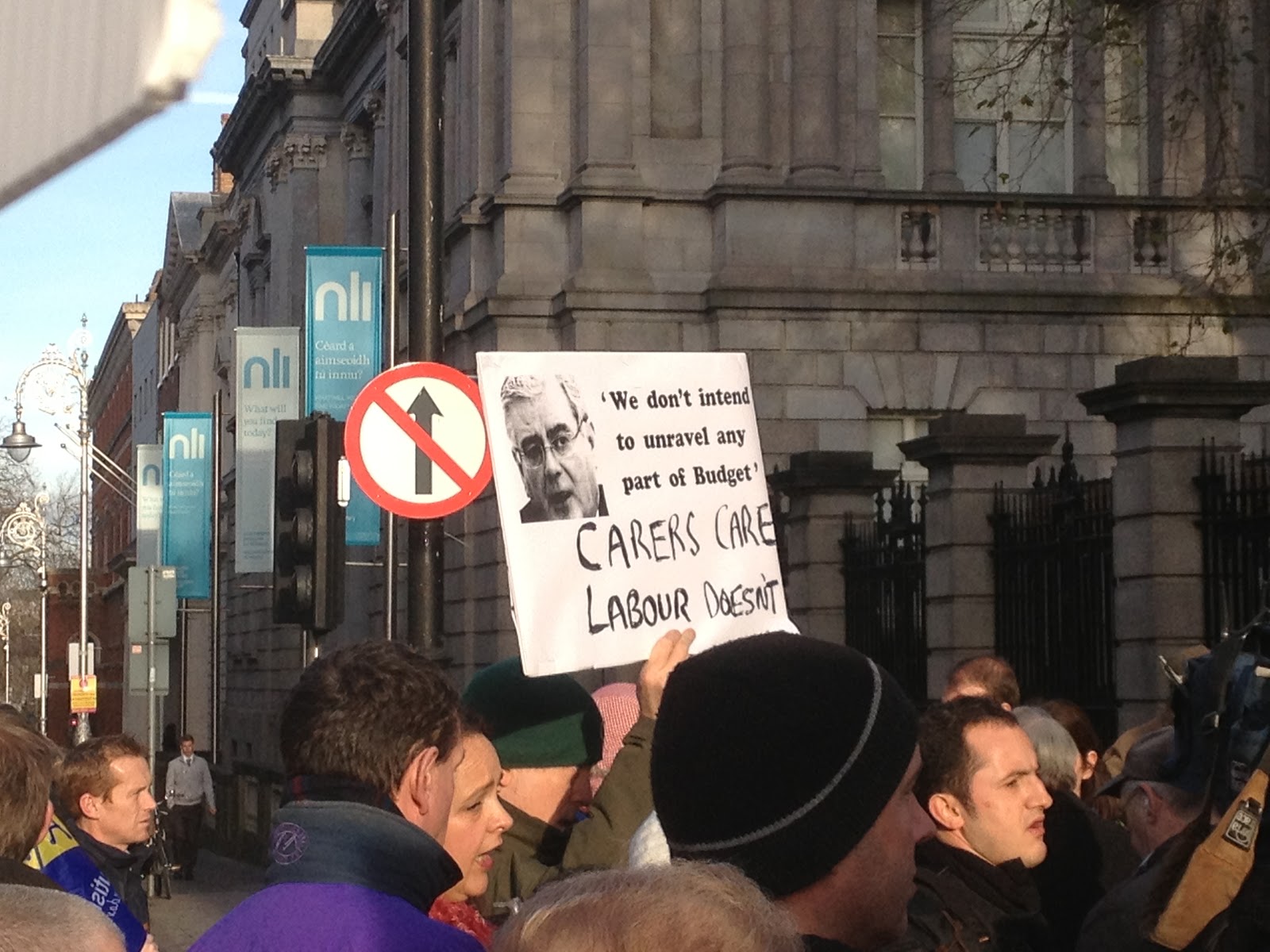
Protest against Respite Grant cuts outside Dáil Eireann, 11th December


Eighteen months ago, in a professional capacity, I undertook a piece of research that involved speaking to carers, both paid and non-paid.
The aim of the project was straightforward – to evaluate their reactions to some communication material and, based on that, suggest amendments.
But it turned into much, much more.
Over the course of a week, I spoke with almost 40 carers, broken into four groups.  Some were caring for elderly relatives, usually parents, but sometimes uncles, aunts. Others were caring for their children, some with physical disabilities, other with intellectual disabilities, some with both. They spoke openly, passionately, and above all, honestly.
The conversations I had with those people that week floored me. What they told me shocked me, and in sometimes, horrified me.
The group discussions were scheduled to run for 90 minutes each.  But such was the level of engagement, so eager were these people to be heard, that the sessions greatly overran. Timekeeping’s usually quite important when conducting qualitative research.  In the last 30 minutes of a 90 minute group discussion, you can sometimes sense a respondent fatigue. Not so, here. Two hours, two hours and fifteen minutes – two and a half hours. They didn’t want to stop. This was the first time they had ever had an opportunity to air their fears, their frustrations and their exhaustions, and have somebody really listen to them. And I couldn’t stop listening.
In light of the cut to the carers’ annual respite grant announced in the Budget last week, I want to share some of what I heard, and learned in those groups
Caring is a full-time job.
The first thing I learned is that being a carer is a full-time role. There is no downtime. And by full time, I mean for some, they were on alert 24 hours a day, 7 days a week.  There is rarely any respite. Family carers spoke of how they shouldered all the burden. Siblings did not contribute fairly, or take any responsibility for the care of their parents. The load typically fell to one family member. They spoke of their exhaustion. How they were on high alert, all the time. “I don’t know how to relax”, one said. “It’s been so long since I relaxed, that I don’t know how to, anymore.” Respite was an essential. “Just a few hours to do your own thing, spend time with your own children, clean your house. Just to have that freedom from each other for a short while.”
Carers don’t always choose to care
The second thing that struck me is that many of those who care for others full-time do not make a conscious decision to do so. Rather, it happens. A parent falls ill, and, needing full-time care, moves into their house. Their child is born needing full-time specialised care. Would these people have chosen caring roles as a career choice? No. Rather, they do it because they have to. Often – and they are willing to admit this – they have no aptitude towards caring, and it does not come naturally. Neither – and this is important – do non-paid carers get any training. Paid carers are trained, but family carers are thrown into the deep end with no support. But they have no choice. They have to do it, and they get on with it.
Isolation is a huge issue
Because being a full-time carer is pretty all-consuming, it’s often impossible to have any kind of a social life. Carers spoke about how gradually, as the caring role subsumed all leisure time, their opportunities for socialising had declined and friendships had waned. Often the sense of isolation was the worst, they said. This is felt particularly in rural areas, where transport can be an issue. Having no-one to talk to is the hardest thing of all. Nobody cares, they felt. The media doesn’t talk about it. “No-one knows what it’s like, and no-one wants to know”. Support from the HSE is non-existent. “Sometimes you can’t even get to speak to a real person.”
Carers are human too – with human reactions
The carers I spoke with were unflinchingly honest. They were willing to admit that sometimes they got angry and frustrated. Sometimes it might be with a parent calling them numerous times during the night. Other times, it may be with a child who had wet the bed for the second or third time that night. Sometimes sheer exhaustion and frustration led them to say things they regretted to those in their care. Sometimes they shouted. Sometimes, they had shocked themselves. “Anything can happen”, one said, “when people are deprived of their sleep”. With no support, no respite, this is exacerbated.
Society ignores those who can’t speak for themselves
Carers felt angry on behalf of those they care for. “What’s missing in our society is dignity and respect for our old people”, one said. “Once they’re past their sell-by date, they’re thrown on the scrapheap. They’re only an inconvenience”.  Unanimously, carers felt invisible. They were shouting into a void, and no-one can hear, nor does anyone want to listen.
What does the annual respite grant really mean to carers?
Remember; however that caring is a full-time job. Carers often work around the clock, and do not have the means to earn an income. In addition, by providing care, they are saving the state the cost of providing this care on a residential basis. This care is provided for an allowance of as little as €200 a week (this can sometimes be the only household income).
So, what does the respite grant mean?
·         Respite means a break. It allows a carer to pay for supervision, either at home, daycare or residential care, so that they have the peace of mind to take a break. Be that a holiday, or just some time free from the responsibility of caring. Reasonable in anyone’s book.
·         Respite grant money is often used to pay for additional therapy for the person in care, to improve their wellbeing, either physically or mentally.
·         The respite grant is not always used for “respite”. Because carers are low-income earners, sometimes it’s used to pay for car insurance, heating oil, or home repairs. Everyday expenses. And yes, often carers depend on it for this.
What can we do?
There are many, many compelling arguments that can be made in favour of reversing this cut. We can express our outrage all we like, but it’s time to stand up and start doing something about it. There is still time to make a difference. Write a letter to your local TD. Or pick up the phone. Come out and protest (there is another protest outside Leinster House on Thursday 13th December at 11am. It’s not easy for carers to come out and protest – so we need to do this on their behalf.) The real mark of a society is how they treat their most vulnerable.
Don’t give up. Speak up for those who can’t speak for themselves. And let’s tell our government what kind of a society we really want.

Our elderly deserve better. An open letter to our TDs

This is a letter I have today written to my local representatives in government, and have published here, for wider circulation.

Reading Marese McDonagh’s piece in today’s Irish Times has made me so angry. Angrier than I ever recall being over the past five years. Enough is enough.

Because I have had a home, and income, my health and my independence, I selfishly haven’t done enough to protest against injustices over the past five years.  But this is my tipping point. I can’t stand by any longer.
____________________________________________________________________________

Dear ….

I write to you, as my local representative in government, including the link below to an article in today’s Irish Times.

http://www.irishtimes.com/newspaper/health/2012/1204/1224327432416.html

If you have not already read this article, I urge you to take just two minutes to read it in detail. Absorb it. And think about what it really means. Put yourself in the shoes of someone who is housebound and dependent on an hour of help a week to maintain just their basic dignity. Really think about it.

I urge you strongly to reconsider the decisions this government has made with regard to the provision of home help cuts in our country.

Enough is enough. What your goverment is doing to the weakest and most vulnerable in our society is wrong, and it has to stop. These cuts must be reversed.

No, providing for the most vulnerable in our society won’t help the economic recovery. But the way we care for our elderly tells, more starkly than any economic indicators ever could, the type of society we really are. 

Is this really the type of society you want to preside over? Really? The type of society that will leave an incontinent woman lying alone in a bed, waiting for her home help to arrive to attempt to restore her some dignity in the space of half an hour? Really? Is this really what we have come to as a country?

Yes, families have responsibilities to older members, but sadly, these responsibilities for whatever reason are not always met. That absolutely does not mean it is acceptable to abandon the people who have called this country home for decades, who have contributed to its economic growth, have raised children and grown their businesses here. To leave them to the mercy of their own physical and mental frailties. Like it or not, we have a duty of care towards these people. They are our parents. Our grandparents.

As a direct consequence of your actions, thousands of our elderly will become directly reliant on the HSE to provide them with care, at the expense of those with chronic illness. Can you not appreciate how short-sighted this is? Remember, this is the same HSE that thinks it is perfectly acceptable to place cystic fibrosis patients, at high risk of infection, in shared wards and in rooms with shared facilities. In a hospital that is suffering with a severe outbreak of the winter vomiting bug. A HSE that has already shown itself, many times over to be inept at bed management. Yet you appear to fail to realise the potential impact of adding more long-term patients to the system, both in terms of bed availability and overall standards of care.

Is this really what you want to leave as your legacy? Really?

We will all be old one day. We may not all be privileged, or have a voice to speak up for ourselves. But we will eventually all succumb to the limitations of our bodies, and possibly even our minds.You cannot in all good conscience argue that this should mean our dignity should also be sacrificed.

This is only one of a number of letters I could have written. I could have written in anger about how your government has not delivered on your promises on mental health. How education aids for those who really, really need them are being cut, quietly, all around the country. I could have written about how your government continues to justify the payment of €30+bn of OUR money to a dead, gambling entity, in order to fulfil the conditions laid out by our European friends. I understand that patience is necessary when dealing with Europe, and that demonstrating prudency and economic discipline can only help in our quest for debt restructuring. But what you are doing to achieve this is wrong. Wrong on so many levels.

I’m a “middle earner”. I’m not well off. By no means. I drive a car that’s 10 years old, can’t afford health insurance and have a certain level of personal debt. But for goodness’ sake, I have a job and an income and I am not reliant on anyone to care for me, and I can stand up for myself when I feel I am being unfairly treated. I’m the person you should be targeting for cuts and levies, if it needs to be done. No, it wouldn’t be popular with voters. I know, and am not dismissing the plight of many middle earners – particularly homeowners – are already under severe pressure. But we are not confined to beds or empty houses with no independence. What you are doing is not right. It is just not right.

I’m tired of being angry. I’m tired of feeling that we are merely postponing the inevitable sinking of our society. But I’m not tired enough to stop fighting for the care of those who need and deserve it the most, and, as representatives paid by us, to represent the interests of EVERY citizen in this country, neither should you.

I want to know what you, as a paid public representative are going to do, to restore this tiny amount of dignity to our elderly by restoring home help hours to their previous (already woefully inadequate) levels. Writing to you is the first step of many. I, like many others have been silent for too long already. I will not stop until I hear evidence that you are taking definitive action to improve the circumstances of those fellow citizens who rely on their home help to provide them with a minimal level of dignity.

I await your reply.

Anne-Marie Flynn.

Seasons

Never mind your festive season, your romantic notions of White Christmases, your open fires and your winter cheer.

In reality, it’s usually just rain. Or slush. And The Grey.

February, anyone? Is there a more miserable month of the year that must be endured? I think not.

No, you can keep that.

Give me glorious Autumn any day, with its crisp, bright golden mornings. Nature’s annual parade of pride when the trees puff out their chests and wear their technicolour coats with aplomb. Harvest smells abound. And the countryside looks so alive and beautiful, it could make your heart burst.

The worst thing about Autumn? It doesn’t last long enough. It’s a few fleeting weeks – a parade, a showtime. Then it’s gone – it’s just a russet-hued, blush-soaked memory of better times,  a distant beacon in your mind when the Grey appears.

I wish it could be Autumn every day.

On shaky ground….

So. We’re a couple of weeks into the adventure, and guess what?

Oh yes. Predictably, I’m beginning to wobble.

The initial euphoria of making the big decision has evaporated, and while outwardly I’m still projecting an air of brash confidence, inwardly, frankly, I’m crapping myself.

Far from the bravado of a couple of weeks ago, and the determination and resolve I had to make this happen, over the course of a mere few days, it feels like every ounce of self-doubt I’ve ever had has congregated in a corner of my mind and is multiplying faster than the worst kind of bacteria you’ll see in any safefood ad. Those pesky little seeds of self-questioning are germinating faster than weeds in a greenhouse and I’m at a loss as to how to kill them off before they strangle me.

I’m questioning myself a bit. My abilities, my motivation, my confidence, my skills. Where I can best apply them to benefit myself and others. I’m panicking because I’ve been scouring the classifieds for new avenues, and – shock –  there really aren’t that many jobs out there. (No shit, Sherlock.) Ridiculously, I’m scared that I’ll actually find a job and be a miserable failure at it. (That luxury is, of course, just a pipe dream at this stage.)  I’m worried that come next year, I won’t be able to pay my rent. I’m afraid I’ll have to pack my bags and move home to my mammy, at the ripe old age of 32. And I imagine she’s twice as terrified at the thought.

All rational enough concerns, I suppose. Mostly.

I’m also struggling a little to maintain focus on my current job. Mainly because, following a really frantic period of juggling lots of interesting and stimulating projects, nothing new or challenging has come my way over the past while, and understandably, such opportunities will be thin on the ground between now and the time I leave. It all feels a little mundane. But I’ve made a commitment to my colleagues and my clients, and I intend to see that through to the best of my ability.

The stress is manifesting itself in funny ways. Odd dreams, tossing and turning at night. Absent-mindedness. I tried to put my seat belt on at my desk, this morning. (Mind you, that’s normal behaviour for a Monday morning.)

My friends have been wonderful, though. I’ve had plenty of encouragement, and offers of food and lodgings should I end up facing destitution. I’ve had physical and verbal hugs. I’ve even been offered a van to live in. So it’s not all bad. I’m very lucky.

In the grand scheme of things, chucking in a job – or potentially a career – isn’t such a big deal. Right?

It’ll work out. It has to. And I’ll keep telling myself that, until it does.

The road less travelled

Recently, I’ve been getting itchy feet.

(Not of the fungal infection kind.)

Change is in the air. I’m restless. I want something different.

The past two years have been … tumultuous. Largely good, but rough, at times. I’ve been shown evidence of the frailty of human existence up very close, no fewer than three times.

There was a different outcome on each occasion.  Each time took its toll, in a very different way.

But I learned a lesson. It’s that life is so, very short. So very fragile.

It’s too short to spend it in a way that means you’re not happy.

I learned another lesson.

It’s that the most precious things in your life are people that surround you. Your family. Your friends – the family you choose for yourself. If you’re lucky enough, the one person you choose to share your journey with, for whatever portion of the way. Nothing, but nothing is more important than those people. Nothing.

After almost six months of constant working almost to the point of exhaustion, I took some time out.

I realised how little I’ve seen my family over that time. I noticed that my friends were busy making plans, and I wasn’t being included. I saw how I’d shut myself off from the world, buried in a laptop, or sitting late in the office. It dawned on me that I’d felt for a long period that the very idea of a relationship simply meant more demands on the time I didn’t have.

To be fair, I’d been working on some great projects. Met some incredibly talented and inspiring colleagues and clients. I’d been learning about things I’d never otherwise have, and uncovering insights that made me feel genuinely excited.  But in a quest to gain experience in the sectors which I felt made my job worth doing, I was sacrificing the time that made my own life worth living.

Such is the nature of agency life, I’m told. Sometimes I drive myself too hard. It’s true. But in a quest to find projects in line with my own values, I ended up sacrificing them.

There’s only so long you can go on like that.

So I went away to the sun. As soon as I stopped, the cold that had been chasing me for weeks caught up with me. I coughed, I sneezed, I sweated and  felt sorry for myself.  When the fever lifted, I slept. Then for days I read. Glorious, glorious books! A joy I’d forgotten. I switched off my phone, ignored emails. I got up at dawn and watched the sun rise over the sea. I took time to breathe, and do nothing at all.

And I thought.

I thought – what is it you want to do with yourself? What do you see yourself doing in five years time? And I couldn’t answer. The only conclusive answer I came to was: Not This.

So I decided – I needed to do something. With no alternative on the horizon, I decided to force myself into a making a change. I decided it was time to leave my job.

I came home. I talked to my family. They stopped just short of telling me I was mad. (I appreciate that they didn’t.) I talked to my friends. They left me in no doubt that they thought I was making the right decision. Some made me feel like anything in the world was possible, and I hope I’ll be grateful to them over the coming months for helping me to believe it. Someone else told me that I “won’t starve”. I hope they’re right.

So, I find myself at the beginning of October, facing into an unknown future. I have just under twelve weeks left to work here, before facing unemployment. It’s daunting.

Scrap that. It’s more than daunting – it’s terrifying.

But … it’s also exhilerating.

I have a blank canvas. Whatever happens from here on in, it’s my decision. I can stay where I am. I can move county. I can move country if I wish. (But I don’t think I will. I like it here.)

I’m scared. Scared that I won’t make this work, and that I’ll have to go back to my employer, cap in hand, and beg them to stay. To be fair, they’ve been incredibly supportive. But to do so in my eyes would be to fail. I feel I have to make this work.

All I do know is that long-term, I want to work in an arena which I know in some small way, helps to make the world a slightly better place. I’m happy to work hard, as long as I know I’m making some small difference. There are things that I’m passionate about. There are things I’m good at. If I can’t find a postion straight away where I make a living working doing things I’m passionate about or good at – fine. I’ll have more time to devote to them outside of my paid employment. And eventually it will come. I want to be able to wake up in the morning and know that I am contributing something to the people around me, to my family and friends, and even to some extent, my country.

And I’ll make it happen. In time, somehow.

Wish me luck. I’ll need it.

file000724748949

My 10k adventure – and a thank you

Two months ago, I took a mad notion and decided I’d run 10km for charity.

Okay, I lie. I did no such thing. I decided I’d repeat the efforts of previous years, and sign up for the Women’s Mini-Marathon, do some token training – consisting of running 500m down the road and back while feeling faintly ridiculous – for the week preceding the big event. Then I’d turn up on the day, togged out like a pro. I’d jog a little and feel smugly fit and healthy before starting to wheeze, and would happily succumb to a(n albeit brisk) walking pace around the 2k mark. Then I’d finish triumphantly by jogging across the line at a respectable 1 hour 40 minutes and head to the pub to smugly celebrate my achievement.

This year was different, though.

I work for a large multinational corporation. I’ll openly admit that this is not necessarily the career path I’d have chosen as a young idealist, but it’s worked out well for me. While I work hard, and sometimes excessively long hours, I consider myself pretty lucky that I can work with some great clients who do fantastic work in the social arena. I’m glad that as part of my day job that I get to meet people who inspire me, and I’m grateful that I’m able to play a very small part in helping them achieve their aims more effectively and successfully.

One of the single biggest positives of my job is that as part of our corporate social responsibility programme, I with a small team of others have been able to work closely with the wonderful people at LauraLynn House, Ireland’s first – and only – Hospice for terminally ill children. Social responsibility programmes within big multinationals sometimes get a bad rap among cynics, who suggest they smell a little of tokenism and are simply part of an effort to generate positive PR, but I say, if I can contribute to a cause like LauraLynn House, even to a tiny extent, as part of my day job, then that’s good enough for me.

I’m sure by now that most of you have heard Jane and Brendan McKenna’s tragic story, but if not, you can read it here where you can also find out a little more about the work that the Children’s Sunshine Home and LauraLynn House do.

Three weeks ago, I was confronted with an image on the front of the Irish Independent that stopped me in my tracks. Tiny baby Leo McWade, aged 6 months old, gazing up at his dad with his beautiful big eyes, had been born with an inoperable heart defect. Told he would have very little time, his parents, Catherine and John had brought him home to care for him side by side with his twin sister Molly. I won’t deny that I cried when I read of his dad John’s feeling of panic when, on a particularly awful night, he phoned the hospital desperately looking for help and was told not to bring him in, that there was nothing they could do. I don’t have children, but I can only imagine the how horrifying that feeling of helplessness must have been.

John and Catherine subsequently moved into LauraLynn House with Leo and Molly, where Leo has received specialist care. The twins are now six months old. John, during his interview with the Irish Independent marvels at Leo’s resilience. “Now we have gotten to know this little boy. We can hold him and he looks up at me and he smiles”, he says. They can now tell Leo’s little sister that they did everything they could for him.

I hope John and Catherine don’t mind me telling their story here. But I don’t mind saying that nothing I have ever read has affected me so much. I hope Catherine and John get some more time with their little boy, and when the time comes, I hope sincerely that they’ll get the support they need at such a terrible time.

LauraLynn House is a wonderful facility. In their recently-opened new hospice building, they’ve thought of everything. It’s full of natural light. The bedrooms are decorated so as to make them feel as homely as possible. While every room houses essential medical equipment such as hoists, they are discreetly housed behind doors so as not to serve as a reminder that this is a medical environment. Large recliners beside beds enable tired parents to rest in comfort. Computer screens where staff can access medical records double as interactive screens for children to play games. There are guest rooms, with small kitchens where families can avail of privacy and retain some dignity at that most terrible of times. And in the most poignant of additions, there is a beautiful room called the Butterfly Suite, where children close to death are brought to die with their families around them. Importantly, LauraLynn House is not a sad place, nor is its sister organisation, the Children’s Sunshine Home. Though the facilities between provide care and respite for hundreds of children and parents, they are places of light and laughter.

LauraLynn House receives NO direct government funding. Not a cent. Apart from some funds diverted from the state contributions towards the Children’s Sunshine home, on whose grounds LauraLynn House sits, the hospice relies solely on the goodwill of fundraisers to pay its staff, and maintain its buildings and equipment. Running costs for the Hospice amount to over €2m annually. That’s a lot of money to raise.

When I read baby Leo’s story, I’d already started fundraising. I’d already raised quite a bit, having beaten my original target of €250, which I’d thought ambitious when I set it. But reading this made me more determined than ever. So I started to make a nuisance of myself, and it paid off. I’ve known from years of getting soaked outside churches while shaking buckets and selling raffle tickets at table quizzes, that we as a nation are an incredibly and unerringly generous people. I’ll always remember the old gentleman with no coat and a jumper that had seen better days who, outside a north Dublin church on a freezing cold, rainy night with a shy nod pressed a €50 note into my collection bucket. Once people are asked, they almost always respond with genuine enthusiasm for a good cause. But when times are that bit harder, and money is tight, I’d have understood if people were more reticent. I was prepared for that. But the opposite proved to be the case. In the end, I’ve managed to raise over €1,200 for LauraLynn House, and to say I’m delighted is an understatement.

One of the most amazing elements of my fundraising effort was the response I got from my efforts to promote the cause using social media. Anyone who knows me will know that I’m  an avid fan of twitter. I’ve been using it for about three years, and during that time (once the initial rite-of-passage novelty of celeb-following wore off), I’ve gathered over 1500 followers, and enjoyed thousands of fascinating, bite-size conversations with people from all walks of life on lots of interesting topics. (And politics.) I’ve even had the pleasure of meeting some people who I can now safely say will be friends for life. But despite my already strong conviction that the people you meet on twitter are among the best you’ll ever find, nothing could have prepared me for the response I got there to my fundraising efforts. In total, nearly half amount came from people who follow me on twitter. Astoundingly, a third came from people I’ve never even met. Some even passed my fundraising page on to friends and colleagues who in turn, also contributed.

Just… wow.

So when I togged out last Monday, I felt I owed it to those who donated to put in a bit of effort, over and above my usual laid-back ambling through the route. Work commitments meant training time was minimal, so I approached the day with some apprehension. (By minimal, I mean non-existent.) An old injury didn’t help, but along with a good (and annoyingly, infinitely fitter) friend of mine, I vowed I’d give it socks. (I even bought special socks for the occasion.) The first kilometre was a breeze. I was starting to wonder what the big deal about running was. By 2k, I was getting a wee bit sweaty. At 3k, I was starting to wheeze and feel a bit dizzy. By 5k, parts of me I didn’t know existed were starting to hurt, and I had to slow down for a bit. (By slow down, I mean stagger to the nearest water station and consider catching a bus.) Around the 7k mark I was definitely starting to hallucinate and reminiscent of the Lenten episode of Father Ted where everything appears to Ted to be a giant cigarette, I was having visions of tantalisingly cold pints of liquid. (Swithwicks.) The firemen cheering us on at Donnybrook at the 8km mark bolstered the spirits somewhat, despite being somewhat of a distraction. By 9k, every single part of me, including my eyeballs hurt (and didn’t stop hurting for four days). But I crossed the 10k mark having managed to run a good 90% of the route, and clocked a time of 1hr 18 minutes. Not exactly impressive, but bearing in mind that I absolutely detest running and avoid it at every opportunity, I was pretty damn chuffed with myself. I was so chuffed that I even contemplated running a victory lap around the Green.

So, this post is a thank you. To anyone who made a donation to the cause, thank you, thank you, THANK YOU, from the bottom of my heart. I’m humbled by your generosity towards what is a wonderful cause. LauraLynn House value every cent of the money you donated. But in addition to that, the past few weeks served to remind me that despite all the negativity and cynicism that pervades the news, the papers and our everyday discourse, there is still an intrinsic goodness in us, and a desire within us to help out others less fortunate than ourselves. And it’s for that reminder that I’m even more grateful.

You can read John McWade’s interview with the Irish Independent here.

Should Old Acquaintance Be Forgot …? (A Little Light Reading)

This post was written as part of the Great Cake Experiment (A Writing Project for the Unmotivated.)

Lots of writers contribute to a common theme on a weekly basis. Do pop over for a look!
____________________________________________________________________________

Well, should it?

Depends on what you mean by “acquaintance”, I suppose. Time has this habit of flying by, bringing with it small chunks of your memory. Someone should have told Time that these memories can be useful to hang onto, thank you very much. There are at least two types of acquaintance-forgetting scenarios I think we’ve all played a part in at some stage.

Firstly, you have the Forgotten Face situation. Ever bump someone you’d actually completely forgotten ever existed?

Awkward, that.

Picture this. They instantly recognise you. They’re delighted to see you. They even greet you by *name*. They remember what you studied in uni, and they ask after your dog. Also by name. You, on the other hand, are panicking. You’re mentally treading water. Although in the dim recesses of your mind you have a vague recollection of this person’s face, you have no memory whatsoever of where they feature in your past. Flailing, rewinding at the speed of light over your school, college and working life, desperately seeking clues in the conversation (although they’re giving nothing away), and conspicuously avoiding addressing them by their name – because you haven’t a notion what it is – it finally clicks and – oh, blessed relief! – you remember.

Simultaneously wondering what on earth it is they include in their diet that helps them to remember such a tenuous acquaintance in so much detail, and trying not to make it obvious that you have only this second remembered where it is you ever met them in the first place, you struggle through the last excruciating moments of the conversation until someone makes an excuse to leave. (Usually them, because you feel too guilty about forgetting their very existence to also lie to their face about being late for something.) You wave them off, exchanging lovely-to-see-you-agains and we-must-meet-for-coffees. You breathe a sigh of relief for getting away with it. You still haven’t a bull’s notion what their name is.

Yep, awkward.

Then, you have the opposite of the situation outlined above. You are the Dog-Name-Rememberer, and yours is the Forgotten Face.

You run into them by chance, in the middle of a car park in some god-forsaken part of the midlands. (Yes, I may be recalling a incident from personal experience here. If you’re reading, I’m glad I made a stronger impression second time round.)You haven’t seen them since college days, and memories of days locked up in libraries and reading rooms frantically piecing together project work come flooding back. You had all the craic back then. You really bonded. Such a shame you lost touch, you were *such* good friends – isn’t it great to see each other? Two minutes in, your ego’s reeling from that punch of non-recognition. You know by the panic in their eyes and the whiff of desperation that they actually don’t know you from Adam. In fact, you have a sneaking suspicion that only this minute have they remembered you ever existed. Stunned – how could they possibly forget YOU?!

Immediately, you switch the conversation mode to ‘Vague’. They don’t remember you? Well, you’ll give them no clues, and watch them squirm. Ask after their mother. And – the killer punch – the dog. By name. You haven’t forgotten, oh no. Then, you see the relief wash over them, as they wipe the sweat from their brow and you know they’ve placed you. Or at least remembered where they last saw you, but you know they still haven’t a clue what your name is. Trying to salvage some dignity, you excuse yourself. You’ve somewhere important to be. You ARE important, despite what they clearly think. You call them by their name at least twice as you say your farewells, and swagger off with as much dignity as your wounded pride will allow.

Yep, even more awkward.

There’s a further scenario, where you run into someone you know you recognise, and you know they recognise you. You’ve been acquainted in the past, but neither of you have the foggiest notion how, or when, or where. But the low level of emotional investment there means the awkwardness remains minimal, and crucially, you both have the good sense to mumble a perfunctory greeting and Just Keep Walking.

There are certain other acquaintances I’ve made in the past that I’d bloody love to be able to forget, but that’s a ramble for another day. I’ve even had a couple of occasions to think that Clem and Joel, as inspired by Alexander Pope had the right idea, and that erasing memories of acquaintances past wouldn’t half be a bad plan, but grudgingly I always come around to the realisation that those memories are part of me, as much as my skin, hair and eyes are, and to lose them, and forget what I had and shared, would be to lose a part of me.

How happy is the blameless vestal’s lot!
The world forgetting, by the world forgot.
Eternal sunshine of the spotless mind!
Each pray’r accepted, and each wish resign’d;

One small tip, though. No matter how forgetful you become, always remember the dog.

Money Talks…

It’s that time of year again. The Great Cake Experiment has kicked off for a second round.

As usual,  I have, at the very last minute, managed to submit this week’s entry.

____________________________________________________________________________________

Money talks, but, as the words of a famous song attest, it can’t sing or dance, and it don’t walk. (Note: “Famous”, naturally, does not equate to  “decent”, or “credible” or even “listenable”.  But I’ll try not to digress, before I even get past the first paragraph. And Neil did have a point, before the chorus descended into farce).

Residing in Ireland these days is no great picnic, at least not according to the media. As a country, we are flat broke, and have sold our sovereignty/souls to the Germans/Devil, (delete as appropriate). Our houses are worth negative money – the bricks and mortar equivalent of celery (yes, if you eat nothing but celery, all the time, you’ll have a negative calorie intake. Crash dieters, take note.)

And oh, how we love talking about this. In outraged tones, we condemn the FF-‘led government of the time for mismanaging us into this pit of destitution. We blame the banks for lending us the cash to buy what we did not need. We scorn the broadsheets for force-feeding us swollen property magazine supplements we did not want (but feasted on). We decry the economists who gleefully discussed  the best and safest ways of investing in property abroad. How we revile the car dealers who persuaded us that a five year payment plan for the BMW X5 – for on-road activity, natch -was a no-brainer. Lacking, however in this blame game, is the more uncomfortable notion of personal responsibility.

Today, in Ireland, to be blunt we have a society that, to its shame, has collectively failed itself. Our most vulnerable are now at risk. There is every indication that tomorrow’s Budget will signal bad news for children in disadvantaged families as child benefit allowances are cut. Class sizes will, in all probability be increased. Already, the number of Special Needs Assistants for children with learning difficulties has been slashed. Nursing homes are closing, resulting in traumatic moves for elderly patients who, for many years have known no other home. Proposed funding for mental health facilities is now no longer guaranteed. Note that those most affected here are the ones with very little power to defend themselves.

Take a bow, Ireland. To say “we all partied” is wrong and unfair, but frankly, there is no denying that many of us did. Plenty of us sit in debt, because we lived beyond our means when times were good. Nobody ever told us we had to buy that car, or take out that mortgage, but we went ahead and did it anyway because everyone else was doing it and we didn’t want to be left behind. Now, in our grim fiscal situation, all we can do is talk about it, and continue to place money at the centre of our lives, and forgetting that the loveliest things we own cost nothing. (The irony is, that despite the fact that €120 billion is held in this country’s banks in hard currency and cash deposits, we collectively cry poverty, but of course, I’m digressing again.)

Times are hard. For many, they’re immeasurably shit, and they have my sympathy, they really do. But for many of us, they’re not as bad as we’d like to pretend.

I can’t understand why we continue to talk ourselves into this negative, defeatist frame of mind. Think of the happiest memory you have. The person you love the most. The things you treasure most dearly. What you would cry hardest over losing. I’m willing to bet that the things that matter most to you don’t didn’t originate in your wallet. Why not place them at the centre of your world, and while you’re at it, make a difference to the people around you by doing something small, something almost immeasurably tiny, in fact, like sharing a smile, holding a door, or just telling someone how much they mean to you? Why not devote your time and energy to what feeds the heart and soul, and worry a little less about what you can’t bring with you where you’re going?

Money talks, but no-one ever said we had to listen.

Two Thoughts on Conforming

“Once conform, once do what other people do because they do it, and a lethargy steals over all the finer nerves and faculties of the soul. She becomes all outer show and inward emptiness; dull, callous, and indifferent.”
~ Virginia Woolf

“Nonconformists travel as a rule in bunches. You rarely find a nonconformist who goes it alone. And woe to him inside a nonconformist clique who does not conform with nonconformity”
~Eric Hoffer

El Camino de Santiago

I promised quite a few people I would write a piece on my journey on the Camino when I came back. And I will.

But for now, I’ll leave you with a couple of photos as a taster and say emphatically that it was the best 250km I have ever walked. (Out of all the 250kms I’ve ever walked – I do it all the time.) It was a retreat for mind and soul – even if it did punish the rest of the body – and I couldn’t recommend taking this time out enough.

The beginning – leaving Astorga. A long road ahead, with scallops and yellow arrows as waymarks.

We were lucky enough to get to watch this sunrise from one of the highest points on the Camino – after a 5.30am start. 6am starts and 10pm curfews became the norm. Quite a departure for a night owl, but I loved it.

These kind of traffic jams, I can live with.

Letting sleeping dogs lie…

Love on the Camino…
(Mind you, if he’d written on the wall of my house like that, he’d be adding a few more blisters to his collection.)

Boy, were we glad to see this place.

The infamous Botafumeira. This giant incense burner was traditionally used to fumigate the Cathedral at the daily 12pm Mass. (Pilgrims are smelly). It’s now been redeployed in a new starring role as end-of-Mass entertainment (just when you think the fun parts are over) as it swings through the nave of the church, accompanied by super-dramatic organ music. Just Google it – I ain’t no fan of mass, but this was quite the spectacle.

The sun goes down in Santiago de Compostela, on a rather perfect day.

More to follow.

Dark Nights of the Soul

Ireland. The land of a thousand welcomes. Where the grass is green, the sun is rare, the Guinness is black (or ruby red, if you’re a purist) and the craic is mighty. Sure it’s a great little country altogether we have. Isn’t it?

Well, it is. For the most part. Unless you’re suffering from mental ill-health, that is.

Ireland, for all its warmth and revelry, its friendliness and humour, struggles to deal with mental health issues. As a population, we don’t really like the thought of anyone being “not right in the head”. We regard those who are “a bit touched” with pity, suspicion and even fear. We exude patronising pity for those who “suffer with their nerves”. We don’t talk about mental ill-health in the same way as we talk about physical ill-health, and if someone shows signs of mental “frailty” they are labelled, for life.

Come to think of it, talking about feelings on any level, apart from the most superficial, tends to be a challenge, particularly if you’re male. And especially not with other males.

Something I’ve noticed over the past couple of years in Ireland is the big increase in media coverage of mental health – and mental ill-health. Be it blogs, websites, articles, newspaper reports dealing with depression and other mental illnesses, this is an area which is generating more conversation than ever before – and not before time. Organisations like Spunout.ie, Headstrong, Grow, and Shine to name but a few of many, have been working to push these issues into the the public arena and popular discourse, and are slowly but surely building conversation, knocking down walls and very, very gradually reducing the stigma around mental illness. An initiative which has really pushed the boat out in terms of working to reduce stigma around mental health problems is
See Change, an alliance formed by over 40 voluntary organisations, state agencies, universities and youth groups including those named above. Their work has really impressed me so far, particularly their ‘Make a Ripple’ campaign, which comprised of stories by real people who have been affected by these issues, serves to remind us that mental ill-health is not solely the preserve of people we don’t know.

This isn’t a post about my own experiences of depression. I’m one of the luckier ones. In my lifetime, I’ve dealt with two pretty bad bouts of the blues, both severe enough to necessitate time off work and both harsh enough to make me wonder through the darkness of despair if life would ever look any brighter again and if I would be better off dead. I’m not going to write at any great length about how waking up in the morning during a period of depression is almost a disappointment… nor about the way it saps your energy and motivation, how broken sleeps provide no respite, contributing only to sustained exhaustion. I don’t intend to dwell on the guilt you feel for your lack of enthusiasm when nothing moves you. Neither will I write much about how, during a period of depression, you become your own worst enemy, locking yourself away, isolating yourself, distancing yourself from the people around you and focusing helplessly on the negative thoughts, feeding the selfishness of the illness until you are trapped in a spiral of misery so intense that all you want to do is go to sleep and not wake up.

No, for those who want to read about the experience of depression in depth, there are plenty of accounts out there, written by those souls courageous enough to share.Like I said, I’m one of the lucky ones. I’ve learned to deal with it. Every so often, another wave will appear, out of nowhere to wash me under, but as any bad surfer knows, sometimes it’s easier to duck beneath the wave and let it roll over you than standing up and trying to fight it. Acceptance has been half the battle, for me.

It does sometimes feel like a constant, exhausting fight, keeping the darkness at bay. A feeling I’m sure many a sufferer will identify with… but to live in fear is to let it dominate your life and I will absolutely not allow that to happen.

Sometimes though, it’s hard.

Everyone deals with things differently, and for me, I’ve always found the internet a ‘safe’ place to share. (That’s why I think Aware’s online support groups are a fantastic initiative.) As per the bio, I don’t much like talking about myself. I like asking questions more than I like giving answers, and I would struggle,  face-to-face to talk to many of my friend about this. Only a handful know that I ever suffered with depression, and it’s never really mentioned. I feel this is partially because, I think, having never suffered it themselves, they cannot empathise. Harsh? Yeah, probably.  And a bit unfair – given that we just don’t know what anyone else is dealing with in their own head.

But it’s no way meant to be derogatory. In my experience, there is a divide between “them” and “us”. Anyone who has ever suffered from depression will comprehend, and those with no experience simply cannot understand. They can sympathise, but can’t empathise with the despair. There’s nothing wrong with that. It’s a good thing, for them. I find however, if I say I’m feeling down, it’s awkward. After a while when it doesn’t lift, people become impatient, or bored. I’m not saying it’s their fault. Naturally, it’s frustrating for them too when they’re getting nowhere. But I sense the impatience, and knowing I am the cause stresses me and upsets me even further. Therefore, I just find it’s easier not to talk about it.

And I couldn’t, in a million years, begin to imagine telling my current employers. I don’t think there is any place for mental “weakness” in business, and I have unfortunately seen very real evidence of this.  I have imagined the conversation in my head once or twice, for laughs. A couple of recent initiatives which have approached the issue from the ‘preventative’ side though, like stress management courses and an emphasis on fresh air and exercise, are positive and ones that I hope are not just tokenism, and will contribute in a small meaningful way to the mental health of all employees who participate, whether they realise it or not.

It’s my hope that all the work being done at the minute by the organisations above can somehow bridge the gap between ‘published’ experiences and real life, and that the conversation can become relevant to all of us. That’s where the real challenge lies. And this is a challenge that needs to be taken on – from the top down. Any politician who actively promotes the issue of mental health is worth their weight to this country in gold. It’s all very well to say that it’s good to talk about these things. We can say that til we’re blue in the face. We know it’s good to talk.

It’s translating the rhetoric into reality, and dealing with mental ill-health in a positive manner when it affects you, or me or someone close to us, and actually talking about it when it happens – that’s what will ultimately show that we are winning this battle, and my fear is that it’s easier to talk the talk than walk the walk. These organisations need to position themselves in such a way that they are accessible to those who have very little strength to actively reach out. And let’s encourage those of us who are stronger to look out for others. I fear that the disconnect remains, but only by working together (and looking out for one another) can we erode this “strong, silent” mentality and help make those dark nights of the soul a little less lonely.

file000100299191

(Image: Morguefile.com)
 

It’s the little things….

Today, we buried my cousin.

23 years old, and until Wednesday morning and the accident, full of life and humour. We’ll miss him more than I can write here.It’s been a rough few days, watching his family grieve. Grieving with them. What’s struck me however through the grief and the sadness and the exhaustion of the past three days is what a big impact the little gestures have.

Firstly, the amount of food that arrived to the house within hours. Trays and trays of sandwiches. Cake mountains. People wanting to do something… anything. Anything at all.

The younger group sitting up all night with him. To watch over him. The stories.

When they carried him out of the house for the last time, nearly thirty cousins, so rarely together, but at that moment together in raw grief, linked to each other for support formed an impromptu guard of honour to see him off. A protective semi-circle wrapping their arms around a broken family. Only wishing so badly we could do anything to take some pain away.

Thousands of people filed through the funeral home. When I say thousands, I mean we sat there for four and a half hours. Four and a half’s worth of people queuing up to offer their condolences. There were queues for miles. Today, those who sat in the front row have swollen, tender hands and wrists. (A tip. When offering condolences at a funeral, don’t squeeze too hard when shaking hands. Work on getting that balance between ‘wet fish’ and ‘vicegrips’ just right. It matters.)

The guard of honour of the local youth group, with which the family is so involved, from the end of the road to the church. They waited nearly two hours for him to arrive, then they walked beside the hearse with him to the church as the ball tolled. Hearing that bell toll…it’s such a lonely sound.

Today, strangers in the cars on the road pulled over as a mark of respect for the funeral. Those little things… Things that you’d never consider worth remarking on, took on a new significance. I never realised until now how touching it is to have a stranger ackowledge your grief. I know I’ll be doing that myself in future.. it may not help, it may make no difference. But it might.

It’s been a long three days. But there are far, far longer days ahead. Sleep well, Spud. We’ll miss you.

file0001188160819

(Photo: Morguefile.com)

While the music lasts…

Like pretty much most people I know, my existence to date has been accompanied by a vast and varied soundtrack.

For each memory, a musical cue, for every tear, a tune. For every heartbursting moment of happiness, a matching chariots-of-fire-esque musical crescendo. Every song, every guitar riff or piano intro capable of transporting me back instantly to a defining – or utterly mundane – moment from my past. I imagine I’m not alone in this.

Recently, I met someone in a social capacity (ahem) who, over a couple of pints announced that he wasn’t “into music”. Astounded, I queried him further. Did he not like certain types of music? Did he not go to gigs? No, he said. He just didn’t like music. He’d never even bought a CD. Ever. In his lifetime. In 34 years. (Sport is his “thing”, apparently.) He switches off the radio when he hears music, because he doesn’t like the noise. He prefers to listen to debates, sports commentary, even the death notices! Anything but music. He’s never been to a gig, nor does he intend to. He couldn’t imagine anything worse, he said.

I was flabbergasted. I don’t mean to be judgemental. Everyone to their own, right? But I’ve met people who claim they’re not into music, but you generally will hear them at some stage humming along to some naff tune on the radio. Or you might meet people who don’t actively seek out music, or don’t have any particular preferences, or just “like the stuff that’s in the charts” (shudder), but this guy was a completely new and different animal. I’d never before met anyone who actively dislikes music, and  I was shocked.

Now this guy seemed like a decent guy, and in other circumstances, I’m sure we would have gotten on well. We’d traded GAA stories around the table – a sure-fire way to get me to like you – and he was quite a wit. But the minute he dropped this bombshell, I instantly stopped trusting him. I just could not comprehend how any living, hearing human being could knowingly dislike music. I still can’t, and to my mind, they are simply not normal. I’m sorry, but that’s just how I feel.

Music is so engrained in everything we do that I wonder how anyone who doesn’t like it can endure life without losing their mind. I mentioned how it holds over me the power to instantly transport me back in time, to a moment where I was utterly consumed in grief, worry, or unadulterated happiness. It can alter my mood in a nanosecond. I hear this song on the radio (not often enough, I might add) and it makes me cry. This reminds me of my formative years when I was just starting to find my tentative way in the world – when hormones ruled and the headiness of newfound freedom had just opened up a world of possibilities. This reminds me of the happiest I’ve ever been in my life. And one day, I hope to again listen to this song without feeling the searing pain in my heart it triggers now. Like a puppet on a string, I am at the mercy of the notes, the air, the melody. And I wouldn’t have it any other way.

My new acquaintance will never experience the sheer beauty of smiling to himself as he hears “their song”, nor will he drive cross country with the window down, singing at the top of his lungs and terrifying the roadside sheep and/or passing cyclists.  He’ll almost certainly never sing his children a lullaby. I feel dreadfully sad for him.

Music may leave us at its mercy, but while there is music, there is life, and heart and soul. While the music lasts, let us dance. Let us listen and sing and celebrate and squeeze the very life out of our existence before the needle lifts and the silence prevails.

file000299027600

Fond Friends Forever…. or a friend indeed

Another post written for the group writing competition, The Great Cake Experiment.

Do check it out – there are just two weeks left in this round.
___________________________________________________________________________

Once, a long time ago, when Kylie loved Jason, I loved Kylie, Snickers bars were called Marathons and everyone’s biggest ambition was to own a Walkman, I made a friend. We sat beside each other in the back row of first class, feet in white ankle socks swinging a few inches above the ground, sharing confidences. I learned that her dog got sick in the kitchen last night, and her dad shouted at her mum. She learned that at the grand old age of eight, I still sucked my thumb to get to sleep. We were best friends. She had pigtails. I, with my boy’s cropped locks, was jealous and begged to plait her hair, like my dolls. We made each other cards daily – middle pages torn from copybooks, adorned with pink marker pen, tin foil flowers, crayoned hearts and declarations of everlasting devotion. Together, hand in hand, we skipped around the playground, hopscotched and built dens under tree branches, where no-one was permitted to enter. We would be friends for ever and ever.

A rather frail child, I was susceptible to asthma attacks and chest infections. One such bout ensured I was housebound for a week. At lunchtime, between bouts of painful coughing, I could hear the screams and laughter of my friends as they ran and skipped and chased in the playground, from my home just metres from school. The week felt like seven rolled into one. Eventually, I healed and was deemed fit to return to the classroom.

On entering the room, I was met with a state of disarray. Chairs facing the wrong way, teacher’s desk stood at the side of the room instead of the front and there were new pictures I didn’t recognise on the wall, and – oh! there she was! – my dearest friend, my soulmate, deep in conversation at a new desk with someone else. I tapped her on the shoulder, excitedly anticipating a rapturous welcome.

“Oh, you’re back”, she said. “Teacher moved the classroom around. You’re sitting over there. I sit here now. Beside my best friend.”

I froze. The world stood still. Hot tears stung my eyes. With a flourish of her pigtails, she swung away from me, and resumed her conversation. On the desk, I could see the telltale glint of a tin foil heart, a declaration of friendship forever, scripted lovingly pink marker pen.

A friend, indeed.

Two Thoughts on Truth

“Truth may be stretched, but cannot be broken, and always gets above falsehood, as does oil above water.”

~Miguel de Cervantes


“False words are not only evil in themselves, but they infect the soul with evil.”

~Plato

Town and Country

As is usually the case, this post was written as part of The Great Cake Experiment. 15 other writers pit their wit and pens against each other, every week on a single topic. Why not have a read?
_________________________________________________________________________________

When I was 16, the gap in my mind between town and country was at its greatest. Living in the country, in what felt like hundreds of miles from “civilisation” (in reality, just 4.1) with the only means of available transport the passenger seat of an unwilling parent, or the rickety wheels of an ancient pushbike, “town” was the holy grail.

Having a bunch of townie friends didn’t help. My best friend and I, living within a mile of each other in “the sticks”, envied them the freedom having a base in Town bestowed on them. They could come and go as they pleased – they even had their OWN KEYS. Our parents didn’t see the need for such liberties. There was no sneaking out late at night for us, and lack of gainful employment meant a heavy dependence on those parental taxi trips (and consequently, necessitated good behaviour, for fear of such favours being withdrawn), with curfews imposed. They even collected us in town at ungodly hours after nights out. (Sometimes we were grateful.)

We did, however have the freedom to hop on those  bikes, and cycle to our hearts content in the sun, hair messed in the wind, exploring the nooks and crannies of our country playground. In this, we felt we had a significant advantage over our town-based peers, even if they didn’t profess much jealousy. We country girls even formed our own gaelic football team. How we bonded – us against the townies. Mercifully, no official records exist of our first competitive scoreline, but it is seared on my mind forever. Our crushing defeats were soothed over pints of lemonade and Tayto, bringing giggling chaos to our one-room local and disturbing the tranquility of the regular clientele at the bar. Our team may have sucked, but our friendships endured.

Fast forward a couple of years, to university. Sharing a house with four townie schoolmates meant that country/town divisions were soon forgotten. Hailing from the same area bonded us in solidarity against the city folk (or the other country folk). The quiet peace of the countryside was scorned and forgotten, as partying became a priority, and city life pulsed in our veins. You could say, without being wide of the mark, that Galway city isn’t much more than a country town, but it was a change of pace, and we relished it. And so it went, for many a year.

Years later, I impulsively booked a flight, and departed to sunnier climes on a personal adventure. It was a trip that served to demonstrate to me how closely the Irish tend to stick together. Country, town, county and provincial divisions are forgotten, as Irish abroad unite simply in their shared nationality. It occurred to me that we as a nation rely heavily on solidarity. We feel a need to have something in common with our companions, to possess and generate shared memories and experiences, and all too often, this connection stems from our shared Irish roots and shared sense of humour.  We adore the ‘6 degrees of separation’ phenomenon, and the fact that no matter where you roam, you will always meet an Irish person who knows another Irish person that you yourself know.

Sometimes, on my solo expedition, it puzzled me. All those miles away from home, but doing very little differently than they would back at base – albeit while adding freckles to the complexion. I felt my own experience was enriched by spending time in the company of other nationalities and I felt the groups of Irish hanging out in PJs and the like in Sydney every Saturday night, drunkenly singing Olé Olé as the nostalgia-laced dizzyhighlights of Italia ’90 were replayed on giant screens, missed out just a little. But each to their own.

Now, years later as I languish in corporate limbo in the capital, I find myself looking for an escape route. The city streets which once held so much intrigue, and pulsed with energy now tire me a little. Not physically, but mentally. My visits home, and my solitary walks by the wild Atlantic  have become more frequent. I relish the relaxed pace, the peace of the wide open spaces, the warmth of knowing your neighbours and find I need to tear myself away when the weekends draw to a close. I’m not unhappy where I am, though. I’ve carved out a wonderful “Dublin family” for myself here, and I’ve realised that it consists mostly of “country” folk.  The irony. I find, when I socialise, that I tend towards places that remind me of home, and where I know I’ll meet people I know and understand.

It always amuses me that even within such a small country, there are such social factions. There’s a distinct vibe within my little group, and it smells of the Atlantic. Without even meaning to, I’ve sought out that sense of solidarity myself. 15 years later, and it seems I’ve come full circle. You can take the girl out of the country, but…….

Wake Up

Once again, this post was written as part of The Great Cake Experiment.

I look forward to the day I can write a weekly without prompting. In the meantime, why not have a read, and marvel at the talent of my fellow writers there?
________________________________________________________________________________

Looking for some inspiration for this week’s topic, and not trying too hard to think outside the box, I took the obvious route and googled the phrase “Wake Up” (including Boolean operators – do people still use those?).

That course of action resulted in this song circulating in my head for a few hours afterwards, which I didn’t much mind. I found this, which amused me greatly (but then there’s no accounting for my sense of humour). I also found this (Oh, the hilarity.) What struck me the most, though, was the proliferation of sites offering advice on “How To Wake Up Early”, “How To Wake up On Time” and “How To Wake Up Feeling Alert!” (“Alert” in my book = “Annoyingly Sprightly”.) All of which got me pondering why it is that so many people need assistance in awakening in the mornings. It appears I’m not so unusual after all.

I can only speak for myself, but waking up in the morning requires supreme effort on my part. It’s not that I’m lazy (Okay, maybe it’s that I’m lazy). I never sleep as much as I should. In fact, I’m almost permanently sleep deprived, and sometimes spend entire days in a state of dazed tiredness. But here’s the thing. I have no-one to blame but me. It’s entirely my own fault, because, well, I hate going to sleep.

This is a confession that few understand, and most greet with incredulous horror. Admitting such a thing usually elicits the same reaction as the one I garner when I’m spotted adding hot water to the milk in my Rice Krispies (I’m sick of having to explain why I do this, so I’m not explaining it here). Or, the response I received when I once admitted I’d never seen the Shawshank Redemption, a crime which, judging by the reaction I received to the admission is clearly on a par with eating one’s first-born child. The majority of folk are sensible, and enjoy winding down for the evening and curling up or cuddling up in bed at what my folks would call “a decent hour”. My genes took a wrong turn somewhere along the way, because my mum rarely stays up past 10pm. She, like most sane-minded people values a good night’s sleep.

Me … I’m different. I love the night. As the day wears on and most people fade, I slowly come to life. When others are fading, I’m starting to shine. It’s for this reason that I start work late and finish late. I’m at my most productive when most folk are comatose. It’s a pattern that’s continued throughout my life – school, university (cramming is king) and unfortunately, my work life. I sometimes wonder if I’m a distant cousin, twice removed of the old Count D.

I’m not sure why I dislike succumbing to sleep so much. Every night is a battle to stay awake, rather than go to sleep. Regrettably, when I really need to sleep, I never can. Oh, the irony! Recently, when I have had occasion to want to sleep, in order to not think any more, I find it eludes me – a shadow, escaping around the next corner, leaving only a trace of its presence as I chase. Ordinarily though, I love the solitude that comes with being awake whilst the world sleeps around me. I love the quietness in the country, and I adore the city at night. I feed off the energy; the lights, and the characters that only emerge after dark, the fellow nocturnal animals. Sometimes I take the car and drive high up the mountains when everyone I live with sleeps, and sit and gaze over the vista I have all to myself.

Oddly, I also adore greeting the sunrise… but only if I’m still awake. There’s nothing I relish more after a night of debauchery than wandering around the garden, preferably in my bare feet in the dewy grass, at 6am on a sunny summer’s morning, listening to the birdsong.  Oddly enough, I never partake of this simple pleasure if I have to set an alarm and wake up to avail of it.

Not sleeping has its drawbacks. Tiredness, I am told results in lower productivity and motivation levels, impairment of ability, and hormone imbalances that can lead to weight gain/loss, amongst others. Personally, I find that if I don’t dream enough, I feel stressed – I think dreaming is the brain’s way of processing and organising the things that happen us during waking hours (even if my dreams do so in the oddest way possible, but I digress). Lack of sleep can also contribute to poor skin, slower healing, and an overall sense of malaise.

So, no matter how much I love the night and reject sleep’s courting, as I get older, and need all the help I can get to stay healthy and sane(ish), I feel it’s probably in my best interests to stop viewing sleep as the enemy, take it by the hand into a quiet corner and get to know it a little better. My health of mind and body will thank me more, and the day will come… one day… when waking up will actually become a pleasure.

Home….

This post was written for Week 6 of the writing project The Great Cake* Experiment Topic was ‘Home’. Why not take a look?
___________________________________________________________

Home is … still where your parents’ house is, because you haven’t yet managed to decide where you want your own bricks and mortar, and nowhere will ever be completely ‘home’ until you can arrive home with a chair you found in a skip without it being binned as soon as you let it out of your sight and you have complete authority over deciding what colour to paint the ceiling.

Home is … arriving after a long, exhausting drive late on a Friday night to the warmth of a wonderful welcome … the dog. Who couldn’t feel loved?

DSCF1393

Home is … tea with every meal, and at least one cup in between.

Home is … regressing to a teenage state of mind, but suppressing the urge to scream at your parents “you don’t understand me!” whilst simultaneously slamming the nearest door.

Home is … long chats with your mum, late into the night… realising how much she does understand you, marvelling at her quiet wisdom and wishing you could be there more often.

Home is … a somewhere you can lock yourself into your room and hide beneath the covers and cry until you can’t possibly cry any more, and not worry about anyone seeing you and trying to make you feel better. Then, when you emerge, there will be tea.

file0001596570127

Home is …. marvelling at the full sky of stars you only ever really see when lying wrapped in a duvet, lying on the trampoline in the back garden.

Home is … being woken by the birds in the soft, damp, grey morning.

Home is … wearing pyjamas until 6pm.

Home is… a short drive from the sea… the warm, wild and wonderful sea… miles of open space and angry waves… where cold rain stings your face and mats your curls, your lungs feel clean and you feel exhilarated and alive….

DSCF1556

Home is … truly, unashamedly letting your own self all hang out. No game face necessary.

Home is … laced with memories… that tree down the road you had a “house” in…the imaginary friends of childhood… the school up the road where you learned to read and write and grow a thick skin… the seashell necklaces… the long cycles on summer afternoons to climb the stone stairs in the derelict castle by the river… the teenage confidences shyly shared… the pain of unrequited teenage love… the agony of requited love… the blossoming of minds and missions.

Home is … no doorbell necessary… an open house. Where you know your neighbours’ names, as well as their dogs’ names.

Home is … is blissful, dark silence in the night … sheer, ink-black peace.

DSCF3945

Home is… the one-fingered salute from the driver of every car you meet on “your road”. Whether they know you or not. In this context, “one-fingered salute” does not refer to an obscene gesture, rather a friendly acknowledgement that you exist, and are sharing the same space, and deserve to be acknowledged.

Home is … in you always …

Why THAT Club Orange ad annoyed me

I’m sure most of you have already feasted your eyes on the orgy of faux bit-squeezing borderline soft porn that makes up the most recent Club Orange advertising effort. If you haven’t, do go right ahead and feast/hide your eyes right here. (I’m not really too fussed about adding the video to my blog – I think I’d feel a bit dirty. Please make sure to clean the screen afterwards….and you can take that any way you like.)

Yes, I know, I know. By talking about it, I’m contributing to the debate, generating buzz, giving them what they want, all that jazz. The only thing worse than being talked about, etc etc. While my profession involves lots of work based around advertising, I tend not to get on my soapbox about creatives, instead preferring to regard them as a necessary evil. The fact that the Club ad has made me feel strongly enough to put pen to paper surprises me, but I’m fascinated by the reaction it’s garnering across all the various spectrums, particularly in social media. The ad has “gone viral” it seems, which is what most savvy marketers apparently aspire to these days. But is it necessarily a good thing?

I have a number of issues with the Club Orange ad debate. I don’t really buy the “Diet Coke break” revenge argument that has cropped up so many times in its defence. Diet Coke ads are equally shit, equally lazy and equally sexist. I know Matthew McConaughy was happy to get his pecs out for the Dolce & Gabbana cause. I also recall another aftershave advert – the brand name escapes me – involving a naked man, and a leather couch (the meeting of which upset me greatly, I might add. Bum sweat on the sofa? No thanks.) We’ve all seen countless ads portraying men AND women purely as sexual objects. Sex sells, or so they say… but this is different.

Firstly, it’s the sheer lack of subtlety that gets me. It’s really not very … classy. Granted, this argument won’t stand up to much scrutiny in a reasoned debate about sexual objectification, but my instant reaction upon seeing this ad was to think, how well, …..cheap … it looks. It’s the advertising equivalent of Katie Price, isn’t it? All boobs, faux sex “appeal”, and very little substance. The ad sells using sex, in its lowest form, aimed at the lowest common denominator in the cheapest, most tabloid-esque manner possible – the type of manner that would make a red-light district window display look positively classy. All brawn, and no brains, and titillation (no pun intended) without fulfilment. Of course, procuring yourself some Club Orange may just provide alternative fulfilment… depends on what you’re into, I guess. On another level, this ad just irritates me no end – it has a “nails on a background” vibe about it and that contrived accent is already starting to grate, before it even hits the screen.

More importantly, however, I’m almost annoyed with the “actresses” featured, and their deliberate, unashamed provocativeness. I feel betrayed by them. Every day, we read about the ‘glass ceiling’ and witness first-hand the struggles women face in the workplace and on the world stage simply in order to be taken seriously and to progress in their chosen careers. Never mind that they shouldn’t have to fight harder, the fact is a lot of them do, and it is strong, powerful, intelligent women that I would prefer to be seen as representative of our gender – and of me. Then, you look at this ad, and read the (mostly male-generated) comments on YouTube, dissecting as they are the finer points of an ad featuring a row of boobs in tiny bra tops (their faces are barely shown, of course) designed to sell a soft drink, and you start to despair. Yeah, there’s a freedom of choice argument – women are free to do as they will with your bodies (mostly) and all that. But I can’t help thinking that women everywhere striving for true equality are being let down by the “actresses” in ads like these.

I’m conscious the opinions above might imply that I think all men are suckers for this low form of wit. I know the opposite to be true. What’s struck me about this palaver over the past few days is the amount of men I have observed rolling their virtual eyes at this and dismissing – nay, slating – the ad both for its lack of intelligence and its dearth of originality. The advert is clearly targeted towards young men, and I’ve noticed quite a few such men taking offence with the notion that advertising agencies still believe they are brain-dead enough to fall for such base concepts. Men object just as much as women to the fact that teenage boys and young men are being targeted using an ad that blatantly objectivises women, and that’s heartening, as is the level of condemnation for the ad by men on behalf of women. I think it’s born out of a realisation that objectivising and sexualising women to the extent where we’re almost watching soft porn before the watershed is wrong and unhealthy, particularly because in our media-saturated world it plays a massive part in skewing young people’s perceptions of each other’s gender at an impressionable age. All of this contributes to a greater malaise in society – and ultimately, on a more serious level, contributes in no small way to a culture where even violence against women, particularly sexual violence, is not regarded or treated with the seriousness it should be. I am in no way exaggerating when I say this. It all adds up.

On another note, having scanned through a number of the reactions on the internet over the past few days, I get the sense that most women actually don’t feel they can voice their annoyance with this ad, without being labelled. Even the stronger, more prolific, outspoken women I’m aware of in the spheres of media and journalism, seem to feel they need to qualify their objections with an “I’m no prude but…” or “You might think I’m being old-fashioned and conservative but…” and this is what really makes me sad. As women, the fact that we still appear to perceive ourselves in such a way that we don’t feel comfortable enough to voice our objections without prefacing them with a qualifier, says a lot about how we feel we are perceived – and at the risk of being controversial here – specifically by men, for articulating these concerns.  I won’t lose any sleep over this ad, but on a moral and ethical level I’m not happy about the level to which sex is used – across any industry – to reduce people to brainless, objectified, sexualised objects. I’m less happy about the fact that it appears to work, to an extent, but I’m most unhappy that I as a women should feel I need to justify my objection to it, for fear of being labelled a frigid old feminist. And yes, feminism is still, in this day and age, seen by many as a dirty word with negative connotations. Hysteria, even. There’s a lot of progress to be made yet.

Finally, I’d also like to note that this ad irritated me purely because I think it’s rubbish. It’s lazy, it’s boring, it’s clichéd and it’s been done to death already. Hunky Dorys got there before Club, Diet Coke before them, and if this ad was designed as a parody, as has been suggested, then it’s an abject failure. I can’t help but feel the agency responsible might have done a pretty great Irish brand a considerable disservice. In what I’m guessing is an effort to differentiate it from its biggest competitor Fanta, they have misfired, and by resorting to such a cliché-ridden, one-dimensional campaign, lacking in any subtle nuances or discernable humour, I wonder if they will cheapen the brand irreparably, and alienate a good proportion of their non-regular buyers.

I’ve no problem with a brand tailoring advertising in order to target a specific market, and indeed redefining their target market – it happens all the time, to good effect and is clever marketing – just look at Special K and Yorkie respectively for examples. But for a brand which had such great potential to shine in a much broader territory, and from a uniquely Irish position, at that – I can’t help wondering whether the agency, and Club themselves have shot themselves in the foot. It’s easy to drive brand equity down, but very, very difficult to reverse the damage.

Time will tell. But I know what I won’t be buying for a sugar rush from now on.

Simple pleasures in sunshine

This weekend just gone, I spent a day with a dear friend, driving and walking through the very best that North Mayo can offer. We walked for miles on the beautiful Enniscrone beach. We walked for mere steps on the smaller, peaveful cove at Ross Strand:

Just look at how clear the water is.

We drove through the rugged coastline of Lacken and Ballycastle, stopping to marvel at the wild, deserted beauty of Kilcummin Back Strand:

We topped it off with a visit to the most savage edge we could find:

The Twelve Apostles? We only need one.

And there we sat for hours, watching the sun dip in the sky. A perfect day.

Overheard Conversation

This post has been written for Week 4 of The Great Cake* Experiment. Why not take a look?
________________________________________________________________

If there is one thing I am grateful to the Great Cake* Experiment project for, it is that over the past few weeks since the adventure began, I have had to re-engage my cerebral muscles and put some thought into coming up with relevant posts. It’s been a while since I exercised my brain in a creative fashion, and I’m quickly coming to regard this time every week as a treat for the mind, a reward for more banal labours conducted over the course of the working week. This week, however, when trying to decide how to proceed, I drew a blank. Apart from the obvious, I didn’t come up with a clever narrative, or an engaging piece of fiction or even a tall tale of past conversations overheard (though I have, in my day heard one or two gems that would make your toes curl, oh yes). What I have realised, whilst racking my brains for some readable, even vote-winning wit, was that overhearing conversations features far more in our everyday lives than I’d ever realised.

I tried to approach this post from a number of different angles. Firstly, I considered all the times I have been stuck on some mode or other of public transport, hemmed in tight between the window, and my (due to my luck/irresistable magnetism, usually malodourous and/or oversized) co-passenger, listening to some imbecile four seats ahead regaling the bus or train with inane details of her holidays/family wedding, or some suit with an over-inflated ego asserting his authority over an unfortunate junior colleague within full earshot of at least three counties.

Upon recalling these occasions, and comparing  these assaults on my eardrums with the agony I feel every time I find myself pumping cash into the bottomless money pit that is my car, I feel vindicated in my decision to reject long-haul journeys on public transport and drive everywhere. (By ‘long-haul’ I mean anything that takes more than 30 minutes, and/or involves any kind of changeover). I’m convinced there is some mathematical formula or theorem of relativity dictating that the more inane the event being discussed, the higher the decibel level needed to discuss it. I firmly believe there should be some sort of (preferably painful) penalty imposed on such inconsiderate individuals for their complete disregard for the comfort and sanity of their fellow travellers and their unashamed levels of oblivion to resulting glares cast in their direction.  I considered re-telling one of these overheard tales as the basis for my post, but frankly, they were clearly all so mind-numbingly dull that I couldn’t recall any.

Secondly, I considered the angle of the conversation overheard in public toilet cubicles. I’m sure most of us at some stage of our lives have fallen victim to one of these overheard tête-à-têtes while we going about our business. Depending on the time of day, the location and often the amount of alcohol imbibed by the participants, the performance can provide varying levels of entertainment. Sometimes, you may even wish to join in, and again, depending on the measure of alcohol consumed, your opinion may even be welcomed enthusiastically (but only if the conversation is centring on some other poor unfortunate, and you are in agreement with the popular opinion.) The unfortunate downside of overheard conversations like these is that one wretched day as you are having some ‘you’ time in a toilet cubicle, you may find yourself as the subject, and the tone may not be generous, and no-one needs me to tell them how unpleasant that can be.  If you do ever find yourself in such an awkward position, I would heartily recommend that, rather than sit there sobbing into the toilet roll and waiting for the perpetrators to leave so you can plot your spiteful revenge in a cloud of victimhood and self-pity, you should quite brazenly march out there, wash your hands and join right in, and take gleeful pleasure in the discomfort of the instigators as they frantically attempt to backtrack. It is comforting to remember that in all likelihood, unless you are 16 years old, and are ensconced in the toilet cubicle for the sole purpose of consuming an illicit, smuggled naggin of vodka at a teenage disco, you are unlikely to find yourself in such a challenging situation, but in this day and age, you can never be too prepared.

I also, while searching for inspiration recalled times, many years ago – back in the Dark Ages, I think – where no-one owned a mobile phone, and conversations with friends and love interests could only be conducted either face-to-face or via the house landline. In my home, an extension line in the bedroom provided ample opportunity for an impatient parent to pick up the handset and interrupt either a riveting blow-by-blow analysis of the day at school or the whisperings of sweet romantic nothings from a new boyfriend by bellowing down the line from the other end of the house in a last-ditch effort to regain use of the line for more pressing matters. Recalling the calibre and cringe level of these overheard conversations, how I gaze enviously now upon my fifteen year-old sister with the array of communications gadgets she has at her disposal.

I considered the ‘voyeuristic’ nature of eavesdropping (what’s the aural equivalent of voyeuristic?). I contemplated the vast array of narrative and film that includes elements of eavesdropping. Shakespeare used the concept to great effect in many of his works, and he wasn’t alone. I learned that there are entire published academic papers dedicated to the psychology of eavesdropping. I reflected on the myriad of websites devoted to witticisms overheard – take Overheard in Dublin as a prime example of a wealth of  bizarre titbits of conversations overheard in this unfair city). I even remembered the kick I’d get while standing on the terraces at a GAA match and savouring the razor-sharp banter between supporters  (indeed, had I thought of this earlier in the evening, I could have written a short novel based on the belly laughs this has given me over the years). I wondered if we are all gossips at heart. Indeed, it dawned on me just how much of the information we glean on a daily basis stems from overheard conversations and made me conscious of my own behaviour in that regard. However, the thing that struck me most is that I never, until now realised just how much – whether we like to admit it or not – we all enjoy the occasional eavesdrop.

Out with the old….

Week 3 of the Great Cake* Experiment
________________________________________________________________

OLYMPUS DIGITAL CAMERA

(Image: Morguefile.com)

The Art of Hoarding. The bane of many an overstuffed wardrobe, groaning attic, dusty garage and open-me-at-your-peril cupboard under the stairs, particularly in homes of a certain age. How many of us have at some point or another waded through a cold (or stiflingly hot) attic, watched warily on either side by rows of dusty, neglected boxes secured with parcel tape, hastily scribbled notes on the side, closed lids protecting their long-forgotten, musty contents? Who among us has not rifled through a crammed wardrobe full of relics from a younger age; impulse buys hanging, abandoned, labels still attached waiting in hope for that day their buyer will lose those stubborn “couple of pounds”? Time meanders on, and with it dust gathers and memories fade in these dark nooks and crannies of our homes and memories.

Spring arrives, and with it, the spring-cleaning enthusiasts. “It’s time to freshen up!” they cry. “Reclaim some living space!” “Allow energy to flow through your home!” “Out with the old!” And wearily, you may pick up your duster and your vacuum cleaner, and all the various paraphernalia, grimly determined to do a “good clear-out” and gain yourself some new space to eh, put more stuff in.

You begin, and you begin well. Before you know it, you’ve filled a black sack for the charity shop. You’re not sure about that jacket you just put in there, but you’ll leave it there for now – it’s a size too small after all, and besides, you’ve nothing that matches it. Be ruthless! Corduroy is SO three years ago. You add – not before administering a tender lingering caress – the shoes you wore to your debs  that  years ago that never quite fit and resulted in some rather spectacular week-long blisters. You discover the dress you wore that night and you smile… you’re transported back to that magical flurry of hairspray, butterflies, poorly applied fake tan and teenage traumas where times, had you only known it, were so much simpler. You decide you can’t bear to part with it, and reinstate it in its rightful place. That dress cost you six months worth of pocket money and days of agonising, and besides, your daughter (still just a twinkle in her as-yet-nameless, faceless daddy’s eye) might just wear it some day….

You move on to the bookshelves, where shockingly, there are still mementoes of your schooldays. You make a mental note to clean more often. The first thing you stumble upon is a mix tape you made when you were 17, dating from those heady days of false IDs and badly applied makeup when you started “going out out”. You look for a cassette player, and realise you don’t possess one any more. Fortunately and perhaps unsurprisingly in a house of this nature, there’s one in the attic somewhere. So up you clamber, and before long you are a teenager again, lost in the strains of Robert Palmer and The Eurythmics while you wander around the nightclub for a “lap”, guarding your vodka and orange fiercely while keeping a firm eye from on a distance upon the then-object of your affections. (Growing up in a small town, it took the big hits of the late 90s a while to reach us). You listen to Madonna and remember the sheer gut-wrenching, heart-crushing devastation of seeing the aforementioned object kissing someone else behind a pillar. Horrifically, you discover a diary from the same era. A colour-bound, dog-eared document of utter cringe, a shrine to your innocence and teenage angst. You read it and dissolve in the utter hilarity/mortification of your own tiny, all-consuming dramas. You berate your 17-year old self for being so goddamn serious and sensitive. You resolve to share these pearls of wisdom also with your own daughter if the day comes. And you place that document back on the shelf, knowing that you can’t just coldly discard those words, those pages so full of feeling. And there it sits – your own unashamed self-obsession bound in those pages forever.

You rediscover notes and letters from school friends, crammed with laughter and innocence and references to the local heroes of the time. Had the local GAA players only known the depths of appreciation that existed for their many talents… Your school yearbook. Printed emails from college friends. Cards commemorating milestone birthdays. Your very first Valentine card, and dusty pressed remains of the first red rose you ever received. Mementoes of trips taken – sunny days on the train to Dublin – what an adventure – fuelled by soft drinks and nail polish fumes. Photographs – boxes and boxes of photographs – taken long before the days when digital took over. The charity shop bag, long abandoned, sits forlornly in the middle of the floor. Time passes.

You feel a little wistful when you realise that your own daughter may never have this simple pleasure. There’ll be no lovingly written notes and scribbled cartoons to be rediscovered, just texts and electronic social media messages, quickly relegated to the digital archives. She’ll probably never know the anticipation of collecting from the pharmacy a set of prints taken during the latest night out, praying that the one shot you wanted came out okay – oh, how we cursed the automatic flash! – or leafing through a long-forgotten photo album. She will never know the sheer frustrating agony of waiting hours to tape a song off the radio, only to be scuppered by the DJ playing a request in the middle of the last verse. And you smile as you replace those precious keepsakes of a bygone era, and realise there’s a lot to be said for hoarding.

Especially now you’ve heard that corduroy will be HUGE this Autumn.

A Good Lie

This is my first post for The Great Cake* Experiment. Other posts can be found here:

http://thegreatcakeexperiment.tumblr.com/

________________________________________________________________

And so beginneth the Great Cake Experiment.

I’m a fan of Cake, myself – be it eating, baking, anticipating, throwing (yes, I’ve had those types of parties, not usually by choice) and sometimes, even just dreaming about it. The promise of some post-work tea and Cake has made many a Monday morning all the more palatable and many a Friday evening more blissful. So the promise of sharing in some Cake with lots of fellow Cake Appreciators in the future fills me with great joy, and is quite a good incentive to confront the deep-seated sense of apprehension I feel about sharing my inane ramblings with real people. But I digress. This post isn’t meant to be about Cake, as much as I’d like it to be.

So… back on topic. A Good Lie. What makes a good lie? Hmmm. At this point, if I were even a generation older, I’d be chewing on my pencil, scrunching up lots of paper into little balls and aiming them unsuccessfully at the wicker waste-paper basket in the corner. Unfortunately, modern technology has ensured that such simple, if environmentally catastrophic pleasures are now no longer available (I mean, who uses wicker waste-paper baskets these days?). I have briefly considered writing a post about golf; where good lies are relatively simple affairs, but that would just be taking the easy way out, and would doubtless make for terminally boring reading. O, Cakemistress, this is a tough one for a rusty writer, I cannot lie, in a good way or otherwise.

The very concept of lying is something that we are taught, almost as soon as we can talk, is wrong. The ironic reality though, is that life, as we live it each day is interspersed with lies. Today, in a bid to get ‘in the zone’ for writing this post, I resolved to be aware of examples of lies – good or otherwise – around me. I woke at 8am, feeling like muck. The last thing the world I wanted to do was open the blinds and admit defeat to the morning light, but sometimes needs (and rent) must. So when my housemate asked me over morning tea/frantic ironing how I was, why, I’d had a wonderful night’s sleep and was full of enthusiasm at the prospect of a day full of meetings about meetings. Bing, Bing! Two lies, and I wasn’t even dressed yet.

Lie #3 followed a similar conversation with a colleague who enquired after my wellbeing, but in my defence, I only told one of the above lies. Bing! Lie #4 was via email to a close friend who’d asked for a favour. Bing! Yes, in all honesty it was some trouble, and yes, it was a minor inconvenience but you don’t know how rubbish I’m feeling today, I would do anything for you, and you would do the same for me in a heartbeat, so telling you it’s no trouble at all doesn’t really count as a lie, right? Lie #5 was to another colleague – “Yes Michael, I’ve almost finished that, I’ll send it on to you shortly…” B… oh you get the picture. (In case you are Michael, and you are reading this, I had some PC issues earlier…… bing.) And so on, and so forth. By lunchtime, I was seriously questioning my integrity and re-evaluating my perception of myself as a decent person. By 4pm, I was projecting, and regarding my colleagues with deep suspicion, convinced that if I was such a compulsive liar, I couldn’t possibly be the only one.

At 7pm, my mother lied to me. “I’m fine. I’m feeling much better today”. My endearingly honest father set the record straight. Bing!

By 10pm I’d stumbled across a rather uncomfortably relevant article about Facebook Fakers – those who use their Facebook, Twitter and various other social media accounts to project false information and portray the image of the ‘perfect’ life (‘Perfect’ by definition meaning having lots of friends – real or virtual, being tagged in lots of photos teetering on gravity-defying heels and looking impossibly glamorous with said friends, preferably with a glass of wine in hand – but never with anyone who’s hotter than you – meeting celebrities, and tweeting from various cool must-be-seen-in locations, while in reality you may actually be stuffing your face with cheesecake from the fridge whilst wearing a face mask, fluffy socks and watching the Late Late Show. For non-Irish readers, watching the Late Late Show is a very non-Perfect-Life thing to do on a Friday night.) Apparently, this is just the beginning, and very soon we will all be appraising our lives, not by our own happiness, but by what others approve of. Or so the ’experts’ say.

By midnight, I’d stopped questioning it, and realised that lies are everywhere.

So the question remains, what makes a ‘good’ lie? This is where the line blurs. What is ‘good’? Who defines it? Indeed, if lying is so prevalent, does it even count as lying anymore?

I suppose a ‘bad’ lie is one with negative consequences for others. A lie in work, told because you don’t want to expose your lack of knowledge or experience, can have consequences for your colleagues. They may have to forsake their time to help you out of a rut. They may even tell you that it’s “fine” and “no trouble at all” Bing! Telling someone you love you’re happy in a relationship, because they’re not in a good place, and you feel telling them otherwise may damage them is a Bad Lie. Telling someone you’re ill, to elicit some pity or because you haven’t delivered on something you should have, that’s a Bad Lie. Lying to yourself, and trying to be someone you’re not to preserve the status quo, that’s one of the worst lies of all. (On the other hand, saying “oh, didn’t you get my text earlier?” just makes you a bad liar.)

After much thought therefore, while lying as a hobby is a bad pastime, there are varying degrees of untruth. If a Bad Lie is one with negative consequences for others, then conversely, a Good Lie is one without. Telling a mate I’m fine in the morning because I don’t want to burden her with my feelings when she’s going through a rough time herself, y’know what,  that’s a good lie. (Particularly when I, in all likelihood will feel fine by lunchtime.) Telling a stressed colleague you’ve something under control, even when you don’t, is a good lie, if it calms them (but only if you frantically begin to get it under control immediately, otherwise, it’s a Bad Lie). Telling your friend you won’t make a fuss of her birthday – in fact, you might not even be around that weekend, but then surprising her with something that makes her feel really special and loved, that’s a Good Lie. Sometimes we compromise ourselves and in doing so, compromise the truth a little in order to make other people feel good. There’s a fine line, and we often teeter on the rope, but sometimes, telling a Good Lie will make all the difference to someone else, and where’s the harm in that?

Now, if you’ll excuse me, I’m off to change my Facebook profile photo to the Face Mask and Cheesecake Horror shot…..

Getting Comfortable.. with Cake*

So…. this is my new home. It’s all new and shiny here…

*pulls up a chair, kicks off shoes, pours a glass of wine*

For now, this is the kind of place that needs coasters, a good doormat and possibly even some dust sheets. But I’m sure it won’t be long before I’m putting my feet up on the table.

I should explain myself. I do the occasional piece of scribbling here and there, when the mood takes me. I had my own blog…. I managed to write five posts over the course of two years. Mostly about me, which wasn’t very interesting. (No really, it’s lovely of you to protes t … but it really was terribly dull.)

So when my lovely friend Kathryn (who can be found here) announced that she was setting up a writing project, I was happy to get on board, if not a tad apprehensive.

The Great Cake* Experiment involves 16 writer, each of whom had, at some point in the last while admitted to Kathryn that they wished to wrote more, or more often, or who had expressed an interest in starting a blog of their own. So Kathryn sent them all a mail suggesting this project with the following rules:

“Everyone who takes part in The Great Cake* Experiment pledges £5, to be collected at the end of the season.

At 4pm every Monday, Kathryn sends out a topic, word or phrase, and the writers then have one week to produce a blog post of any description.

When everyone’s posts are online, each one who contributed votes for their three favourite posts. After 12 weeks, the points are added up and the top three writers win everyone’s £5 – to spend on cake!

They don’t *have* to spend the winnings on cake, but really, it would be a crying shame if they didn’t.

So… this is my new blog, which will contain all my Cake* posts, and maybe a few other bits and pieces too.

Other Cake posts can be found here.

Looking forward to writing and reading with you all, Great Cake Experimenters.